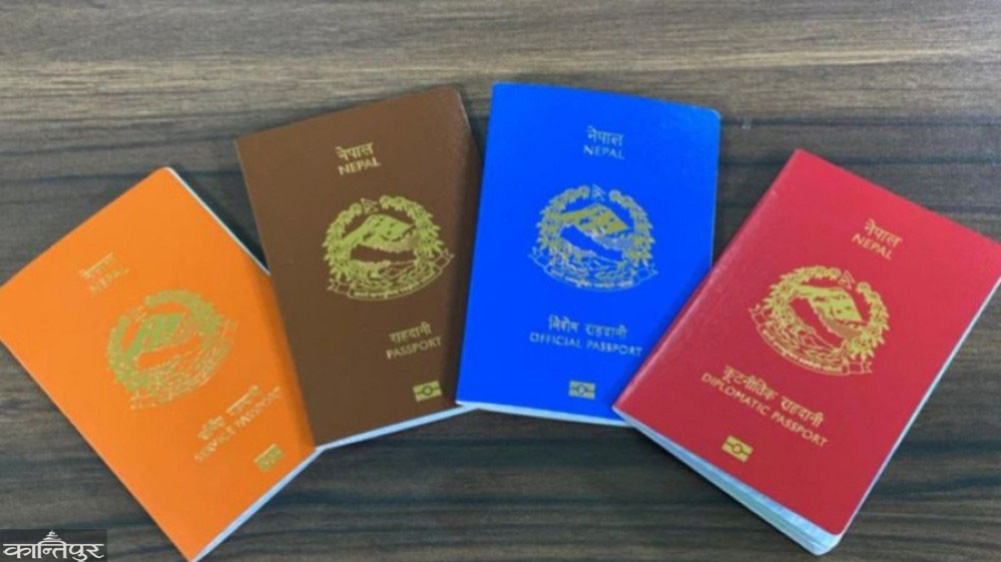
The controversy had begun after the Passport Department awarded an e-passport contract worth over Rs 7.75 billion to German companies Veridos and Muehlbauer in June last year.
We use Google Cloud Translation Services. Google requires we provide the following disclaimer relating to use of this service:
This service may contain translations powered by Google. Google disclaims all warranties related to the translations, expressed or implied, including any warranties of accuracy, reliability, and any implied warranties of merchantability, fitness for a particular purpose, and noninfringement.
What should be the relationship between the Commission for the Investigation of Abuse of Authority, a constitutional body responsible for investigating corruption, and the executive body, the Prime Minister's Office? The answer to this question can be found within the constitution. The Authority is an independent and autonomous institution that is not obliged to work under the direction of the executive body. But an incident in the first week of Ashar 2083 has raised serious questions about this constitutional arrangement.
The controversy had already begun since the Passport Department awarded an e-passport contract worth more than 7.75 billion rupees to German companies Veridos and Muehlbauer in June last year. But this issue came to the center of public debate when Prime Minister Walendra Shah's advisors called the Chief Commissioner of the Authority, including officials, to Singha Durbar for a long discussion. And, on the same day, German Ambassador Udo Eugen Volz also reached the Prime Minister's Office.
The investigation has now gained momentum. Director General of the Passport Department Tirtharaj Aryal, Information Technology Director Sunil Kumar KC, then Accounts Officer Tulsi Prasad Acharya and Nepal agent of German company Veridos Manindra Malla have been arrested. The special court has extended the remand of all four for a second time by 5 days. It is claimed that the CIAA is preparing to file a case within the next week.
But this case is not limited to a single contract irregularity case. It has raised serious questions like transparency of public procurement, independence of constitutional bodies, executive interference, political accountability and diplomatic etiquette at once. Let's try to understand this case in 7 questions.
What is the passport case?
After the contract with the French company IDEMIA, which has been providing biometric passports to Nepal since November 2021, expired in December 2025, the government had initiated a new contract process.
Accordingly, on June 6, 2025, the Passport Department awarded the contract for the e-passport system to two German companies named Veridos GmbH and Muehlbauer. The total contract amount was more than Rs 7.75 billion. In which Veridos had contracted to print passports worth Rs 6.15 billion and Muehlbauer to work on the biometric system worth Rs 1.60 billion.
According to the agreement, the companies had to supply the first batch of passports within 240 days, establish personalization centers in all 77 districts and Nepali missions abroad, and complete data migration work.
But soon after the agreement was signed, questions began to arise over the procurement process. Competitor company IDEMIA knocked on the doors of the Prime Minister's Office, the Authority for National Security and the Supreme Court, alleging serious irregularities in the public procurement process. This is where the current passport case began.
Why was there a dispute over the contract awarded to the German company?
Questions were raised from various angles from the beginning of the contract process. Idemiya, which lost the tender, has alleged violations in the technical evaluation, incorrect calculation of foreign exchange rates, and neglect of qualified bidders.
In July 2025, the company filed a writ petition in the Supreme Court. The Supreme Court did not issue an interim order, but in the latest hearing, it ordered a full hearing by Asad.
On the other hand, sources close to the German company have been claiming that the entire process was carried out in accordance with the public procurement law. According to them, Idemiya started raising the dispute only after the opening of the financial proposal. Meanwhile, the delay in the supply of passports, the government's claim that the stock is dwindling, and the German company's argument that additional passports were ordered from the old contractor have made the dispute more complicated.
Why didn't the CIAA investigate for so long?
A complaint was filed with the CIAA in June 2025 alleging irregularities in the passport contract. But the investigation did not gain much momentum for about a year after that. Officials in the Prime Minister's Office have claimed that the CIAA did not investigate at all. Officials in the Commission, on the other hand, have claimed that the investigation is ongoing.
In a discussion held at the Prime Minister's Office, CIAA Chief Commissioner Prem Rai had mentioned some of the reasons for the delay in the investigation. According to him, the case was pending in the Supreme Court, the Public Procurement Monitoring Office had already shown interest, and the technical and procedural complexities related to the procurement process had taken time to investigate.
What is the real dispute between the Prime Minister's Office and the CIAA?
The Prime Minister's Office had summoned officials including the CIAA Chief Commissioner to Singha Durbar to discuss the passport case. The Prime Minister's advisors had raised questions about the status of the investigation in the meeting. According to some officials present at the meeting, the authority was pressured to expedite the investigation. But the Prime Minister's Office has said that it was just a process of regular information exchange. It has been said that discussions were held with the authority because the stock of passports is dwindling, there is a potential crisis if the new company does not start supplying on time, and there are irregularities in the procurement process. But critics have a different argument here. Since the authority is an independent constitutional body that monitors the government, it is not in line with constitutional practice for the executive body to try to influence the pace or direction of the investigation. That is why this case has now risen above the contract dispute and become a subject of constitutional debate. How did this raise questions about the independence of the constitutional body? The Constitution of Nepal has provided for the Commission for the Investigation of Abuse of Authority as an independent constitutional body. It is believed that the commission should decide for itself how and when to proceed with its investigation. But after the Prime Minister's Office showed direct interest in the status of the investigation into the passport case, a debate has begun about the constitutional boundaries.
Constitutional commissions are institutions established to monitor the executive power. If they start taking decisions under pressure from the executive body, their independence and credibility may be questioned. Constitutional scholars and former administrators have expressed the view that although the government has the right to be interested, it should not influence how the investigation is conducted.
How did the presence of the German ambassador make this case a diplomatic issue?
While discussions were being held with the authority at the Prime Minister's Office, German Ambassador to Nepal Udo Eugen Volz also reached Singha Durbar. Sources claim that he reached there after receiving information that an investigation had been launched against a company with German government investment.
In this process, the ambassador was made to wait for some time and returned dissatisfied, as Kantipur has also confirmed through various sources. Although the German Embassy did not make a formal comment on the matter, the ambassador had to clarify his position on social media. By the way, Veridos, which is embroiled in a passport contract dispute, is a company with investment from the German government. Therefore, it seems that the German side has shown interest after the investigation into the company began.
Where can this case go now?
So far, Director General of the Passport Department Tirtharaj Aryal, Information Technology Director Sunil Kumar KC, then Accounts Officer Tulsi Prasad Acharya and Veridos' Nepal agent Manindra Malla have been arrested. The CIAA is investigating various aspects of political influence, administrative decisions and technical evaluation in the procurement process. Therefore, the scope of the investigation is not limited to the employees of the department but has reached the political leadership.
Meanwhile, former Foreign Minister Arju Rana Deuba has also been called for a statement. However, statements have been taken from more than 30 people, including former Foreign Minister Narayan Kaji Shrestha.
Now the CIAA can file a case in a special court. And, it appears that the hearing of the writ petition in the Supreme Court and the criminal investigation by the authority will proceed in parallel.