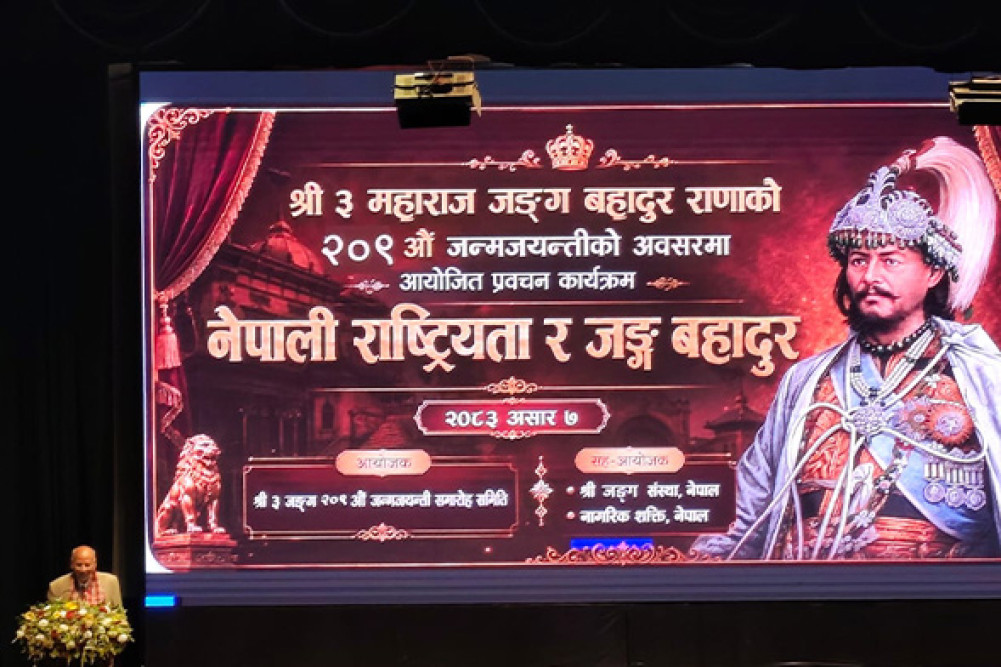
Historian Prof. Dr. Ramesh Kumar Dhungel has claimed, based on historical documents, that only 21 to 40 people were killed during the Kot festival, not thousands.
We use Google Cloud Translation Services. Google requires we provide the following disclaimer relating to use of this service:
This service may contain translations powered by Google. Google disclaims all warranties related to the translations, expressed or implied, including any warranties of accuracy, reliability, and any implied warranties of merchantability, fitness for a particular purpose, and noninfringement.
How many people were actually killed in the 'Kot Parva', which is considered one of the bloodiest and most mysterious events in Nepali history? Popular belief suggests that thousands were killed. But historians do not accept this.
This historical topic received special attention at a special discourse program organized in Kathmandu on Sunday on the occasion of the 209th birth anniversary of Rana Prime Minister Jung Bahadur Rana. At a program titled 'Nepali Nationality and Shri 3 Maharaj Jung Bahadur Rana' organized by Shri 3 Jung Sanstha, Nepal and the Ceremonial Committee at the Tribhuvan Army Officers Club, distinguished historians, intellectuals and media persons presented new facts about Jung Bahadur's historical contribution, illusions and diplomatic ingenuity.
The speaker of the program, historian Prof. Dr. Ramesh Kumar Dhungel, citing historical documents, claimed that the claim that thousands were killed in the Kot Parva was completely misleading. Emphasizing the need for a factual reevaluation of history, he said, "The way history has been misrepresented by saying that thousands were killed during the Kot festival is wrong. If we look at historical documents and evidence, only 21 to 40 people were killed."
Dhungel argued that it was wrong to call Jung Bahadur a slave of the British, and also presented the historical fact that Nepal imposed strict conditions of financial compensation and the return of the 'new country' under the pretext of helping the British.
Similarly, journalist Dev Prakash Tripathi opined that the violence during the Kot and Bhandar Khal festivals should be viewed in relation to the then-current environment and compulsion of gaining power. He said that it would be unfair to portray Jung Bahadur only as a villain in history. Tripathi said, "The violence during the Kot and Bhandar Khal festivals was the then-current environment and political compulsion of gaining power at that time." However, history should not forget that Jung Bahadur never compromised with any foreign power in matters of national interest and sovereignty.’ The chief guest of the program, former President Bidya Devi Bhandari, said that history should not be viewed only as praise or criticism, but should be evaluated from an objective and balanced perspective based on the circumstances of the time and the achievements achieved. She recalled that Rana Prime Minister Jung Bahadur issued the Muluki Ain of BS 1910 and tried to bind the administration of the state to certain rules and procedures.
Bhandari positively mentioned that Jung Bahadur took the initial initiative to discourage the sati practice prevalent in the then society and made arrangements to prevent his wives from undergoing sati. She said that maintaining Nepal’s independent existence during the colonial expansion of the 19th century and returning the ‘new lands’ (Banke, Bardiya, Kailali and Kanchanpur) to Nepal for helping suppress the 1857 rebellion were great national achievements of Jung Bahadur’s tenure. 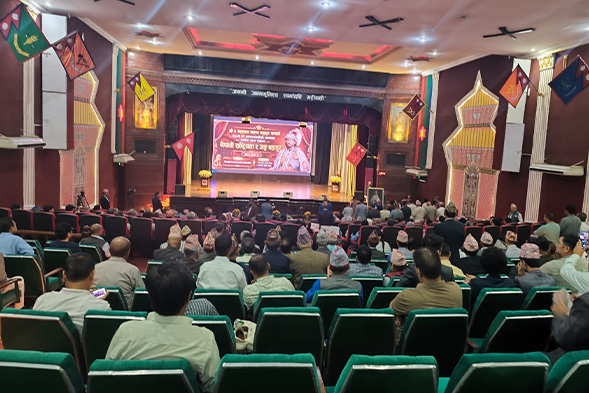
Professor Dr. Ram Prasad Upadhyay narrated interesting anecdotes about Jung Bahadur's European travels and diplomatic acumen. During his visit to Britain in 1850, he introduced himself as the 'Prime Minister' for the first time in Asia, a position that did not exist anywhere else in Asia at that time. This was a high example of his diplomacy, so even the British Governor General Dalhousie was impressed with him.
Upadhyay said that Jung Bahadur's main objective was to bring back the land lost by his ancestors. During his stay in Britain, he had to wait 25 days to meet Queen Victoria, because the Queen was in labor at the time. Ultimately, he met the Queen 7 times, which was a very rare and honorable opportunity for any foreign Prime Minister. Upadhyay mentioned an interesting incident in the program, saying, ‘When Jung Bahadur showed his sword in Britain, a security guard tried to stop him, to which Jung Bahadur immediately retaliated physically. Later, the British themselves said that Jung Bahadur’s action was right. They accepted and respected him as a sign of his self-respect and bravery.’ According to Upadhyay, after Britain, Jung Bahadur also visited France, where he was given a grand welcome by Napoleon III. After watching the parades of the armies of both countries, he concluded that the British army was more powerful and organized than the French and understood that the real power of the nation was the army. Upadhyay said that he was able to bring back the ‘new country’ for helping the British in suppressing the Indian Sepoy Mutiny of 1857, which was the result of his successful diplomacy.
Former Vice-Chancellor of Nepal Pragya Pratishthan, Dr. Jagman Gurung portrayed Jung Bahadur as the protector of religion and culture. According to Gurung, Jung Bahadur even had a temple of Satyanarayan built at Kalmochan Ghat on the banks of the Bagmati River to atone for the sins of bloody incidents such as the Kot Parva and the Bhandarkhal Parva.