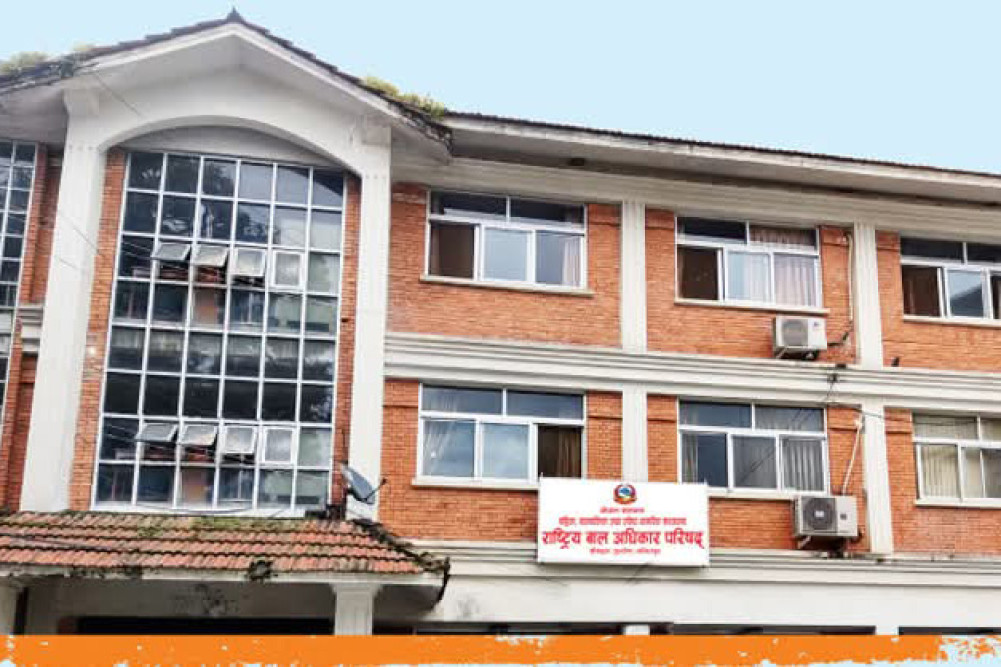
The decision to abolish the National Children's Council is said to be against the Constitution, the Convention on the Rights of the Child, and the existing legal system.
We use Google Cloud Translation Services. Google requires we provide the following disclaimer relating to use of this service:
This service may contain translations powered by Google. Google disclaims all warranties related to the translations, expressed or implied, including any warranties of accuracy, reliability, and any implied warranties of merchantability, fitness for a particular purpose, and noninfringement.
Finance Minister Swarnim Wagle, while presenting the budget for the fiscal year 2083/84 in the federal parliament on 15 Jestha, announced the abolition of 31 bodies, merger of 6, transfer of 6 and restructuring of 18 bodies. With Minister Wagle's announcement, the only government body working in the field of child rights, the National Child Rights Council, has also been included in the list of abolition.
As soon as the government's decision was made public, various organizations and activists working in the field of child rights have protested. On 7 Jestha, Rastriya Swatantra Party (RSWP) MP Indira Rana Magar had drawn the attention of the government not to abolish the National Child Rights Council until a clear alternative structure and effective system is ensured, considering sensitive issues such as children's rights. She had drawn the attention of the Government of Nepal not to implement the decision immediately. 'I urge the government to reconsider this issue after extensive consultation with stakeholders. In my language, children are the most vulnerable group.' I do not call a poor person helpless. I also urge that they should be called helpless,’ he said.
The National Council for Child Rights is a specialized government body for child rights established under Section 59 of the Children’s Act, 2075 BS. The former Central Child Welfare Committee was converted into the council by the decision of the Council of Ministers of the Government of Nepal on 12 Ashad 2076 BS. Formed with the objective of protecting and promoting the rights of children, this council facilitates the implementation of policies and programs related to child rights, monitors incidents of child rights violations, conducts data and research on child protection, and prepares an annual report on the condition of children. It also plays an important role in the prevention of child labor, child marriage, violence and abuse, and the rescue, protection and rehabilitation of children. It is working as a central coordinating body for the protection and promotion of child rights in Nepal.
Nepal is a party to the United Nations Convention on the Rights of the Child (CRC). Nepal has accepted the international obligation to respect, protect and implement the rights of the child as set out in the Convention after ratifying the Convention on 14 September 1990. Last year, the Fourth Periodic Review (UPR) report of the United Nations Human Rights Council had made suggestions such as the effective implementation of the Child Rights Act, the end of practices such as child marriage and Chhaupadi, making birth registration of children compulsory and easy, and strengthening education, health, and neonatal mortality programs.
Ram Bahadur Chand, Member Secretary of the National Child Rights Council, has said that the council is needed to protect the rights and interests of children. According to him, the council has been playing an important role in providing immediate rescue, relief, protection and counseling services to children at risk of violence against children.
He mentioned that the Council has been working to arrange the necessary policies, laws, plans, programs and institutional mechanisms for the respect, protection, promotion and fulfillment of children's rights. He said, 'If the Council is abolished, there is a risk that the institutional mechanism built for the protection and promotion of child rights will be weakened and child-related issues may be overlooked by the state's priorities. Removing the structure of an organization working in a sensitive area like child rights will have a long-term impact.' He said that the Council has the justification to provide relief, protection and counseling services to children at risk of violence against children by immediately rescuing them. He said that the Council has the justification to arrange the necessary policies, laws, plans, programs and institutional mechanisms for the respect, protection and promotion of children's rights and fulfilling their duties. He said that if the Council is abolished, the institutional mechanism built for the protection and promotion of child rights will be weakened and child-related issues may be overlooked by the state's priorities.
Tilottam Paudyal, President of the National Campaign for Children's Peace Zones (CZP), said that Nepal needs a stronger institutional mechanism to implement the recommendations given by the United Nations Convention on the Rights of the Child and the Universal Periodic Review for the protection of child rights. According to him, although about 34 percent of the population in Nepal is children, a separate, effective and adequately resourced high-level mechanism to look into their issues is still weak.
Paudyal expressed dissatisfaction with the decision to abolish the council and other mechanisms that need to be strengthened. According to him, it is not enough to limit child rights work to collaboration with civil society and NGOs. He said, "Currently, some services including helplines are being run in collaboration with civil society organizations. The role of the government seems limited to collaboration only." According to Paudyal, when child-related policies and structures are weak, children remain at greater risk during disasters and crises. He said that the government should immediately take initiatives to make the mechanism working in the field of child rights high-level, effective and sustainable without abolishing it.
Former Executive Officer of the National Children's Council Milan Dharel has also said that the decision to abolish the National Children's Council is against the Constitution, the Convention on the Rights of the Child and the existing legal system. Stating that the Council is a special body established for the rights and interests of children, he interpreted its abolition as a violation of the special rights guaranteed by the Constitution.
Since Nepal is a party to the Convention on the Rights of the Child, Dharel says that it must also bear international obligations for the implementation of child rights. He said, "An effective structure is required at the national level for the protection and implementation of children's rights under the Convention, and since the Council is an institution established under the Act, it cannot be abolished by an executive decision alone. Going towards abolition without completing the legal process is a flawed step from both procedural and policy perspectives."
Warning that the abolition of the Council would have a serious impact on the child protection system, Dharel said that the protection mechanisms operating across the country would be reduced to almost zero. He said that the idea of creating departments within the ministry and conducting all work is against the essence of the federal system of governance. He said, "In federalism, responsibilities have been distributed to the local level, the idea of conducting all work from the center is the mentality of the centralized state, and the debate on the abolition of the Council seems to be mainly carried out from a financial perspective." He emphasized that sensitive issues like child rights and child protection should not be viewed as an economic burden, but should be seriously considered for their social and humanitarian aspects.
The government's 100 agenda for governance reform mentioned that boards, committees, projects and institutional structures under various ministries and bodies that are unproductive, have dual responsibilities and create unnecessary financial burdens should be comprehensively evaluated and restructured. In accordance with the same agenda, a task force was formed under the coordination of Kiran Sharma, Secretary, Office of the Prime Minister and Council of Ministers. A high-level task force was formed comprising representatives of the Office of the Prime Minister and Council of Ministers, Ministry of Finance, Ministry of Industry, Commerce and Supplies, and Ministry of Federal Affairs and General Administration. The council and other institutions were abolished based on the recommendation of the task force.
The ministry is in favor of continuing the structure even after making some changes and restructuring in the budget. The Talukdar Ministry disagrees with the decision to abolish the council. Durga Prasad Chalise, Head of the Child Protection and Development Section under the Ministry of Women, Children, Gender and Sexual Minorities and Social Security, said that the ministry disagrees with the decision to abolish the child-related structure. According to him, the ministry is in favor of continuing the structure even after making some changes and restructuring in the budget. Chalise said that the child-related agency cannot be effectively limited to just one branch and that there is a need for a separate institutional structure. He also mentioned that there is lobbying within the ministry in favor of continuing this issue. He said, "What if the Nepal government decides to abolish it, but the ministry is not in favor of abolishing it."
The government has stated that it has taken this step with the aim of making public administration agile, effective and cost-friendly. Deepa Dahal, Press Coordinator of the Prime Minister and Council of Ministers, said that the government has taken the decision to abolish it on the recommendation of the task force formed as per the government's 100-day action plan. She said that coordination is being carried out between the concerned ministry and the Office of the Prime Minister and Council of Ministers on issues including the abolition of the agency, employee management, etc. She said, "Our office has only facilitated the issue of abolishing the agency, and discussions are underway between the concerned ministry and the agency."