The annual report 'Digital News Report 2026', recently released by the Reuters Institute for the Study of Journalism under the University of Oxford, shows that readers/viewers are attracted to social media and video platforms.
We use Google Cloud Translation Services. Google requires we provide the following disclaimer relating to use of this service:
This service may contain translations powered by Google. Google disclaims all warranties related to the translations, expressed or implied, including any warranties of accuracy, reliability, and any implied warranties of merchantability, fitness for a particular purpose, and noninfringement.
The development of technology and digital transformation have changed the way readers around the world read, watch, and understand news. Readers who used to log in to media outlets' own websites or open mobile apps until yesterday are now busy on social media and video platform walls.
This global shift has forced traditional journalism and mainstream media outlets to rethink how to survive. The Reuters Institute for the Study of Journalism, a division of Oxford University, recently released its annual report 'Digital News Report 2026' , which found that readers are increasingly turning to social media and video platforms.
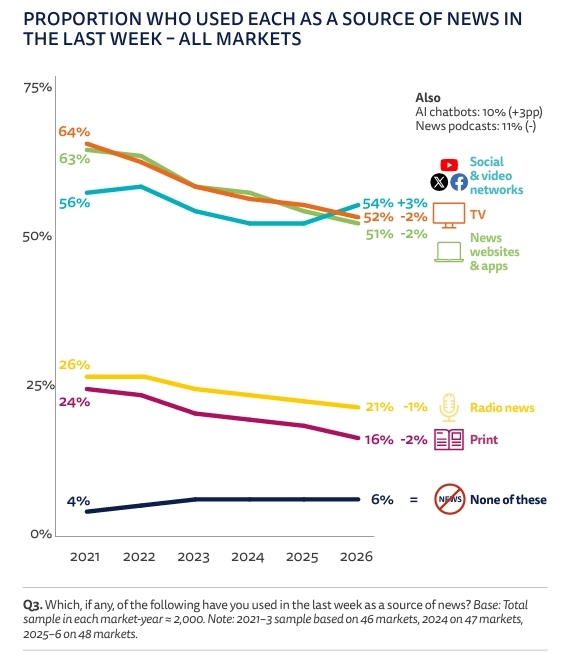
The survey, conducted among respondents from 48 countries around the world, found that social media and video platforms have overtaken news organizations' own official websites or apps. According to the report, social media and video platforms have become more popular as the main source of news than news websites and apps in 30 of the 48 countries studied.
According to the data, 54 percent of respondents choose social media and video networks as their main means of getting news online, while the number of people using news organizations' own digital platforms has shrunk to 51 percent.
The biggest concern for the media is the continued decline in public trust in journalism. According to the report, the global average trust in news has fallen by 3 percentage points compared to last year to 37 percent, the lowest and most disappointing since the Reuters Institute began measuring it. News credibility has declined in 29 of the 48 countries surveyed.
Even in countries like the United States, which is considered to have strong press freedom and a strong media foundation, only 25 percent of people trust the news. Experts believe that political polarization, the sensationalism of exaggerating content in the race to increase views and followers, and the flood of 'clickbait' have increased disillusionment with the media.
This disillusionment and negativity towards the media is why 42 percent of people worldwide sometimes or often deliberately ignore the news. The report clearly shows that people are starting to consider news as 'stressful', 'disappointing', and 'bad for mental health'. Readers, fed up with the negative news of politics, war, crime, and economic recession that comes every day, are now consciously trying to stay away from the news world.
In addition, artificial intelligence (AI) technology has emerged as another big challenge and competitor for media organizations. Readers are now starting to get information directly through AI chatbots like ChatGPT instead of searching on Google to find any information.
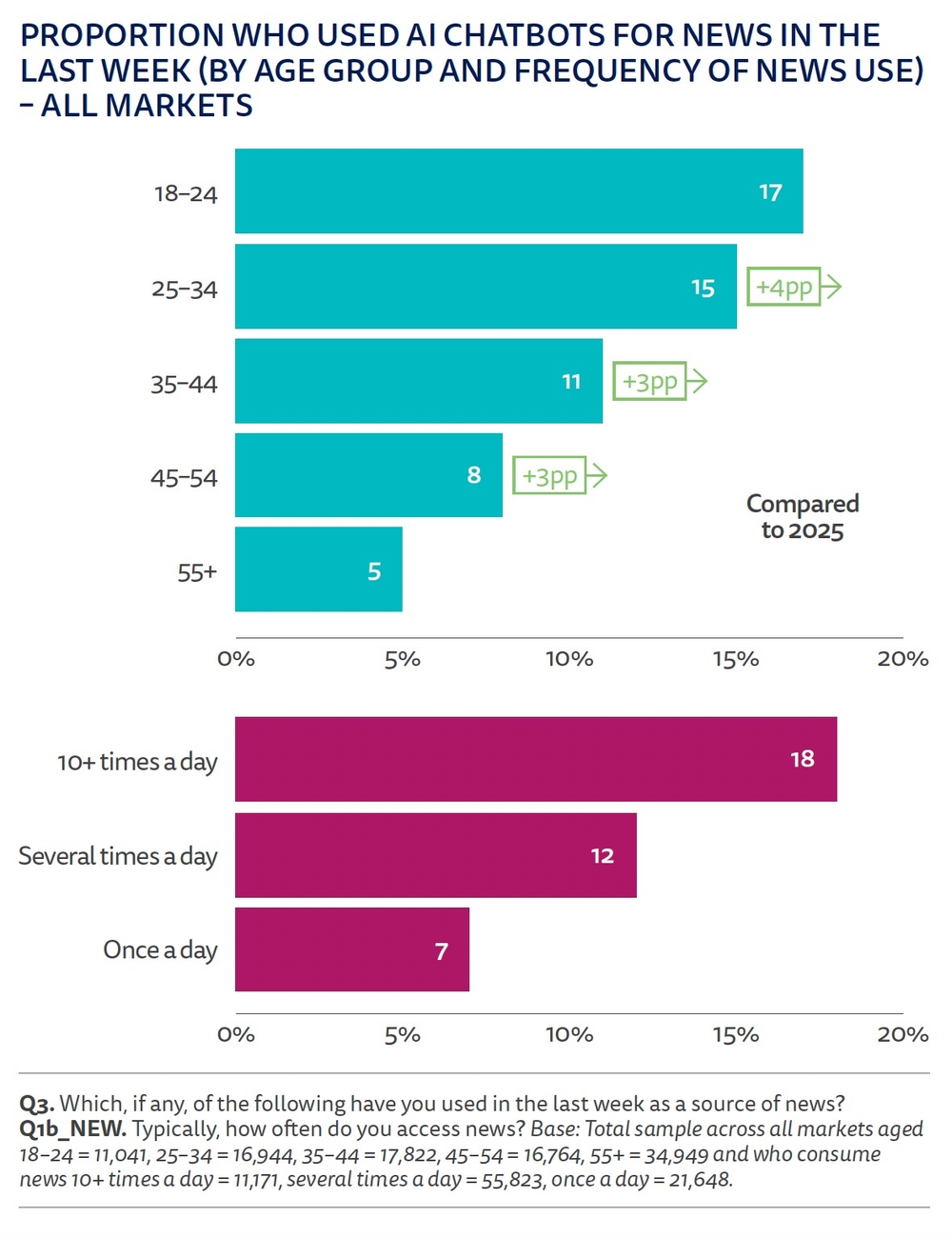
The weekly use of AI chatbots to get news has reached 10 percent globally, which was only 7 percent last year. This rate is even higher among the younger generation under the age of 35, at 16 percent. Users are using AI not only for general information, but also as a 'personal tutor' to easily understand complex political or economic topics. 42 percent of respondents preferred the chatbot's 'follow-up question' feature the most. This technology is also becoming very effective in preparing short summaries of long news and reading foreign language news after translating it.
Along with AI, content creators and social media influencers have also become strong competitors for traditional journalism. According to the report, about 27 percent of respondents worldwide get their daily news updates from news-focused creators or influencers. The public finds these creators to be more entertaining, easy to understand, and 'relatable' than traditional media news presenters. However, people still rank mainstream media higher than influencers in terms of trust, fact-checking, and impartiality.
This year's report further confirms the fact that people are gradually decreasing their habit of reading long articles or analysis and increasing their habit of watching videos. Today's consumers prefer watching short and engaging videos over reading long texts. About 77 percent of people regularly watch online video news, and 35 percent have made YouTube their news source on a weekly basis. Meanwhile, the rate of watching videos through the video player on the media's own website has decreased by 5 percent.
It has been found that readers find it difficult to play videos on the news organization's own website and find it more convenient to watch videos on native platforms such as TikTok, Instagram and YouTube. While 55 percent of people on TikTok watch short videos of less than 2 minutes, 23 percent of users on YouTube watch news videos, documentaries or interviews longer than 20 minutes, which shows that YouTube is still a strong medium for serious journalism.
On the one hand, the traditional advertising market has been captured by technology companies such as Google and Facebook. On the other hand, the report states that the media industry around the world is facing an extreme economic crisis as the media's own readers are declining. The model of paying for news on digital media has also not gained the momentum it was expected to. The rate of people paying digitally for news has been stagnant at 17 percent globally for a long time.
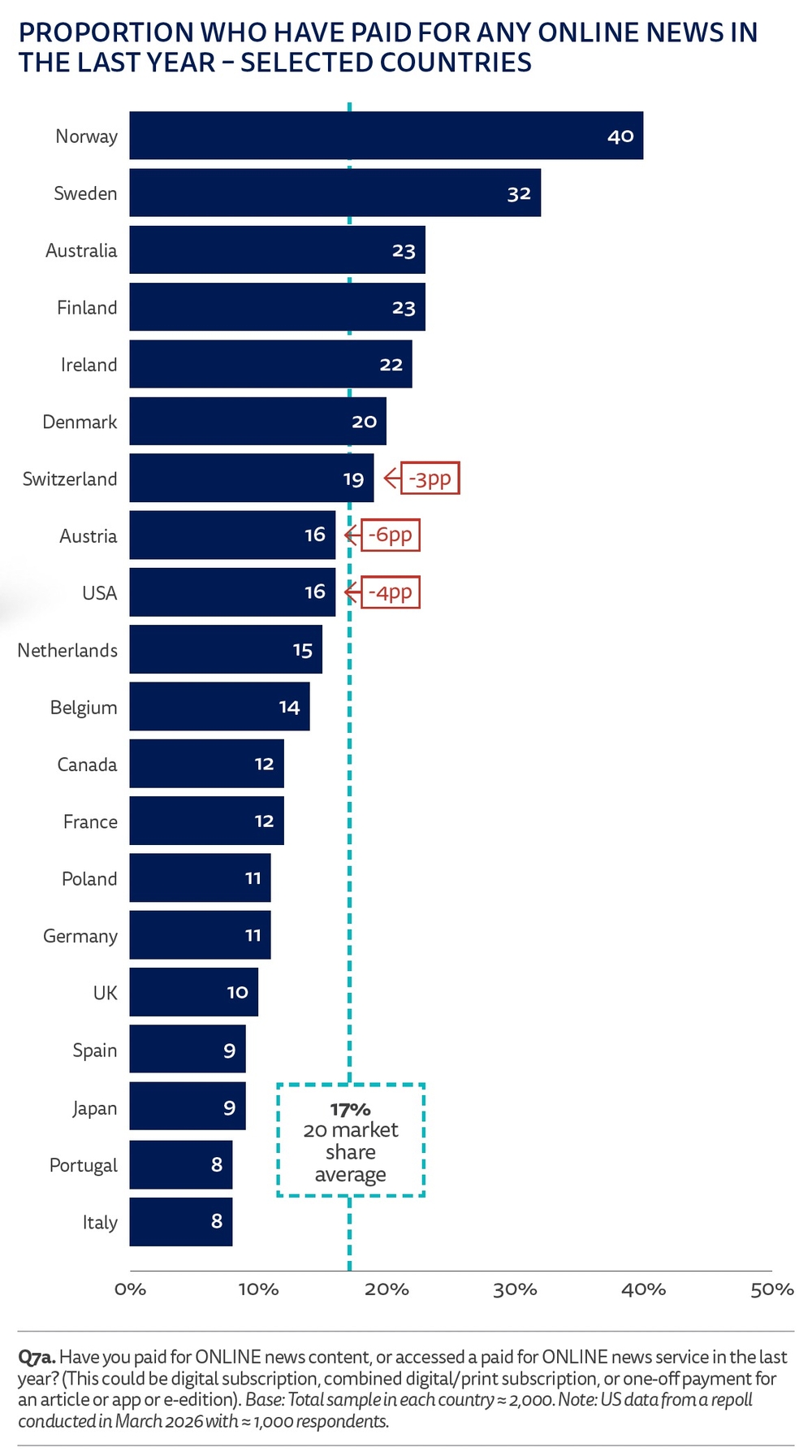
In most countries, except for countries like Norway and Sweden, there has been no improvement in the rate of readers paying for news. People are now suffering from 'subscription fatigue', the boredom of paying separately for multiple apps or media. To avoid this, most world-renowned news organizations are now adopting a 'bundling' strategy to retain existing customers rather than adding new customers. For example, the American newspaper 'New York Times' is enjoying great commercial success by selling an 'all access package' that includes serious political news, cooking recipes, sports and word puzzles.
Despite political polarization and accusations of bias against the media around the world, the majority of ordinary citizens still stand firm in favor of fair and balanced news. According to the report, 45 percent of those surveyed said they prefer to receive information only from completely impartial news sources, without any particular political leanings or viewpoints.