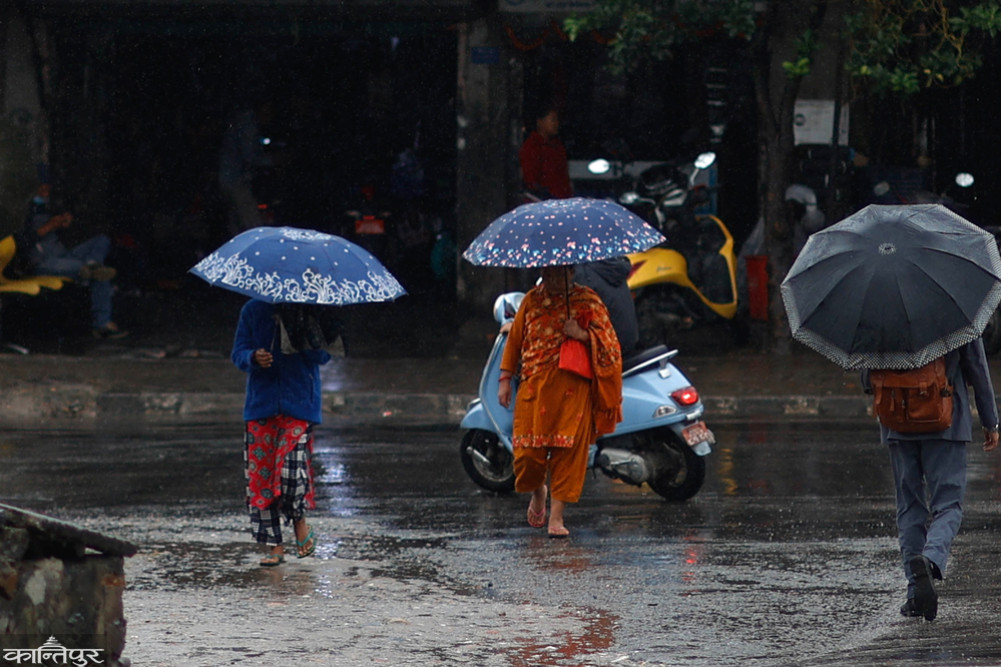
The department has stated that there is a possibility that the monsoon in South Asia, including Nepal, may be weak due to El Nino.
We use Google Cloud Translation Services. Google requires we provide the following disclaimer relating to use of this service:
This service may contain translations powered by Google. Google disclaims all warranties related to the translations, expressed or implied, including any warranties of accuracy, reliability, and any implied warranties of merchantability, fitness for a particular purpose, and noninfringement.
After the monsoon did not arrive even after the onset of Asad, the Department of Hydrology and Meteorology issued a statement on Monday and said, 'El Niño has developed in the Pacific Ocean and is still strengthening.'
The department says that this year's monsoon will be affected due to El Niño. Because in previous years, El Niño had delayed the arrival of the monsoon. The department has stated that there is a possibility that El Niño will also affect the arrival of the monsoon in Nepal and that the monsoon in South Asia and Nepal may weaken.
El Niño is a natural weather cycle. When the water in the Pacific Ocean becomes unusually warm, it brings about major changes in the weather around the world. The hot vapor rising from here also weakens the South Asian monsoon system.
The average date for the arrival of the monsoon in Nepal is June 13. But even after Asad, there is no sign of the monsoon entering. The westerly wind is still active. Due to the influence of local winds, moderate rainfall with thundershowers is occurring in the Himalayan and hilly regions of Koshi, Bagmati, and Gandaki provinces.
The department has issued a notice that hot winds will blow in some places in Lumbini and the Terai areas of the Far West on Tuesday afternoon. The department estimates that the maximum temperature will reach 40 degrees Celsius in Dhangadhi, Nepalgunj, Bhairahawa, and Simara.
The monsoon had entered India late this year. The Indian Meteorological Department had estimated that the monsoon would enter on May 26. Passing that time, it entered India on June 4, three days later than the average date. Monsoon usually enters India on June 1.
‘Usually, the monsoon that enters Kerala reaches Nepal within 12 to 14 days,’ said Saroj Pudasaini, a meteorologist at the Department of Hydrology and Meteorology. ‘This year, the monsoon process is slow.’ Last year, the monsoon arrived in Nepal on May 29, 15 days ahead of the average date.
Department spokesperson Vibhuti Pokharel informed that the monsoon will be delayed by a few more days in Nepal. Based on the analysis of data received from satellites and mathematical weather forecasts, she said that there is a possibility of a delay in the onset of monsoon in Nepal by a few days.
In the past, the monsoon had arrived late due to the effect of El Nino in 1972, 1982, 1983, 1987, 1992, 1997, 2002, 2009, 2016, 2019 and 2023. In 1982, the monsoon arrived very late, on June 27.
The department said that the Meteorological Forecasting Division is continuously monitoring this year's monsoon system.