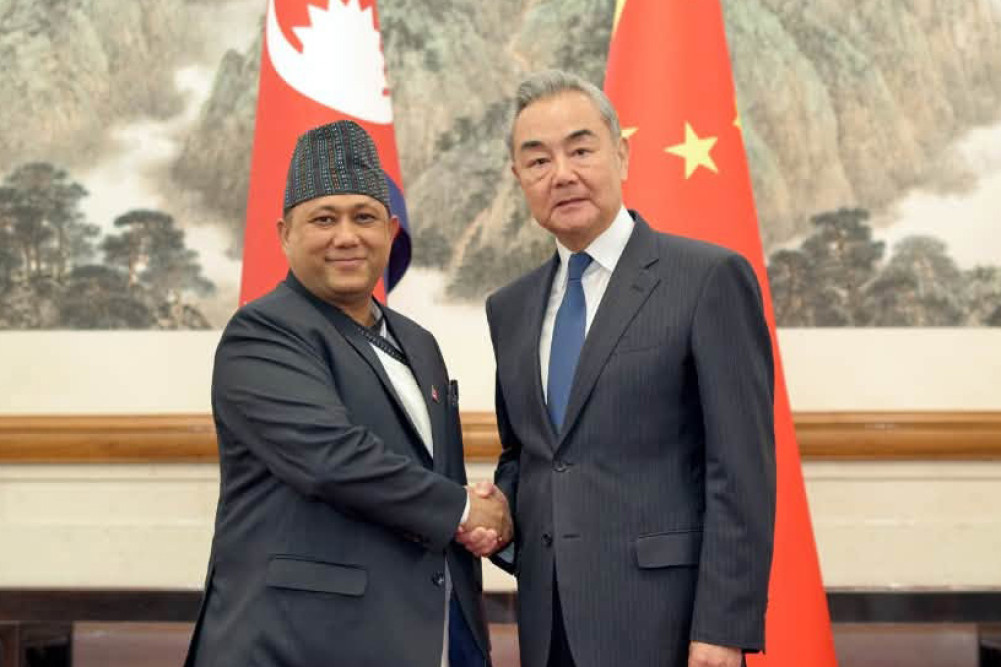
Chinese Foreign Minister Wang Yi has said that a close neighbor is better than a distant relative, alluding to China's understanding of the recent political developments in Kathmandu and the role of Western countries in them.
We use Google Cloud Translation Services. Google requires we provide the following disclaimer relating to use of this service:
This service may contain translations powered by Google. Google disclaims all warranties related to the translations, expressed or implied, including any warranties of accuracy, reliability, and any implied warranties of merchantability, fitness for a particular purpose, and noninfringement.
Foreign Minister Shishir Khanal, who is on a four-day visit to China, met with his Chinese counterpart Wang Yi on Monday evening. During the meeting, Chinese Foreign Minister Wang pointed to China's understanding of the recent political developments in Kathmandu and the role of Western countries in it, saying that a close neighbor is better than a distant relative.
According to the Nepali representative participating in the meeting, Wang and other Chinese high-ranking officials also expressed interest in the US Millennium Challenge Corporation (MCC) and the State Partnership Program (SPP), citing the context of Western influence in Nepal.
Minister Khanal tried to reassure the Chinese side by saying that Nepal is committed to improving relations with China. While mentioning the priorities of the new government, Minister Khanal said that the Nepalese government is committed to people-centered development and non-alignment policy. Minister Khanal said that although Nepal and India should discuss the Lipulekh issue, the repeated agreements between India and China have further complicated the border issue.
‘Taiwan and Tibet issues are China’s internal affairs,’ a statement issued by the Chinese Foreign Ministry quoted Khanal as saying, ‘Nepal is committed to the one-China policy and will never allow any force to use Nepali territory to the detriment of China.’
‘A comprehensive discussion was held on all aspects of bilateral relations, including connectivity, border management, trade, technology transfer and multilateral cooperation,’ Khanal said in an interview after the meeting. ‘We reiterated our shared commitment to further strengthen Nepal-China relations for the expansion of people-to-people ties and the mutual benefit of both countries.’
In the meeting, the Chinese side expressed interest in the corruption case filed against a Chinese company in the Pokhara International Airport Project. Minister Khanal replied that a competent body in Nepal had investigated the case and filed a case in court, and that the government had no involvement in it.
A Nepali official who attended the meeting informed that. “Beijing was particularly concerned about the corruption case filed against the Chinese contractor at Pokhara Airport and possible anti-China activities in Nepal,” the Nepali official said.
Similarly, stating that China’s development is an opportunity for Nepal, Minister Khanal also said that Nepal welcomes Chinese investment and provides a smooth business environment for Chinese companies. Chinese Foreign Minister Yi praised Nepal’s commitment to the one-China policy. Minister Khanal had also proposed four corridors, including the Trans-Himalayan Railway connecting the northern border with central Nepal.
“China has always prioritized relations with Nepal in its neighborhood diplomacy, and its friendly policy towards Nepal is aimed at the Nepali people,” the Chinese Foreign Ministry said, quoting Foreign Minister Wang Yi. “China will always be a reliable and trustworthy good neighbor and partner in Nepal’s development, prosperity and modernization process.”
Minister Wang also expressed China's willingness to work together on the Belt and Road Initiative (BRI), focusing on power transmission lines, highways, ports and air services, with the aim of helping Nepal transform from a landlocked country to a land-connected one.
"Both sides should make effective use of various cooperation platforms and mechanisms to deepen practical cooperation and promote people-to-people exchanges," he said. "China encourages its companies to invest and do business in Nepal, and hopes that Nepal will provide a more fair and transparent business environment. Both sides should strengthen multilateral cooperation and safeguard the common interests of developing countries."
China has been urging Nepal to cooperate and participate in the BRI, the Global Security Initiative (GSI), the Global Development Initiative (GDI), the Global Civilization Initiative (GCI) and the Global Governance Initiative (GGI). This time too, the Chinese side has reiterated that request. However, a Nepali official said that Nepal has already signed the BRI, so it is receiving some assistance under the GDI and GCI. The official said that Minister Khanal did not make any commitment on other Chinese initiatives.
According to the Nepali Embassy in Beijing, both sides have also expressed their commitment to the early implementation of previously agreed programs and projects. In addition, the meeting emphasized on further cooperation on issues of common interest in multilateral and regional forums.
The two delegations discussed infrastructure, connectivity, border management, energy, trade, investment, agriculture, technology transfer, information technology, digitalization, tourism, chemical fertilizers, petroleum and natural gas exploration and people-to-people contacts, according to a statement issued by the embassy.
Earlier, Minister Khanal had met with Liu Huixing, head of the International Department of the Communist Party of China (CPC). During the meeting, party-to-party relations and Nepal-China relations were discussed.