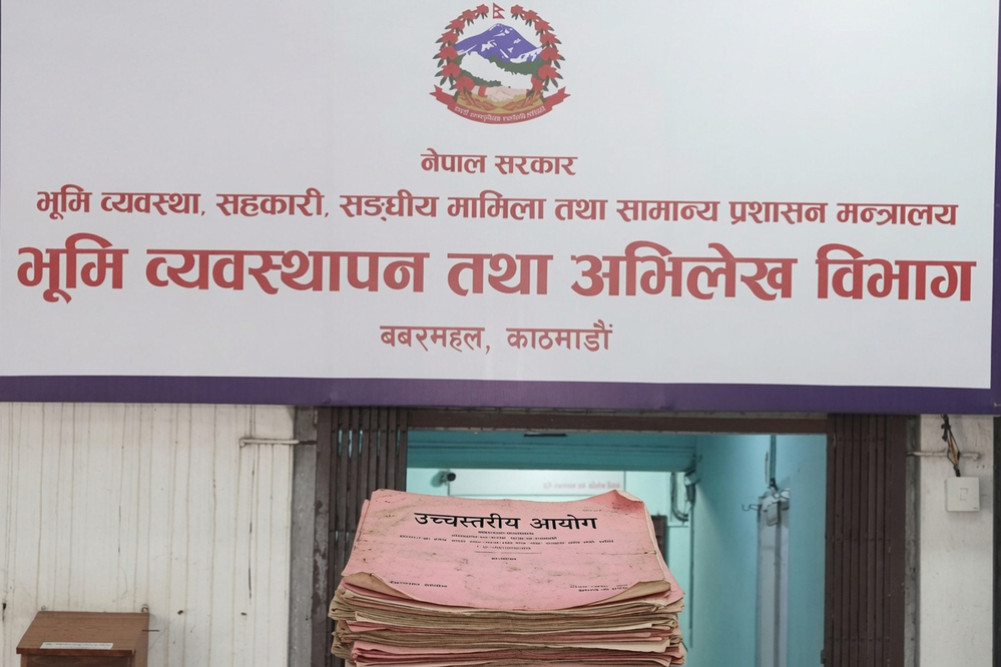
The government has moved forward with the implementation process of the Rawal Commission report on encroachment of government land within Kathmandu Metropolitan City, 31 years after its publication.
We use Google Cloud Translation Services. Google requires we provide the following disclaimer relating to use of this service:
This service may contain translations powered by Google. Google disclaims all warranties related to the translations, expressed or implied, including any warranties of accuracy, reliability, and any implied warranties of merchantability, fitness for a particular purpose, and noninfringement.
The government has moved ahead with the implementation process of the Rawal Commission report on encroachment of government land within Kathmandu Metropolitan City after 31 years. On Monday, the Ministry of Land Management, Cooperatives, Federal Affairs and General Administration wrote to the Department of Land Management and Records and the Department of Survey to freeze 1,859 ropanis of encroached land.
Last Friday, the Council of Ministers had decided to implement the 'Report of the High-Level Commission on Investigation and Protection of Government and Public Land (Rawal Commission) 2052'. Accordingly, the ministry has written a letter with instructions to freeze the encroached land included in the report so that it cannot be bought, sold, transferred or transferred in any other way in the name of any person. The Land Revenue and Survey will keep those lands on the freeze list from Tuesday.
Minister for Land Management Pratibha Rawal said that some Land Revenue offices have mentioned the land mentioned in the Rawal Commission in the report itself and that there is a challenge to search for some. 'But the report will be implemented without any excuse. The ministry has already started the work, she said, “Now, in necessary coordination with all stakeholders, encroached government and public lands will be protected, and the results will be visible in a few weeks.”
She claimed that not only the Rawal Commission report but also the reports of all land-related commissions will now be implemented. “The ministry has already issued a notice regarding Guthi land,” Minister Rawal said, “The decision on implementation of other reports will also be made gradually.”
The ministry has also formed an eight-member facilitation committee led by Krishna Prasad Sapkota, Deputy Director General of the Survey Department, on Monday to implement the Rawal Commission report. The committee has been given 15 days. Coordinator Sapkota said that discussions were held in the ministry on Monday and the scope of work has been determined and work has already begun. When asked whether all the lands mentioned in the report will come under the government’s name, ministry spokesperson Ganesh Prasad Bhatta said that it will take some time. “After the committee submits its report, the ministry will move forward with the further implementation process,” he said. Should the Rawal Commission also vacate the lands that were frozen and released from the court or not? When asked what happens if the purchase is made to a third person, spokesperson Bhatta said that in cases where the court has vacated the land, a decision will be made after looking at the verdict, and in cases where the land has been transferred to the government's name. He argued that there would be no problem as the government has transferred such land from individuals to the government's name in many other cases, starting with Lalita Niwas. 'Once it belongs to the government, it belongs to the government,' he said.
The commission had suggested three models for vacating encroached land. First, efforts should be made to remove all encroachments in Kathmandu at once, and that this would be practical, the report mentioned. The commission had said that all details should be collected and information should be given for this. The commission had said that giving 7 days and 35 days' notice was impractical and suggested that widespread information should be given and that people should be encouraged to vacate themselves.
Similarly, the second suggestion states that a campaign to remove encroachments can be launched by selecting a limited area as a model. For this, it is said that the most encroached area or the least encroached area, Khichapokhari (6 annas and 3 paisa of encroachment) can be started. The third option is to create a successful model and move forward as a pilot project in other areas. The committee itself suggested that it could be started from the areas around the Bishnumati, Bagmati, Dhobikhola and Manohara rivers and that it could also be started from areas that have seriously affected the public interest.
The government led by Prime Minister Balendra Shah had decided to implement the Rawal Commission report, which was accepted by the then government in 2052 BS, in the Council of Ministers meeting on 29 Jestha. A directive order was issued by the Supreme Court in the name of the government for the implementation of the report.
The Council of Ministers meeting also decided to maintain a systematic record (alagat) of government and public lands across the country based on the court order and protect such lands.
The commission was formed following complaints of widespread encroachment of government and public lands in the Kathmandu Metropolitan Region. Former Minister of State Siddha Raj Ojha was the chairman of the commission from 26 Pus 2049 to 2 Pus 2050. Later, the government led by the then Prime Minister Girija Prasad Koirala gave the leadership of the commission to former Secretary Ram Bahadur Rawal. After a detailed study, the commission submitted its report but it was kept secret. However, the Center for Investigative Journalism had disclosed the details of land encroachments on 6 Baisakh 2076 using the Right to Information. The report mentioned that ponds, temples, rivers, wells, streams and Guthi lands were encroached upon in Chabahil, Bouddha, Battisputali, Kamalpokhari, Nagpokhari Thapathali, Baneshwor and other areas.
In 2067, an investigation committee was formed under the leadership of former Special Court President Mohan Raman Bhattarai regarding encroachment of government and Guthi lands. Janaki Ballabh Adhikari, who served on the committee, said that the implementation of the Rawal Commission report, albeit late, was positive. However, he said that it would be challenging to bring the land back to the government as the evidence and evidence had been lost and the land had been transferred to various individuals. ‘It is not possible to say whether more land will be found or not,’ he said, ‘but this work started by the government, even if it is slow, is positive.’
He suggested implementing the report on land of Tribhuvan University, the report prepared by himself, and the report of the Bhojraj Ghimire Commission formed to search for Guthi land in Dhanusha and other districts. Ministry spokesperson Bhatta said that the implementation process of the report would move forward. ‘It will not be very difficult. We have all the data and details safe,’ he said, ‘The implementation will start after the land tax and surveyors find out its status.’
How did the encroachment happen?
At that time, there were 35 wards in Kathmandu Metropolitan City. A report was prepared by collecting detailed details regarding land encroachment of all the wards, including survey maps and print maps. The commission had identified and studied government and public lands based on the survey conducted in 2022 BS and the double map of 2044 BS. According to the report, out of a total of 18,941 ropanis of public and government land in the Kathmandu Metropolitan Region, about 10 percent, or 1,859 ropanis, has been encroached. The commission had prepared separate reports on the encroachment of government and public land by encroaching on private land and the encroachment of government and public land directly. According to the report, 1,187 people were using 308 plots of government and public land for private purposes. Similarly, 6,966 people had encroached on 1,762 plots of government and public land in their names and made land ownership deeds. In this way, the report includes the fact that 2,700 plots of government and public land were encroached on by 8,93 people.
Encroachment of more than 100 ropanis of land
The report mentions that more than 100 ropanis of land was encroached on in the then 11 wards. The highest number of encroachments was in the Boudha area, 222 ropanis of land. After Boudha, the most land was encroached on in the Chabahil area. It is mentioned that 192 ropanis of 9 anas 1 paisa 1 daam of land has been encroached on in Chabahil. Then, 184 ropanis of 2 anas 1 paisa 3 daam of land has been encroached on through the Baneshwor-Dhobikhola area to Shankhamul and Mahadevsthan. Similarly, 159 ropanis of 5 anas 2 paisa 3 daam of land has been encroached on through Koteshwor, Manohara Khola and Tinkune.
Coincidence of the report: Granddaughter implementing
A strange coincidence has occurred in the Rawal Commission. The then coordinator of the commission, Rawal, is the grandfather of the current Minister for Land Management, Cooperatives and Poverty Alleviation, Pratibha Rawal. Minister Rawal herself led the decision to implement the report. ‘Coincidentally, the commission was led by my grandfather,’ said Minister Rawal, ‘now I have been given the responsibility of implementation.’
A verdict after eight years, implementation after 31 years
After the government did not make the commission’s report public, senior advocate Prakash Mani Sharma, who is active in public interest cases, filed a writ petition in the Supreme Court in 2060 BS, making the Office of the Prime Minister and Council of Ministers the defendant. Hearing the writ petition, the Supreme Court had formed an expert committee under the coordination of the Secretary of the Office of the Prime Minister and Council of Ministers on 17 Jestha 2066 and ordered it to submit a report with suggestions.
The committee submitted its report on 1 Chaitra 2066, including suggestions to study the issue of encroachment of government and public land in other parts of the country besides the Kathmandu Valley. After studying the report, the Supreme Court had given a final verdict on 12 Jestha 2067, giving the government a directive order to give high priority to implementing the Rawal Commission report and investigating encroached government and public land across the country and taking action according to the law.
Despite the clear order of the Supreme Court and widespread public interest, no government in the next three decades has shown the political will to implement the report. Instead, the issue was further complicated by forming various committees.
The Rawal Commission report has also been brought forward in the course of searching for important decisions that remain to be implemented under the 'Zero File Campaign' launched by the Balendra Shah-led government, which was formed on Chaitra 13. Senior advocate Prakash Mani Sharma, one of the writ petitioners, said that this is also an important order among the public interest cases filed by him and said that even though the previous governments did not implement it due to various vested interests, the current government's decision to implement it is a positive step.