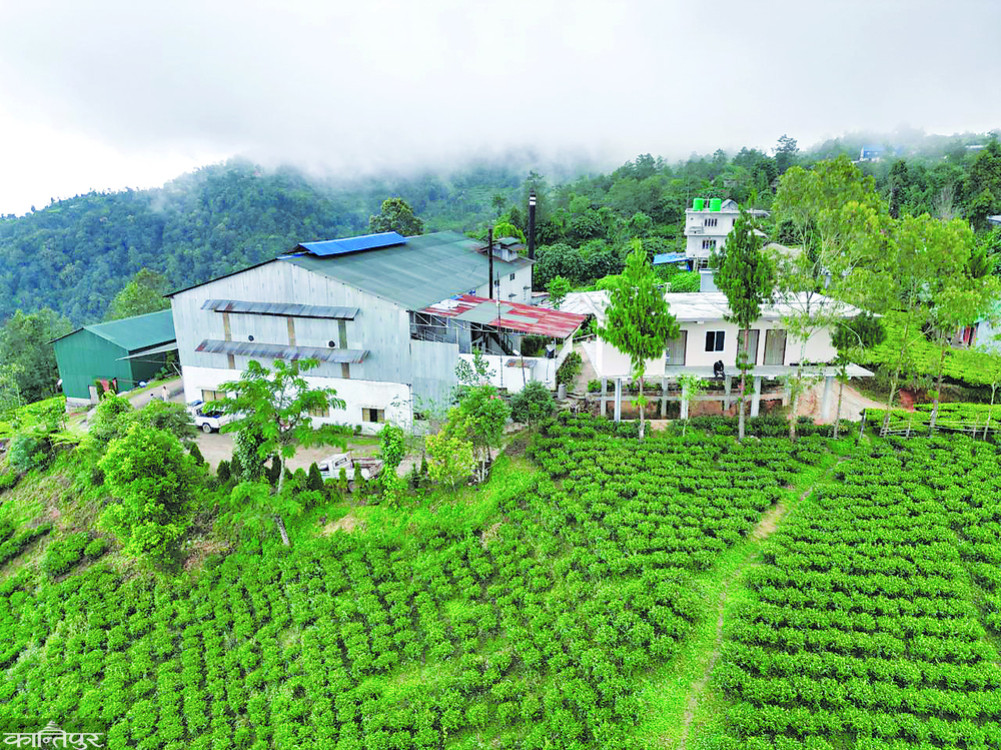
Industrialists complain that the mandatory testing of the quality of each batch of tea in the standards implemented by the Tea Board of India from May 1 is impractical.
We use Google Cloud Translation Services. Google requires we provide the following disclaimer relating to use of this service:
This service may contain translations powered by Google. Google disclaims all warranties related to the translations, expressed or implied, including any warranties of accuracy, reliability, and any implied warranties of merchantability, fitness for a particular purpose, and noninfringement.
The Nepali tea industry is in crisis due to the new standards implemented by the Indian Tea Board for Nepali tea exports. 53 industries in Ilam are being closed since Monday after exports have stopped. 30 tea industries in Jhapa have been announced to close from Asad 4.
53 tea industries in Suryodaya Municipality have announced to stop production from Monday after exports have stopped. According to the Suryodaya Orthodox Tea Producers Association, more than 300,000 kg of Nepali tea that has reached the Indian market has been stopped in the name of quality testing. There is an additional stock of more than 700,000 kg of prepared tea in the industries.
There were obstacles in the past on various pretexts, but now even the tea that has reached the market cannot be sold. – Gopal Kattel, General Secretary, Suryodaya Orthodox Tea Producers Association The tea processing shutdown will not only affect the workers working in the industry, but also the employment of workers who pick tea leaves. If the industry shutdown is prolonged, farmers will also be directly affected as green tea leaves grow on the plant. Industrialists have said that due to the stoppage of exports, it is difficult for farmers to pay the price of green tea leaves already.
Association President Dilli Shrestha said that the operation of the industry is becoming impossible due to the inability to sell the tea produced. ‘The tea purchased from farmers and prepared by processing the green leaves has not been sold. The warehouses are full. The industry is unable to operate as farmers have to be paid,’ he said.
The ‘Standard Operating Procedure’ (SOP) implemented by the Tea Board of India from May 1 has made it mandatory to test the quality of every consignment of tea exported from Nepal. But industrialists say that it has increased the business risk significantly as it takes more than two weeks to receive the test report, the tea cannot be sold until the report is received, and if the sample fails, the tea has to be destroyed or returned.
Association General Secretary Gopal Kattel said that this time the problem is more serious than the previous obstacles. ‘There were obstacles before on various pretexts.’ But now, even tea that has reached the market has been prevented from being sold,’ he said.
Industrialist Poonam Rai said that the Indian side’s behavior is such that it is causing problems for Nepali tea. ‘If it is a quality problem, then the customs should have tested it.’ It is not fair to stop the sale after it reaches the market,’ he said.
As soon as the industry stops production, farmers should stop picking green tea leaves. In Suryodaya Municipality alone, 2,995 farmers are involved in tea cultivation. About 20 million kg of green tea leaves are produced annually in the 33,655 ropani area of the municipality.
According to Indra Adhikari, agricultural officer of the National Tea and Coffee Development Board, Nepal exports more than 7 million kg of orthodox tea annually, of which more than 90 percent depends on the Indian market. Orthodox (leaf) tea is prepared in hilly districts including Ilam. CTC (granulated) tea is mainly prepared in Jhapa.
Nepal has been exporting prepared tea worth about 4.25 billion rupees annually. 50,000 people, including workers and farmers, are directly involved in the Nepali tea industry.
The Nepal Tea Producers Association, in a meeting on Sunday, decided to close 30 tea industries, both large and small, and more than a dozen tea gardens in Jhapa from Ashad 4. According to Shiva Kumar Gupta, senior vice-president of the association, the industries and gardens will be closed until the Indian side removes the obstacles imposed on the export of Nepali tea. “We have decided to continue the strike until India removes the obstacles,” Gupta said.
Industrialists have complained that exports have been affected when Nepali tea trucks were stopped in India due to the new quality testing process implemented by the Indian Tea Board. Tea is cultivated in more than 10,000 hectares in Jhapa. More than 20,000 farmers and workers are directly involved in the tea sector here.
Suryodaya Municipality has called the Indian move a non-trade barrier and urged the government to take diplomatic initiatives for an immediate solution. Industrialists, farmers and public representatives have said that the tea crisis should be considered not only of Ilam but also as a serious economic issue related to national production, exports, employment and foreign exchange earnings.
Tea entrepreneurs have been demanding immediate diplomatic initiatives with India through the Nepal government to resolve the problem and remove the obstacles to exports.
Ilam MP Suhang Nembang has also drawn the government's attention to the crisis in the tea industry. He has demanded high-level diplomatic initiatives through the Office of the Prime Minister and Council of Ministers, the Ministry of Foreign Affairs, the Ministry of Industry and Commerce, the Ministry of Agriculture, and the Nepali Embassy in New Delhi to open up the sale and export of tea.
He said that the testing process should be transparent, predictable, and time-bound. 'Tea leaves do not wait for administrative processes and diplomatic correspondence.' Today's delay puts the farmers' year-round labor, industry investment, and the employment of thousands of workers at risk,' Nembang said on social media. He stressed the need for speedy testing of tea, a system for India to recognize Nepal's laboratory certificates, and providing concessional working capital to the affected industries.