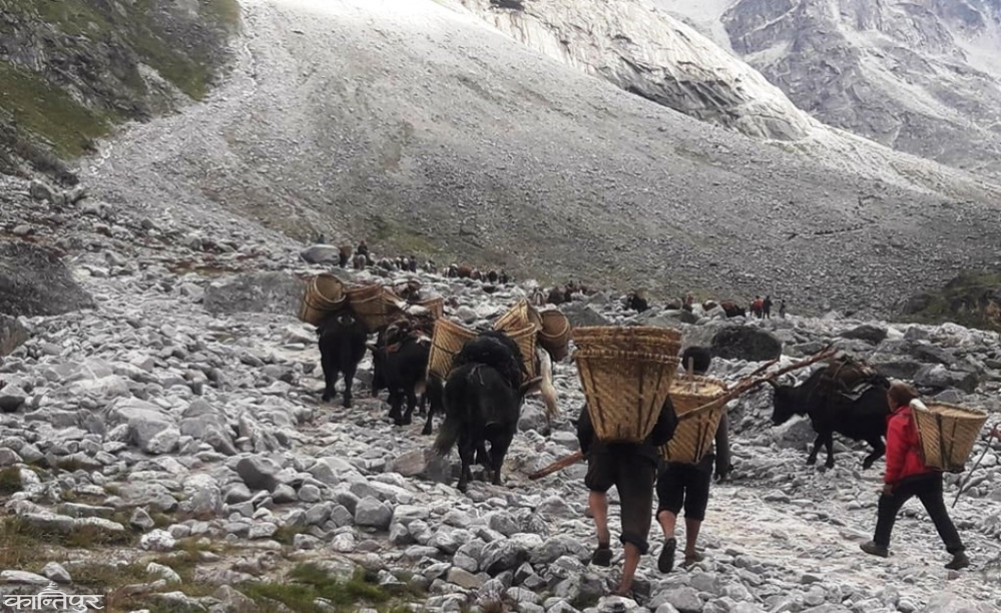
Despite being close to the Chinese border, the residents of Mugamkarmarong have been managing their supplies by making risky journeys and spending a lot of money because the roads and checkpoints are not open.
We use Google Cloud Translation Services. Google requires we provide the following disclaimer relating to use of this service:
This service may contain translations powered by Google. Google disclaims all warranties related to the translations, expressed or implied, including any warranties of accuracy, reliability, and any implied warranties of merchantability, fitness for a particular purpose, and noninfringement.
Sanduk Tamang, 56, of Mugamkarmarong-3 in Mugu, walks for two days to reach the district headquarters, Gamgadhi. He can reach Nakchenaglam, located on the Chinese border, in a single day. But since the Chinese border is not open and there are no road facilities, he is forced to reach the district headquarters, Gamgadhi, for daily necessities and food.
‘We are forced to travel to and from the district headquarters on narrow roads, taking risks. In the absence of roads, there is no alternative to carrying goods on mules,’ he said. ‘If the road from the headquarters to the village was open, the obligation to transport food by paying double the cost of the goods would have ended.’ He said that due to extreme cold and lack of irrigation facilities, only one crop of yam is produced in the village per year. According to him, since that production is not enough to eat for even 3 months, we are forced to consume food from outside for almost 9 months.’
Tasi Lama of Mugumkarmarong-1 Mugugaun also hopes that his children and grandchildren would be happy if the road was connected to China. ‘The road to China has been connected since long ago, even if vehicles came to the village, it would be much more convenient,’ he said.
The residents of Mugumkarmarong Rural Municipality are deprived of road facilities as the Gamgadhi-Nakchenagla road connecting Karnali to the China border has been stalled for a long time due to lack of budget. According to the rural municipality chairman, Tshiringkapne Lama, this is the shortest road connecting Karnali to China. According to him, only 18 kilometers of this road, which is 68 kilometers from Gamgadhi, has been opened so far up to Chail in Mugumkarmarong Rural Municipality. The road construction work was started in February 2062.
The village head Lama said that although trade relations between the indigenous people of Mugugaon on the China border and Tibetans have been established since 1915, the lack of roads has prevented the trade relations from becoming valid. ‘If the road were built, one could travel from Hajimar to Lhasa in Tibet in 2/3 hours,’ he said. ‘If the motorway was opened up to the border, trade between the two countries would have increased.’
Due to the lack of road facilities, the locals of Kimri, Karti, Takha, Khari, Mugu, Dolfu, Chitai, Reus and Puwagao in Mugamkarmarong are forced to walk for at least one and a half days even to ride a motorbike, said Dhanargolbu Lama of Kimri. ‘When will the road reach the village and our suffering end?’, he said, ‘Since it is a cold place, only one crop of yam is grown in the municipality, that grain does not even last for 3 months, we are forced to face food shortage every year, when the road reached, we could at least afford to eat.’
According to him, a sack of rice carried by mules, horses and carts costs 6,000 rupees. While a sack of rice weighing 30 kg is available in the district headquarters, Gamgadhi, for 2,200 to 2,500 rupees. He said that horse-mules transport goods to the village for 100 rupees per kilogram.
According to him, although there is a food depot in the village, rice has not arrived since last Ashar. He said that due to the lack of roads, the village’s agricultural produce including potatoes, apples, yam and other vegetables goes to waste. Village Municipality Chairman Lama said that due to the inconvenience of the road, the price of construction materials is also a problem in development work.
Shravan Kumar Mahatara, Acting Chief of the Road Division Office, Jumla, said that Rs. 120 million has been spent so far on the road, which was estimated to cost Rs. 800 million. “There is no budget for the road, and even if there is, it is very low,” he said. “Contractors are short-changing and tendering even with a small budget. How can quality work be done?” According to him, since work is done only in the middle of Ashar every year, there is also a problem of most of the budget for the road being frozen.
Although a budget of Rs. 40 million has been allocated for the upgrading of the Nagma-Gamgadhi road this year, he informed that no budget has been received to open a new track towards Nagchenagla. He said that since the Mugu is a road that crosses the Karnali River and reaches the Tibet border area, there would be no problem if the budget was sufficient to construct this road.