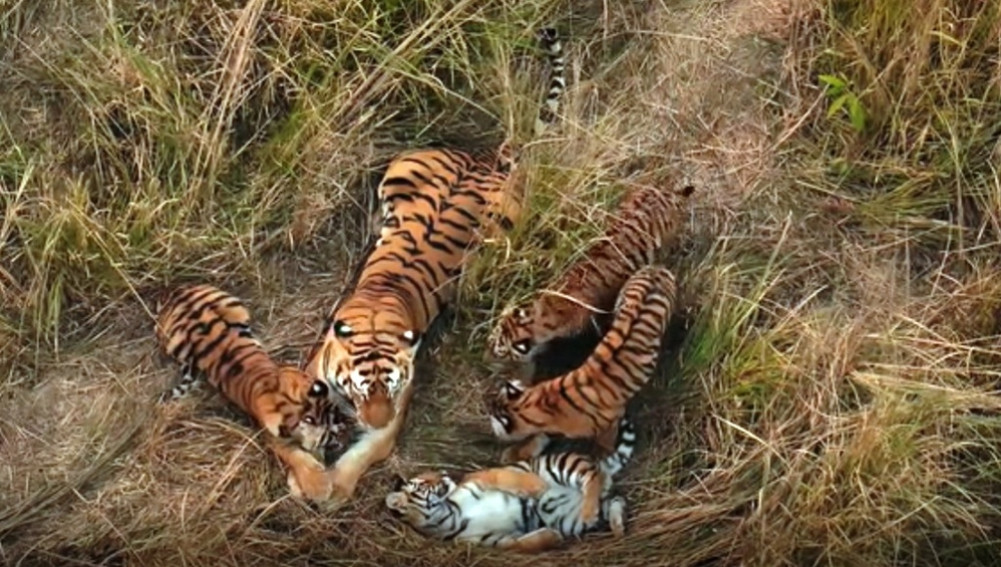
The BBC's hour-long 'Tiger Island' series about tigers in Bardiya National Park, broadcast on June 7, 2026, features a rare scene of a female tiger caring for another female tiger's cub.
We use Google Cloud Translation Services. Google requires we provide the following disclaimer relating to use of this service:
This service may contain translations powered by Google. Google disclaims all warranties related to the translations, expressed or implied, including any warranties of accuracy, reliability, and any implied warranties of merchantability, fitness for a particular purpose, and noninfringement.
Bardiya National Park in western Nepal is a tiger destination. Tourists have been flocking to the park recently as tigers are not easily seen during jungle safaris. The tigers of Bardiya are currently in the news with a new series prepared by the BBC. The lifestyle of the tigers captured in the series has attracted the attention of the world.
The first series of the new wildlife series 'Tiger Island' prepared by the BBC, which covers the amazing, unique, unforgettable and exciting activities of tigers in the 5 intermediate community forest areas around Bardiya Park, is currently in the news. The main reason for this debate is the new facts revealed through the series.
'Tiger Island', which was broadcast worldwide on 7 June 2026 on the British broadcasting organization BBC One and BBC i-Player, has revealed new and exciting facts. The nearly hour-long series shows a rare scene of a female tiger caring for another female tiger's cub. Experts say that the fact that tigers also raise and care for other tiger cubs along with themselves has been revealed. On the other hand, the fact that male tigers kill their cubs on sight has also been found to be wrong.

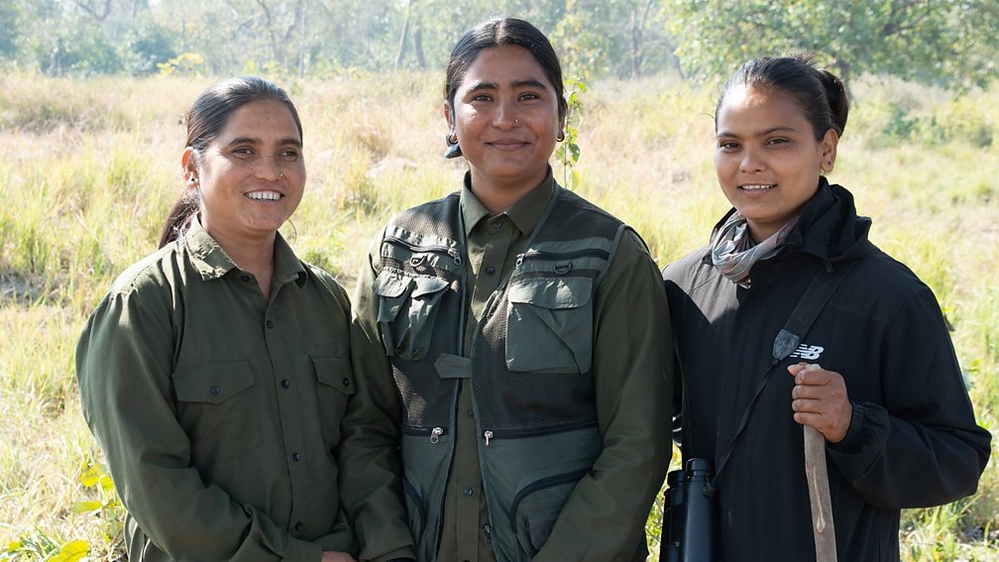
It has revealed that male tigers do not kill small cubs on sight, but also show affection and care for them. However, the 'visitor' has also shown that male tigers kill cubs on sight. A rare scene of a tiger eating a cub has also been filmed in this series. Experienced nature guide sisters Sushila, Manju and Ranju Mahatara from Bardiya worked closely with the BBC team for the documentary.
They managed to film rare and fascinating scenes for the documentary by regularly monitoring, searching and monitoring the tigers. Nature guide Sushila Mahatara said that the BBC's new Tiger Island series was started after the local names Goma and Jugini, who were locally named, were filmed having sex when BBC Asia came to film the documentary in late 2022 and February 2023. 'Then the decision was made to follow these two,' she said, 'while working, I learned about the tiger's behavior and new practices.' She said that the process of following both tigers began in consultation with director Patrick Evans, who was in Bardiya at the time. Evans is the current co-director of the series.
Sushila said that she also saw Goma and Jugini getting pregnant while following them. ‘When the cub Ali grew up, the team came to film the documentary,’ she said, ‘the scene was filmed of Goma taking care of two cubs, about 9 months old.’
The BBC team had visited the community forest for the documentary. She said that the BBC technical team was surprised when they saw three more cubs with Goma. Then, during further investigation through a drone camera, it was discovered that the three cubs added to Goma belonged to a female tiger named Jugini, said nature guide Manju Mahatara.
Jugini had also established a ‘territory’ around Goma. While filming the activities of Goma and Jugini through a drone camera, a female tiger named ‘Mala’ was found to have conceived for the first time and given birth to a cub. Mala, who is about 4 years old, is revealed to be Goma's last child. Juguni, who is estimated to be about 6 years old, is also believed to be Goma's first child.
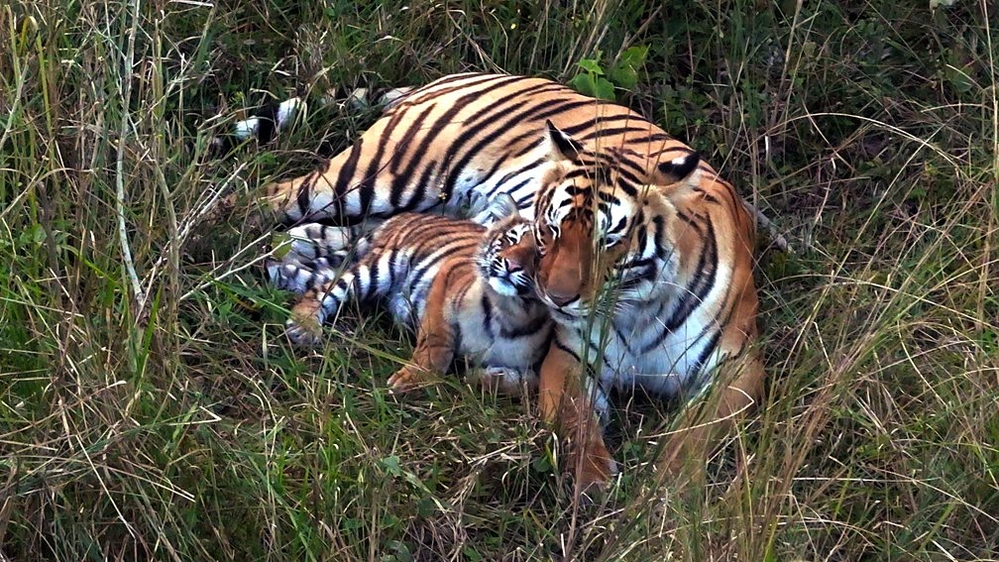
Juguni had three cubs. Both cubs were about 9 months old. BBC One is airing the second series of Tiger Island on June 14, featuring Mala, who has become a mother for the first time. Her habits and behavior are shown in the series. The series also includes a rare scene of Mala's cub being killed and eaten by a visiting rooster. Mala's cubs were three months old. This documentary is also about an hour long.
‘In February 2023, Goma and Jugini were seen mating about a hundred meters away,’ said Manju, ‘that was the beginning of the Tiger Island series.’ She said that after that, she tracked Goma and Jugini and informed the BBC team.
She said that a technical team with high-level technology and a big cat scientist came to film and research as needed. ‘The series includes rare scenes of Jugini’s two cubs being killed by a male tiger,’ she said. According to her, in the second series, two of Jugini’s cubs have also been killed by a male tiger. Goma has two cubs. Mala also has two dead and only one is left. The second series has many night scenes. ‘It shows how tigers behave at night and how they live,’ she said, ‘at night. There was not much research on the activities, so the BBC focused more on the night and made the series.'
In 2021, BBC One also made and broadcast a documentary on Bardiya called Return Tiger. Then, BBC Asia worked on 2022/23 and released another tiger documentary in late 2023. This was the next production. In 2025, a team with BBC technicians came twice. The first time was in February and the second time in May.
The team stayed in Bardiya for about two months on both occasions. There was a team of 16 people, including 2/3 Nepalis. The video was shot using a camera drone around the Shivpur Vanarwa, Banu Gaun, Bahadurpur, Kailasi and Asare Gairi Intermediate Community Forest User Group areas around the park. The documentary was broadcast after editing a year after the video was shot.
The documentary aired by the BBC has brought out new facts about the ecological behavior of tigers and has attracted the attention of the world, said Dr. Ashok Ram, Chief Conservation Officer of Bardiya National Park. ‘The documentary has given so much publicity to the tigers of Bardiya that now Bardiya does not need to be introduced to the world,’ he said.
Ajit Tumbahamphe, Head of the National Trust for Nature Conservation Bardiya Program, said that the conservation efforts being made in Nepal have presented the current tiger tourism as an excellent model on the international stage. He said that this will spread as a brand of Bardiya tigers all over the world. He expressed his belief that it will become an excellent destination for tourists and researchers.
This historical series produced by the BBC Studios Natural History Unit has exposed the forests of Bardiya National Park and the surrounding buffer zone, the tiger habitat and its biodiversity to the world. A question has been raised by tiger experts through the current documentary, said Dr. Baburam Lamichhane. ‘A new thing has come up,’ he said, ‘further studies and research are needed to confirm this.’
He said that research is needed on whether the tiger’s behavior has changed and whether the number has increased due to insufficient space. ‘This confirms that Bardiya is a virgin place for those who study tigers,’ he said.
Ornithologist Ram Shahi said that it was possible to film this historical scene due to the knowledge and patience of the three sisters, who are nature guides, towards nature and wildlife. He said that the appearance of these teenage girls as guides in the BBC documentary has proudly established the leadership and participation of locals in ecotourism in Bardiya and the country. The sight of a mother and daughter raising five cubs together in a natural environment is itself amazing and unique, said WWF Nepal Representative Dr. Ghanshyam Gurung. ‘Anyone would be happy to see the mother’s affection for the cubs on an island,’ he said, ‘This documentary has made the tigers of Bardiya roar in the world market. There is no need for marketing. Nepal, especially Bardiya, is a must-see for tigers.’
Nepal’s name has once again come into the spotlight in the conservation sector after a new discovery about tigers in a high-level BBC documentary was discussed in the international media. This has increased the interest of tourists and conservationists from all over the world in Bardiya Park. Tigers give birth to cubs every two to three years. In the meantime, the female raises the cubs, teaches them to hunt, and teaches them to mark their territory. The faster they learn, the faster they leave their mother. Tigers are pregnant for 104 to 109 days. Two to four cubs are born in a litter. It is understood that the ecosystem of a place where tigers are found is healthy.
Since tigers are the main predator in the food chain, they contribute significantly to the balance of the environment by controlling other animals, said Dr. Bhagwan Dahal, Nepal Country Representative of the Zoological Society of London. If it can be shown that tigers and humans can coexist, it will be more exemplary for the world, he said.
According to the 2022 census, the number of tigers in Nepal is 355. In 2010, there were 121 tigers. The data of the national tiger census conducted in 2026 is ready to be made public on World Tiger Day, which falls on July 29.