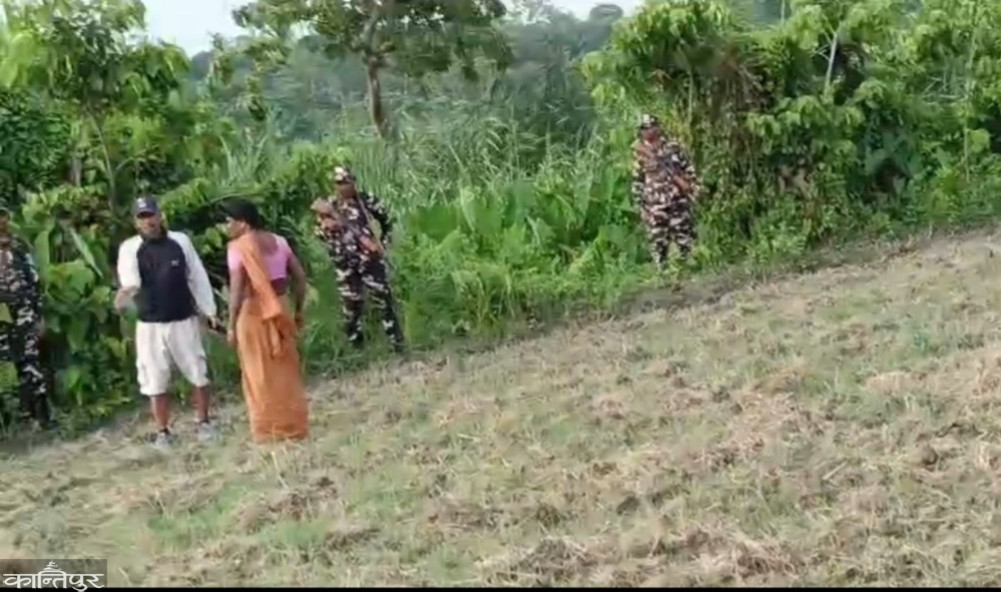
Deepak Raj Ghimire, Chief District Officer of West Nawalparasi, says, “The situation in Susta is now normal after the immediate arrival of Nepali security personnel.”
We use Google Cloud Translation Services. Google requires we provide the following disclaimer relating to use of this service:
This service may contain translations powered by Google. Google disclaims all warranties related to the translations, expressed or implied, including any warranties of accuracy, reliability, and any implied warranties of merchantability, fitness for a particular purpose, and noninfringement.
Locals have retaliated after the Indian Border Security Force (SSB) entered Nepali territory in Susta. On Friday morning, around 7 am, the locals shouted and asked the SSB to go back to their own land.
After the SSB entered Nepali territory on 17 Jestha to stop the construction of an embankment on the Narayani River, both the Nepali and Indian sides are keeping the area under increased surveillance.
Locals working in the fields asked the Indian security personnel to go back, asking why they had entered Nepali territory. After a brief argument with the locals, the SSB headed towards India.
Chief District Officer of West Nawalparasi Deepak Raj Ghimire said that a team of Indian security personnel on regular patrol had come to Nepal to cross the border due to waterlogging, saying, “But after the Nepali security personnel arrived soon after, the situation in Susta is normal now.”
Rabindra Jaiswal, spokesperson for the Susta Save Campaign, informed that after seeing the Indian security personnel on Nepali territory on Friday morning, the locals asked them to go towards India and not enter their land, and there was a dispute for some time, and later the problem was resolved with the initiative of security personnel from both sides.
In 2022, the then King Mahendra had settled some former soldiers and about 400 families in Susta to protect the border. In 2034, the Narayani River changed its course and turned the settlement into a swamp, and they were displaced. After that, the locals allege that the Indian side has been continuously encroaching and taking advantage of the lack of a border post.
Out of the total area of 40,980 hectares of Susta, India has encroached and taken over 14,000 hectares, while 19,480 hectares have not been allowed to be cultivated, saying that it is disputed. The residents of Susta are currently cultivating only 7,500 hectares of land.
Although there are 16 border pillars from Sanhi to Kudiya in western Nawalparasi, there is no border pillar in the 24-kilometer area of Susta. In places where there are no border pillars, rivers, trees or other biological boundaries have been relied upon, and disputes have repeatedly arisen between the citizens of the border areas over the issue of cultivation. A Simal tree has been considered as a border pillar in the disputed land between Nepal and India.