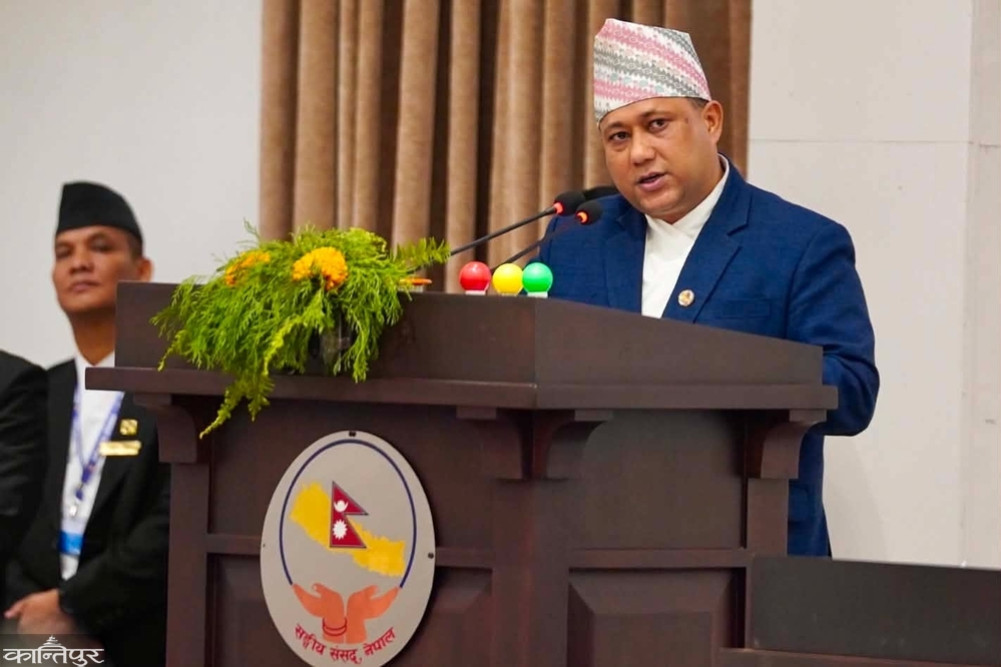
Discussions and parliamentary proceedings on the Appropriation Bill were disrupted as the meetings of the House of Representatives and the National Assembly were disrupted since 18 Jestha.
We use Google Cloud Translation Services. Google requires we provide the following disclaimer relating to use of this service:
This service may contain translations powered by Google. Google disclaims all warranties related to the translations, expressed or implied, including any warranties of accuracy, reliability, and any implied warranties of merchantability, fitness for a particular purpose, and noninfringement.
The obstruction in the federal parliament has been lifted after Foreign Minister Shishir Khanal clarified Prime Minister Balendra Shah's statement on the Nepal-India border. The discussions on the Appropriation Bill and parliamentary proceedings were obstructed due to the disruption of the meetings of the House of Representatives and the National Assembly since 18 Jestha.
On Wednesday, Foreign Minister Shishir Khanal clarified on behalf of the government regarding Prime Minister Shah's statement in the House of Representatives. During that, Khanal said, "Nepal and India have a centuries-old and open border. The current Nepal-India international border is established and guided by the Sugauli Treaty of 1816. The Susta and Limpiyadhura, Lipulekh and Kalapani areas under the Nepal-India border are yet to be mapped." Apart from that, there is a problem of 'cross border occupation' and ten-gaja encroachment in some places.'
Foreign Minister Khanal said that since the 'fixed boundary principle' was adopted in the river border area while determining the Nepal-India border, there is a situation of 'cross border occupation' where citizens of one country are farming and settling in the territory of another country. 'The study of the technical committee has shown that in some places, the land currently under the use and enjoyment of Nepal may fall towards India, and the land currently under the use and enjoyment of India may fall towards Nepal,' he said. He said that the context of the Prime Minister's statement is related to the ten-gaja encroachment and 'cross border occupation.'
Prime Minister Shah had said in the House of Representatives meeting on 17 Jestha, 'India has not only encroached on Nepal's land, but Nepal has also encroached on India's land.' Minister Khanal also said that the Nepal government is committed to resolving the border dispute with India through diplomatic talks based on historical treaties and maps in line with the spirit and spirit of the close relations between Nepal and India.
Bhishma Raj Angdembe, leader of the main opposition party, Nepali Congress, said that there is no point in searching for Prime Minister Shah in Parliament now. Speaking in the House after Khanal's clarification, he criticized the ruling Rashtriya Swayamsevak Sangh (RSS) MPs for clapping and supporting him when Prime Minister Shah made a statement that Nepal had crossed the border with India. 'I would like to humbly draw everyone's attention to the mature and responsible responsibility that this Parliament should not remain complacent on this issue anymore. Discussion on this year's budget is yet to be held,' he said. 'Many other vital issues of the Nepali people need to be discussed. The Prime Minister may not want Parliament, but the opposition does. The Prime Minister may come again in a guerrilla style someday, but I do not want to search for him anymore.'
UML, NCP, Labor Culture and RPP, who spoke at the meeting, also opposed the Prime Minister's statement. They demanded that the Prime Minister's statement be removed from the parliamentary record. UML parliamentary party leader Ram Bahadur Thapa said, "The Prime Minister should answer, not the Foreign Minister. The crisis in the House has come about because of the Prime Minister's statement. We will continue the struggle for the dignity of the country until the crisis is resolved."
NCP MP Pramesh Hamal said that the party believes that the Prime Minister should appear in Parliament and give an explanation and apologize. "We have decided on a strategy to change the nature of the struggle to move the Parliament forward and discuss the budget," he said.
RPP parliamentary party leader Gyan Bahadur Shahi commented that the government is moving in the opposite direction. This is the first time such a situation has been seen not only in the political history of Nepal, but also in the political history of the world. Where the ministers have to correct a serious political and geopolitical mistake made by the country's executive head, the Prime Minister," he said.
Labor Culture Party Chairman Harkaraj Rai demanded that the Speaker rule to allow the Prime Minister to be present in Parliament. After being surrounded by a well to allow him to speak in Parliament, he got the time to speak, saying, ‘We had to protest to speak in the House. People are protesting for the Prime Minister to come here. Protest is a country of protests!’
The Parliament meeting has been held with Minister Khanal’s clarification and the statements of the opposition party leaders. A general discussion on the annual estimate of revenue and expenditure for the fiscal year 2083/84 has started in the House of Representatives since Wednesday. On Thursday, Finance Minister Swarnim Wagle is likely to answer the questions raised in the discussion.
In Thursday’s meeting, Finance Minister Wagle will propose a motion seeking permission to present the Appropriation Bill, 2083. After that, a possible agenda for presenting the Appropriation Bill has been prepared. Finance Minister Wagle is likely to present the bill to raise the national debt. Similarly, a possible agenda for presenting a proposal to consider the Nepal Rastra Bank (Third Amendment) Bill, 2083 has also been decided.
The parliament's agenda for discussing the Appropriation Bill was disrupted when the opposition parties obstructed the parliament in protest against Prime Minister Shah's statement. The opposition MPs were demanding that the rule that written questions from MPs should be answered in the first week of every month should be implemented as per the provisions of the House of Representatives regulations. If there is no opportunity to answer in the first week of the month, the opposition had been raising its voice in the House as per the provisions of the regulations that the Prime Minister should answer in the meeting held the next week. Prime Minister Shah had appeared in the Parliament on 17 Jestha. Instead of answering the questions of MPs, he had taken questions from political parties.
Meanwhile, to remove the obstruction in the House, RSP President Rabi Lamichhane had called two all-party meetings on Monday and Wednesday.