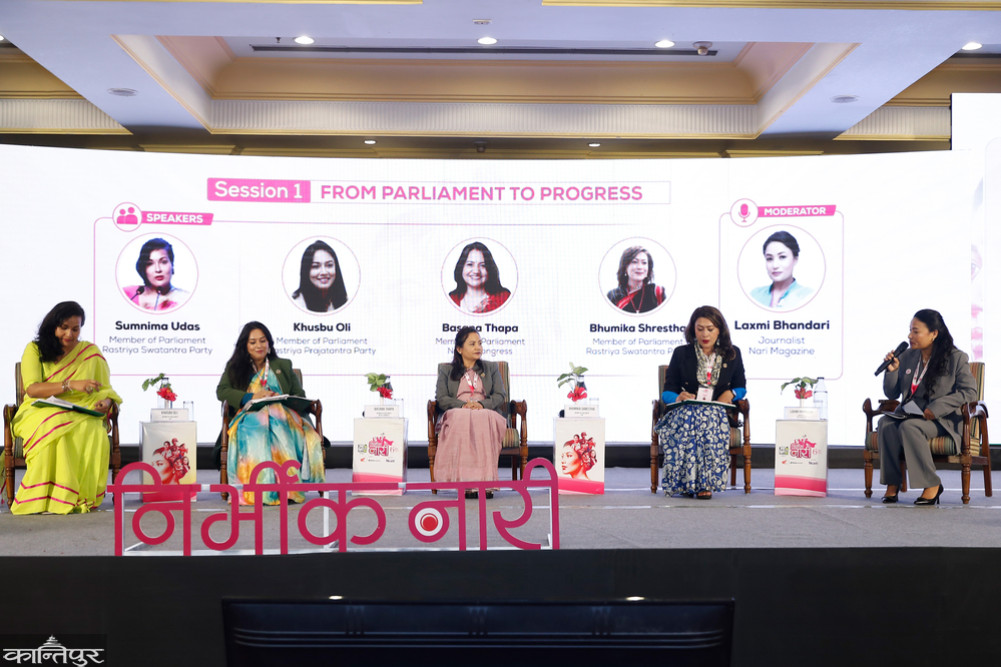
Speakers in the session emphasized that women's representation should not be limited to numbers alone but should be transformed into effective participation in policymaking and decision-making processes.
We use Google Cloud Translation Services. Google requires we provide the following disclaimer relating to use of this service:
This service may contain translations powered by Google. Google disclaims all warranties related to the translations, expressed or implied, including any warranties of accuracy, reliability, and any implied warranties of merchantability, fitness for a particular purpose, and noninfringement.
In the session titled ‘From Parliament to Progress’ under the sixth edition of ‘Nirbhik Nari’ organized by Nari Monthly, a co-published by Kantipur Publications, women MPs from various political parties shared their experiences and perspectives on issues of politics, leadership, women’s representation and inclusion.
The session was attended by National Independent Party (NIS) MP Summina Udas, National Democratic Party (NDP) MP Khushbu Oli, Congress MP Vasana Thapa and RSP MP Bhumika Shrestha, who represents the sexual and gender minority community. The program was facilitated by Nari Monthly journalist Laxmi Bhandari.
MP Summina Udas, who is also a former journalist, mentioned the difference between journalism and parliamentary roles and said that she has now reached the level of policy making. ‘When I was at CNN, my job was to ‘report the story’, while now I am responsible for ‘making the story’ from the microphone of Parliament,’ she said.
Terming RPP President Ravi Lamichhane's visit to India as an 'ice breaker' in the context of Nepal-India relations, she expressed her belief that dialogue and cooperation would further strengthen the relations between the two countries.
Udas said that even if her party can fulfill only half of the commitments made public, it will be a great achievement. 'Our party has hundreds of commitments. Even if it can fulfill only 50 percent of them, it will be a significant achievement,' she said.
RPP MP Khushbu Oli shared her experiences of social reality that inspired her to enter politics. She said that the incidents of child marriage and teenage pregnancy in Jhapa inspired her to become active in politics. Recounting the story of a mother of 15 children she met during her visit to Bajura, she said that there is still pressure in society to have sons. 'That woman cannot be blamed. Access to education, health and awareness is still not reached in many places,' she said.
Noting that women are fulfilling responsibilities both inside and outside the home, she specifically recalled the contribution of full-time housewives. ‘We also work, we also run the house. Full-time housewives work 24 hours a day without pay,’ she said.
Although the increase in the number of women MPs in Parliament is positive, she was of the opinion that it should not be considered the only achievement. ‘Today, there are 96 women MPs in Parliament.’ However, what is more important than the number is the influence of women in the decision-making process,’ she said.
Stating that women’s leadership and contribution have not been adequately documented in history, she recalled the contribution of leading women like Shailaja Acharya and Yogmaya.
‘Women’s signature should reach the decision-making level of the nation through homes, society, municipalities, and parliament,’ she emphasized. Responding to criticisms raised about the proportional electoral system, Oli said that representation is an important basis of democracy.
‘Now, the debate should not be about how women came to parliament, but how to increase their representation and influence,’ she said.
Similarly, Congress MP Vasana Thapa, recounting her experience of winning the direct election and reaching parliament, said that the citizens of Karnali elected her with great trust. ‘I am a woman who went from a big place to a small place.’ That is why I got the opportunity to understand the needs and problems of the people there closely,’ she said.
She said that child marriage, malnutrition, lack of education and health services are still serious challenges in Karnali. ‘Along with women empowerment, it is necessary to increase awareness and consciousness among women,’ she said. Stating that the development of Karnali will not be possible by staying in Kathmandu, she emphasized that policies should be formulated by understanding local needs and geography.
‘Only if a development framework is prepared by staying in that geography, the real development of women in Karnali and the entire region is possible,’ she said.
Bhumika Shrestha, who represented the sexual and gender minority community in Parliament, said that her community is still waiting for the implementation of its rights. ‘Society has given it identity, roads have given it employment, now the Parliament must ensure its rights,’ she said.
Even though awareness about sexuality and sexual diversity is increasing in Nepal, she said that the society still has a strong belief that only women and men are gender identities. ‘The Constitution has ensured rights.’ However, patriarchal thinking is still deeply rooted,’ she said.
Sharing her experience of both increased expectations and responsibilities after becoming an MP from a rights activist, Shrestha said that one of the reasons for the delay in legal and policy reforms is the limited understanding within the bureaucracy. ‘The government is positive, but some bodies have still not been able to fully assimilate the issues of our community,’ she said.
According to him, homework is being done to implement the provisions of the constitution, amend the necessary laws and advance policy reforms.
The speakers of the session emphasized that women's representation should not be limited to numbers alone but should be transformed into effective participation in policy-making and decision-making processes. They also concluded that it is necessary to ensure the voice of women, marginalized communities and sexual and gender minorities at all levels of the state.