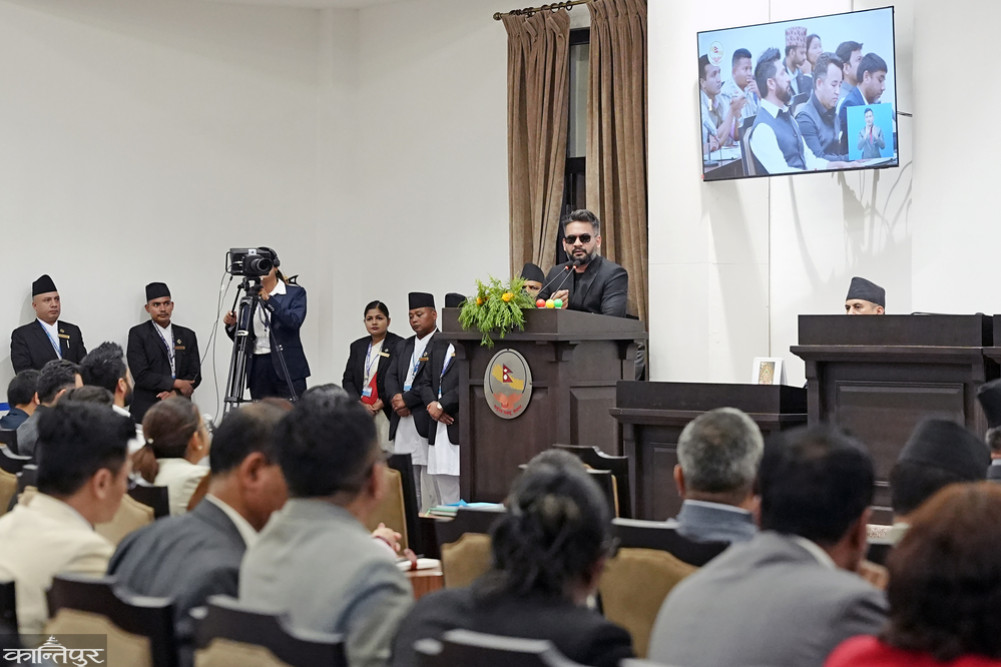
The ordinance risks being rejected in the National Assembly, but the bill appears to be free of problems, so the government is working on drafting a related bill.
We use Google Cloud Translation Services. Google requires we provide the following disclaimer relating to use of this service:
This service may contain translations powered by Google. Google disclaims all warranties related to the translations, expressed or implied, including any warranties of accuracy, reliability, and any implied warranties of merchantability, fitness for a particular purpose, and noninfringement.
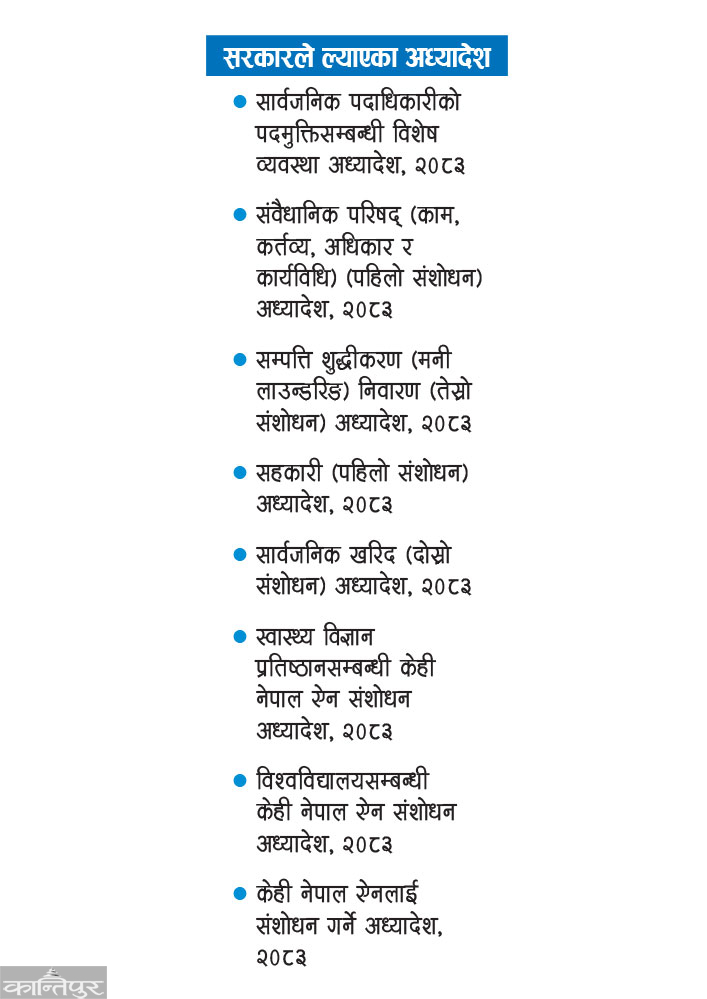
Four weeks after the government presented eight ordinances in the meetings of the House of Representatives and the National Assembly, the approval process has not been moved forward. After the ordinances are approved, the government is discussing whether to move forward with a replacement bill, while taking a new bill to Parliament.
The eight ordinances issued by President Ram Chandra Poudel until April 22 on the recommendation of the Council of Ministers were presented in Parliament on April 28. After that, a motion to approve the ordinances should have been presented. But the process has not been moved forward for that. “No other process has been moved forward after the ordinances were presented, and it is not even on the agenda of the House of Representatives for April 25. Even after that, whether the ordinances will move forward or not will depend on the government,” said Ekram Giri, spokesperson for the Parliament Secretariat.
The parliamentary calendar brought by the House of Representatives for the upcoming April 15 does not include the issue of approving the ordinances. There is a constitutional provision that an ordinance will be converted into a permanent act after it is passed by both houses within 60 days of its presentation in the House and certified by the President. Even if no decision is made within 60 days of its presentation in the first meeting of the Parliament, the ordinance will automatically become inoperative. Therefore, even if it is not taken into any process, the ordinance will automatically become inoperative after 26 Ashad. Due to the opposition's obstruction in the Parliament meeting, both the government and the Parliament are under pressure to pass the budget-related bill.
 Article 114, Clause 2 (a) of the Constitution provides that if the ordinance is not accepted by both houses, it will automatically become inoperative. Since the ruling Rashtriya Swayamsevak Sangh (RSS) holds almost two-thirds of the seats in the House of Representatives, the government has no problem in moving the ordinance forward. However, the presence of the Rashtriya Swayamsevak Sangh (RSS) in the National Assembly is zero. Opposition parties have already registered a motion to reject the ordinance. This is the reason why the government does not want to move the ordinance forward. The House of Representatives can move the bill forward without accepting the amendment suggestions given by the National Assembly.
A minister said that the government could not proceed with the approval process due to the inability of the government to properly discuss the budget-related bill in the parliament, the opposition party had filed a motion of rejection in the National Assembly, and the purpose of bringing the ordinance had been fulfilled. He informed that discussions are underway on an easier way to register the bill directly with the parliament secretariat instead of submitting a replacement bill for the ordinance.
The government had brought an ordinance on the Constitutional Council to facilitate the process of recommending the Chief Justice. Immediately after bringing the ordinance, the Constitutional Council recommended the Chief Justice.
It has been discussed that it will be easier to move forward with the new bill as it can be passed quickly since the government has a strong majority in the parliamentary committees and the House of Representatives. - Law Secretary Parashwar Dhungana After that, Manoj Kumar Sharma has been appointed as the Chief Justice after completing the parliamentary hearing. Although some office bearers are vacant in the Constitutional Commission, the appointment does not seem to be a priority for the government. The government has already removed about 1,500 people by bringing an ordinance on the removal of public officials. The ordinance has also dissolved the employee trade union. A writ filed in the Supreme Court against this move is pending. ‘Even if the ordinance is now inactive, it does not seem to have much of an impact on the government,’ said a ministry secretary.
In the National Assembly, where the only opposition party is the UML, all eight ordinances and the Congress and the NCP have registered a notice to reject two ordinances. There is a possibility that the ordinance will be rejected if these proposals are moved forward. Another reason for the government’s lack of interest in the ordinance is that discussions on the budget in the House of Representatives have not been able to take place amicably. Parliament meetings have been postponed repeatedly due to opposition party obstruction. The government understands that moving forward with the replacement bill will provide the opposition with more opportunities for obstruction.
Law Ministry Secretary Parashwar Dhungana also informed that discussions are underway on moving forward with a separate bill in parliament instead of the replacement bill. "It has been discussed that it will be easier to move forward with the new bill as it can be passed quickly because the government has a strong majority in the parliamentary committees and the House of Representatives," he said. "Accordingly, the concerned ministries are preparing the bill." In the first meeting of the budget session, Law Minister Sobita Gautam presented the Public Procurement (Second Amendment) Ordinance, the Special Provisions Ordinance on the Removal of Public Officials, the Constitutional Council (Work, Duties, Powers and Procedures) (First Amendment) Ordinance, and some Nepal Act Amendment Ordinances.
Finance Minister Swarnim Wagle presented the Prevention of Money Laundering Third Amendment Ordinance, while Land Management Minister Pratibha Rawal presented the Cooperatives First Amendment Ordinance, and Health Minister Nisha Mehta presented some Nepal Act Amendment Ordinances related to the Health Sciences Academy. Similarly, Education Minister Sasmit Pokharel presented some Nepal Act Amendment Ordinances related to universities.
According to a minister, the concerned ministries are doing their homework on the draft bill by keeping the provisions in the ordinance. Once the draft is ready, it will be submitted to the Ministry of Law. After the opinion of the Ministry of Law, the concerned ministry will submit it to the Council of Ministers. After the Council of Ministers gives its approval, the bill will be registered in the House of Representatives.
Former Secretary of the National Assembly Rajendra Phuyal comments that the government does not have a clear vision on the ordinance. “Ordinances are like sunset laws, which have to be converted into permanent laws through a replacement bill within 60 days. Delaying this is not good practice from a legislative perspective,” he said.