According to diplomatic sources, the border dispute was a prominent issue in discussions between Khanal and his Indian counterpart S. Jaishankar.
We use Google Cloud Translation Services. Google requires we provide the following disclaimer relating to use of this service:
This service may contain translations powered by Google. Google disclaims all warranties related to the translations, expressed or implied, including any warranties of accuracy, reliability, and any implied warranties of merchantability, fitness for a particular purpose, and noninfringement.
Foreign Minister Shishir Khanal has said that Nepal is not seeking mediation from a third country in its border dispute with India. He also reiterated Nepal's long-standing stance that pending issues should be resolved through bilateral talks and diplomatic mechanisms.
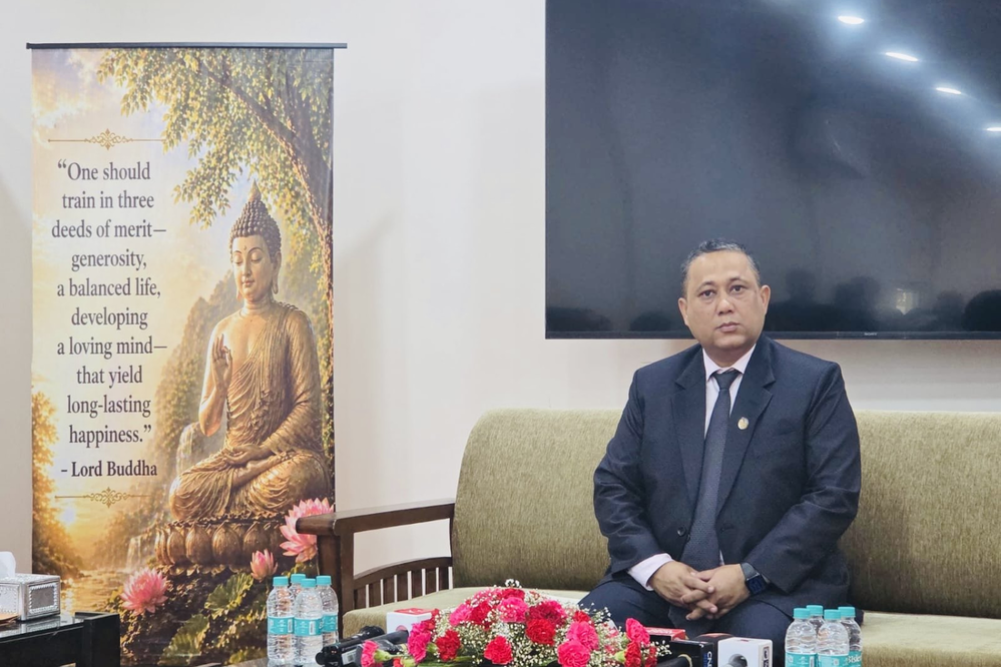
The Indian Foreign Minister is likely to visit Kathmandu in September Addressing Indian media persons at the Nepali Embassy in Delhi on Sunday before returning to Kathmandu after completing his visit to India, Khanal tried to clarify the confusion created over Prime Minister Balendra Shah's statement on the border issue in the House of Representatives. 'We need historical evidence and we have tried to understand whether we can obtain such historical documents and evidence from the British library or archives.' That does not mean that we are seeking mediation from anyone. That is not the intention of his (Prime Minister) statement,' Khanal said. 'If you listen carefully to his statement in Parliament, he has clearly stated that we want to resolve the border dispute through dialogue and diplomatic means.' This has been Nepal's stance for a long time. And, today's stance is the same.'
Khanal also mentioned that most of the border disputes are a legacy of the 1816 Sugauli Treaty, which determined the modern border between Nepal and British India. 'When we sit at the negotiating table, these issues will be resolved through bilateral discussions and diplomatic mechanisms. We want to resolve misunderstandings through diplomatic means,' he said.
This clarification came from Foreign Minister Khanal the day after holding bilateral talks with his Indian counterpart S Jaishankar. Prime Minister Balendra Shah, while addressing the House of Representatives on 17 Jestha, had said that Britain should also show interest, keeping in mind the historical relationship of the 1816 Sugauli Treaty. He had also mentioned that diplomatic dialogues are underway with China and England (Great Britain) on the issue of Lipulekh. India then reiterated that third-party involvement in the border dispute with Nepal was unacceptable and that disputes would be resolved through bilateral mechanisms.
Separate statements issued by Nepal and India after the foreign ministers' meeting on Saturday clearly mentioned the border dispute. The separate statements issued by the foreign ministries of Nepal and India did not clearly mention the long-standing border dispute. According to diplomatic sources, the issue was raised as a priority in the meeting between Khanal and Jaishankar before the delegation-level meeting. According to two Nepali government officials familiar with the discussions at the meeting, the two ministers also agreed to activate the existing bilateral mechanism on the border and to hold regular meetings.
‘The meetings of various bilateral mechanisms have not been held for a long time, so it was decided to activate all the mechanisms between the two and hold regular meetings of those mechanisms,’ said a Nepali official familiar with the developments in Delhi, ‘We have definite and established mechanisms to address border issues, so both the ministers are ready to address mutual disagreements through dialogue. If necessary, the top political leadership will also provide necessary guidance to both the sides.’
As per the agreement, the Survey Officials Committee (SOC), a technical committee headed by the Deputy Director General of the Survey Department under the Border Working Group (BWG), is expected to meet on August 24-25. After the SOC meeting, the BWG will review the latest progress. The BWG was formed in 2014 to resolve technical issues related to the border except Kalapani and Susta. Khanal also admitted that many bilateral mechanisms have been dormant in recent years. ‘There is no harm in sitting at the table and discussing these issues,’ he said, ‘right now the mood of both sides is positive.’
The border dispute came to the surface last month after India and China announced that they would resume the Kailash-Mansarovar pilgrimage via Nepali land, Lipulekh. After that, the government sent diplomatic notes to both countries expressing its protest. In an interview with Indian media, Minister Khanal reiterated his stance by sending diplomatic notes to both India and China.
‘We have clearly told both countries that that land is ours.’ That is also a historical claim... These and other issues are part of the historical legacy, especially regarding the Nepal-India border. We want to resolve these issues through the diplomatic process,’ he told Indian media.
Khanal claimed that India and China cannot reach an agreement on Lipulekh without Nepal’s consent. “We have conveyed our disagreement to both India and China through official diplomatic notes,” Khanal said. Similarly, during his meeting with Foreign Minister Khanal, Indian External Affairs Minister Jaishankar assured him of visiting Nepal before leaving for the 81st United Nations General Assembly in September, a senior Nepali official said on condition of anonymity.
The delegation-level meeting on Saturday also discussed intensifying cooperation in the areas of cross-border trade, connectivity, energy, air routes, agriculture and water resources. The Nepali side also raised the issue of providing additional air entry routes from India for the operation of Gautam Buddha International Airport and Pokhara International Airport. According to officials, both sides have also agreed to convene a technical committee meeting on this issue within a month.
Minister Khanal also urged the Indian side to support the establishment of accredited laboratories in Nepal to facilitate the export of Nepali tea and agricultural products and reduce trade barriers. The ministerial meeting reviewed the progress made in inter-country transmission lines, flood management, irrigation cooperation, rail connectivity and energy trade. In the process, the Nepali side emphasized the need to bring the proposed Janakpur-Ayodhya rail link into operation soon.
As it is also the first official visit to India, Foreign Minister Khanal said that his main objective is to resume high-level political contacts that have been stalled for a long time. ‘The last high-level visit was two years ago.’ During this period, many things have changed in Nepal,’ Khanal said, ‘Now high-level visits will start from both sides.’ And, I am confident that such visits will take place regularly between the two countries.’ Khanal expressed confidence that the meeting with the Indian leadership was very fruitful and that concrete results will be achieved in the coming days. ‘I am confident that the Janakpur-Ayodhya railway service will start soon.’ We also discussed this issue,’ said Minister Khanal.
Similarly, he reiterated that since the Nepal-India Intellectuals Group (EPG) was formed by mutual consent, its report can only be formally accepted by the Prime Ministers of the two countries. ‘The report can only be submitted to the two Prime Ministers. I have no right to accept it or make it public,’ he said.
Minister Khanal said that he is returning to Kathmandu with great optimism from the meetings and bilateral discussions held during the visit. Minister Khanal said that he has come to India with two objectives. ‘First, to resume high-level political visits between the two countries. Second, to communicate the priorities of the new government,’ he said.