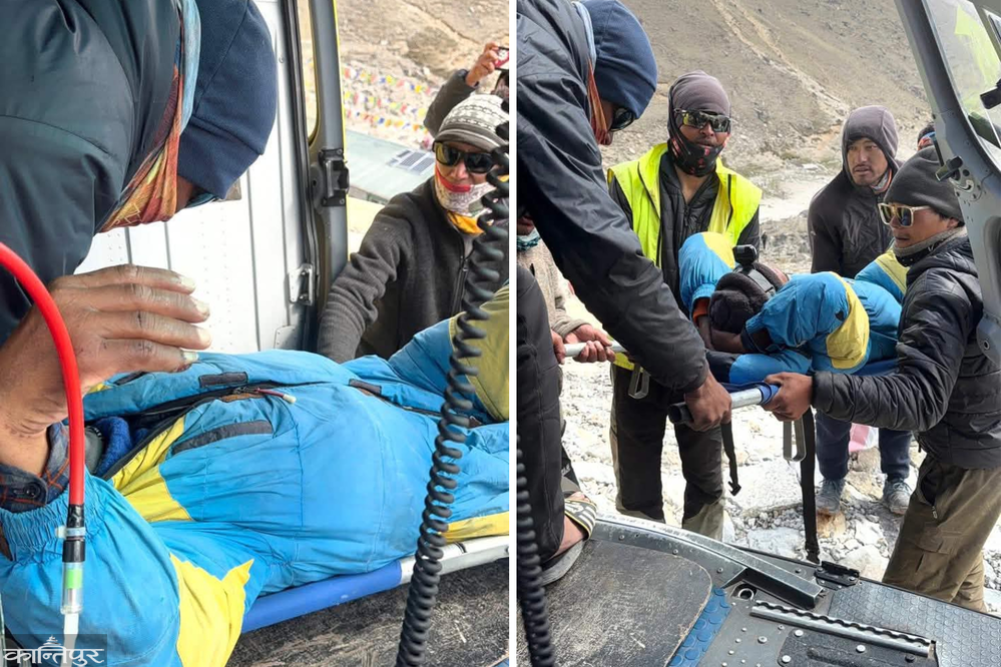
Despite the good news that Dawa was rescued alive, the incident has raised questions about serious negligence, managerial weaknesses, and possible unprofessional practices on the part of the company that operated the climbing expedition.
We use Google Cloud Translation Services. Google requires we provide the following disclaimer relating to use of this service:
This service may contain translations powered by Google. Google disclaims all warranties related to the translations, expressed or implied, including any warranties of accuracy, reliability, and any implied warranties of merchantability, fitness for a particular purpose, and noninfringement.
Nepali guide Dawa Sherpa (Hillary), who was missing in the Everest region, has been found alive after 6 days. Dawa, 57, from Okhaldhunga, went missing in the extremely dangerous ‘Death Zone’ area of Mount Everest on 15 Jestha. He was found crawling towards the base camp at a place called ‘Crampon Point’ near the Khumbu Icefall on the morning of the seventh day. Climbers have called the discovery of Dawa alive after being out of contact for such a long time a ‘miracle’.
According to mountaineer Tshering Jangmu Sherpa, it is considered extremely rare to survive in the Himalayan region for such a long time in extreme cold, lack of oxygen, without food, water and shelter. ‘This incident is extremely rare for the Himalayan region,’ said Sherpa, the operator of Everest Sherpa Expedition Company and an internationally recognized guide. ‘This is also a unique incident for mountaineers and doctors in the Himalayan region.’
A helicopter was deployed from Kathmandu on Wednesday to search for Dawa. Captain Vivek Khadka, who is known for search and rescue in the Himalayan region, was deployed along with two assistants to search for Dawa. ‘We searched from the sky for about 25 minutes from the Everest base camp to the side of the third camp at an altitude of 7,300 meters, but we did not find him,’ Captain Khadka of Altitude Air told Kantipur.
The news that Dawa was found near the Everest base camp on Thursday morning was reported to Dawa’s friend Pasang Dawa Sherpa by the staff of the Everest Pollution Control Committee who were cleaning there. Pasang is his old friend. Pasang, a resident of Okhaldhunga, had also launched a search operation for Dawa. Pasang said that after receiving the news of Dawa's discovery, he spread the information everywhere.
Immediately after receiving the news of Dawa's discovery, Captain Khadka, along with ATK's Lakpa Sherpa, who was in Lukla, made a chartered flight from Lukla to Gorekshep at the request of ATK. Dawa was carried to Gorekshep until the helicopter reached. From there, Captain Khadka put him in a helicopter and brought him to the Lukla mountain pass. After resting and feeding him for some time, he was taken to HAM's Hospital in Kathmandu's Ring Road by helicopter. After that, Khadka returned to Lukla. The last helicopter charter flight to search for Dawa was conducted by ATK Expeditions in Thamel, said Lakpa Sherpa, the company's operator.
Along with the good news that Dawa was rescued alive, this incident has raised questions about serious negligence, managerial weaknesses and possible unprofessional practices on the part of the company operating the climbing expedition, said an official of the Mountaineering Operators Association of Nepal. The climb was organized by Himalaya Traverse Adventure Pvt. Ltd., based in Budhanilkantha, through ATK Expeditions in Thamel. The Everest climbing team that went through Himalaya Traverse consisted of five people, including British national Chris Thrall and Polish national Marus Simleski. Marus, who returned after approaching the peak, has accused Himalaya Traverse of serious negligence in management.
Marus, who is undergoing treatment at Hams Hospital after suffering frostbite on both his fingers, alleged that the expedition was conducted in a disorganized, dangerous and unprofessional manner. He told Kantipur, “I have serious doubts about the company organizing this expedition. Everything, including the summit attempt, was slow and disorganized.” Marus said that more “disorder and spur-of-the-moment decisions” were made in this expedition than professional preparations. According to him, the camps for the climb were set up only at the last minute. He also said that communication facilities were almost non-existent and food supply was very poor.
Marus complains that even after a difficult 15-hour journey from the base camp to Camp-2, they were not given food and water until the next day. He said that the support team could not even operate the cooking stove. Marus had returned from 8,450 meters after failing to summit on 14 Jestha. Marus said that another member of the climbing team, British citizen Chris Thrall, had successfully climbed Everest and returned to Camp-4 with the other team.
According to Marus, on 15 Jestha, when the weather was very bad, only about 20 units were left in the oxygen cylinders he had, which would last only for 30 minutes. He complained that even though he had purchased 7 cylinders, he did not get enough oxygen cylinders due to poor management. According to him, a Sherpa had promised to give him spare oxygen when he descended. But he later accused him of taking oxygen for himself.
According to Marus, British climbers Chris Thrall and Dawa were separated from Camp 4. Marus said that they had to travel without oxygen at an altitude of 7,500 to 7,600 meters. Marus said that he met Thrall on the way. Thrall said that he had separated from Dawa and asked him to come down, saying that his condition was fine. Both the climbers had descended through thick snow in the middle of the night, crossing the Khumbu Icefall. They said that they had to travel using the same headlight and sharing oxygen for a short time.
According to the Polish climber, although Dawa had a walkie-talkie and a satellite phone, contact was lost after the fourth camp. Marus also alleges that the company managing the climb did not immediately launch a search operation. “There was no search operation for Dawa. No Sherpas were sent. I was asked not to talk to anyone and not to say anything to the media,” he said.
After a long period of no contact, Thrall posted an emotional message on Instagram, calling Dawa a 'true warrior of the mountains'. Marus also posted a tribute status on Tuesday, considering Dawa dead. According to Marus, Dawa Sherpa, the head of Himalayan Traverse, had said before leaving Kathmandu that only experienced Sherpas would be used in the climb. However, Dawa (Hillary), who had no experience in climbing Everest, was sent as a guide.
Dawa (Hillary) herself later admitted in a conversation with Marus that she had never climbed Everest. Her daughter Mendo Sherpa also told Kantipur that her father had not 'climbed' Everest so far and that she had been given the responsibility of cooking and other supporting work in the mountaineering team this time.
Dawa was initially only in the role of cook and manager at Camp-2. But due to a shortage of qualified manpower, she was sent to climb the peak. Marus has accused the company's manager, Dawa Sherpa (Kale), and his son, Angphurwa Sherpa, of 'only looking out for money' and 'playing with human lives'. According to him, the company representative who visited him at the hospital told him that the $1,500 deposit he had deposited would not be refunded, saying that it was spent on the rescue. The police climber has demanded a thorough investigation into the incident.
Dawa is receiving treatment in the ICU. His brother-in-law, Nima Ngati Sherpa, said that Dawa is speaking well and his health condition is normal. 'I spoke to him for 3-4 minutes. He is fine. Some of his fingers have been eaten by the snow.' Dawa told his family that he was separated from the group at Camp 4. 'Father got left behind at Camp 4,' Mendo said.
Dawa has told his family about eating food left by climbers at Camp 3, getting stuck in a snow pit, and finding it difficult to find the way because the ladders and ropes hanging on the climbing route were pulled. He has not been able to comment as doctors have not allowed him to speak due to health reasons. Himalaya Traverse chief Dawa Sherpa and another operator Angpurwa Sherpa refused to comment on the incident.
After the incident came to light, a serious debate has started about the regulation, license checks and safety standards of mountaineering companies. Director General of the Department of Tourism Ramkrishna Lamichhane said that a detailed investigation into the incident has been launched and that the climbing team's liaison officer Madhusudan Pudasaini was questioned on Thursday. "We will conduct a detailed investigation into this incident. If found guilty, strict action will be taken against the company involved according to the law," said Director General Lamichhane.
Climbing on Everest is suspended after May 29 every spring. This time, the climbing team, including Dawa, climbed Mount Everest almost towards the end. The climbers are also demanding an investigation into the role of the Temporary Liaison Office, the Everest Pollution Control Committee, the Mountaineering Operators Association, and others in the rope and ladder pulling work on the path below Camp 4 while they were on top.