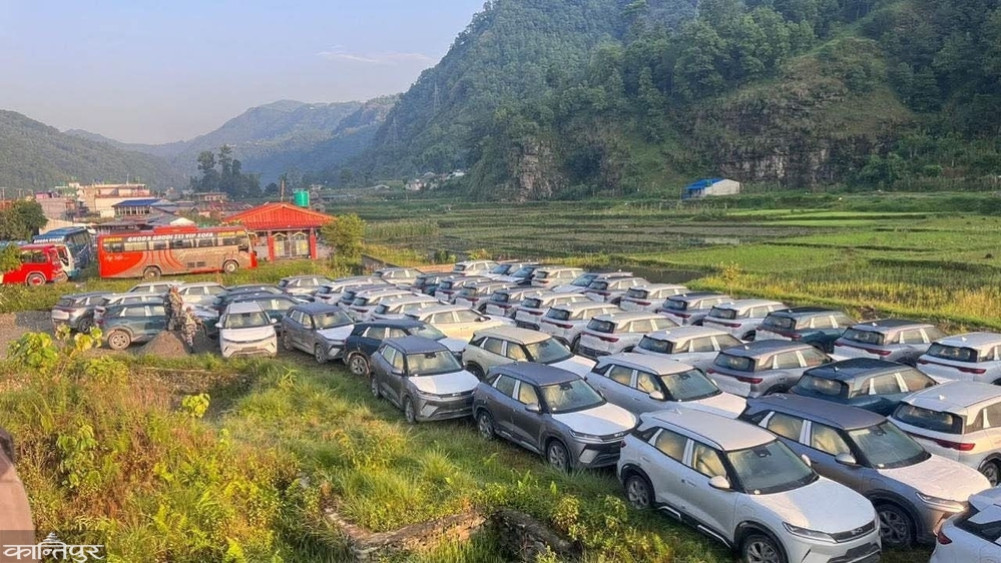
Mustang Customs Chief says, ”I have cleared the inspection as per the rules, I don't think there are any issues.”
We use Google Cloud Translation Services. Google requires we provide the following disclaimer relating to use of this service:
This service may contain translations powered by Google. Google disclaims all warranties related to the translations, expressed or implied, including any warranties of accuracy, reliability, and any implied warranties of merchantability, fitness for a particular purpose, and noninfringement.
The issue of revised tax rates on electric vehicles (EVs) and vehicles that were inspected by customs at the beginning of the budget has also been in controversy this time.
The Armed Police Force (APF) has seized 776 electric vehicles that were inspected by customs at Korala and Rasuwagadhi checkpoints on suspicion that information regarding the revised tax rates was leaked before the budget statement for the fiscal year 2083/84 was made public. The vehicles were seized from Hemja in Kaski, Kusma in Parbat, Jomsom in Mustang, Korala and Rasuwa.
Armed Police Spokesperson DIG Bishnu Prasad Bhatta said that 774 vehicles that were inspected at Korala and 2 vehicles from Rasuwa were seized based on information that fake 'documents' were submitted while importing vehicles. "Based on information that vehicles were imported through document fraud, a circular was sent to units across the country, and accordingly, those vehicles were seized," he told Kantipur. "We will refer them to the relevant agency (Customs) for further investigation and investigation, and the investigation will be conducted from there."
Nepal The official distributor of BYD in Nepal, Cymex Inc., has stated that the import was made due to the fact that bookings have already been confirmed by customers and to address the growing demand for electric vehicles in Nepal. The majority of the seized vehicles are BYD. BYD's official dealer in Nepal, Cymex Inc., stated that the imports were made because bookings had already been confirmed by customers and to address the growing demand for electric vehicles in Nepal. "All these imports were carried out keeping in mind BYD's production schedule, transportation availability, regular business plans, and challenges related to transportation and transportation management. The entire import and customs process was carried out in accordance with the prevailing laws and regulatory provisions of Nepal," Cymex Inc. said in a statement.
Allegations that it has coordinated with government agencies to avoid tax changes or to take any unfair advantage are completely baseless, untrue and damaging to the company's reputation, Cymex Inc. has stated that all import-related activities have been planned and conducted based on regular business needs, inventory management, transportation schedules and prevailing laws.
Cymex Inc. has also stated that it will assist in the investigation or investigation. 'It is hereby informed that all necessary documents - import-related records, customs declaration details, shipping records, border entry-related, payment details and inspection approval documents are fully prepared to be provided to the concerned authorities,' the statement said.
According to the statement issued by the company, the seized vehicles were inspected by customs from 23 Baisakh to 13 Jestha. Finance Minister Swarnim Wagle had made the budget public on 15th Jestha. Vehicles started arriving from 9th/10th Jestha and 649 vehicles were inspected and cleared between 12th and 13th Jestha, said Bidur Chudal, chief of the Mustang Customs Office and customs officer. ‘Importers bring 50/60 drivers in buses at a time to take the vehicles, they have started moving the vehicles since 14th Jestha,’ he said, ‘They have taken some to Jomsom, some to Hemja, some to Kusma. Some vehicles are in the yard.’
Chudal said that some vehicles that have been inspected and cleared from Korala and some that are yet to be inspected have been taken into custody from the yard. ‘I have inspected only 649 vehicles. My understanding is that the vehicles that are yet to be inspected were taken into custody from the yard,’ he said, ‘I don’t think there are any other issues.’ He said that he himself had those vehicles inspected as per the rules.
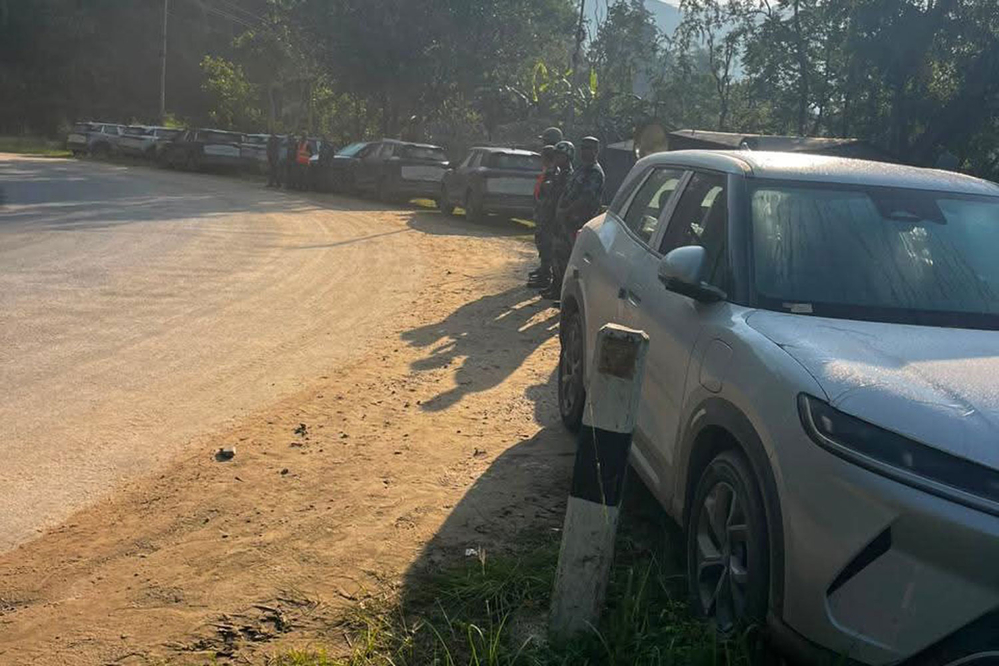
Before seizing the vehicles, the Customs Department on Wednesday removed six employees, including the head of the Rasuwa Customs Office, Tulasi Bhattarai, and sent other employees under the leadership of Rajendra Dhungana, Undersecretary of the Ministry of Finance. According to the Ministry of Finance, a committee coordinated by Customs Department Director Bhupal Raj Shakya, including representatives from the police and the Armed Police Force, has also been sent for monitoring and study. The seized vehicles have been placed under security guard by the Armed Police Force at the place where they were seized. The Prime Minister's Office had directed the Ministry of Finance on Wednesday to increase surveillance on electric vehicles and conduct necessary investigations.
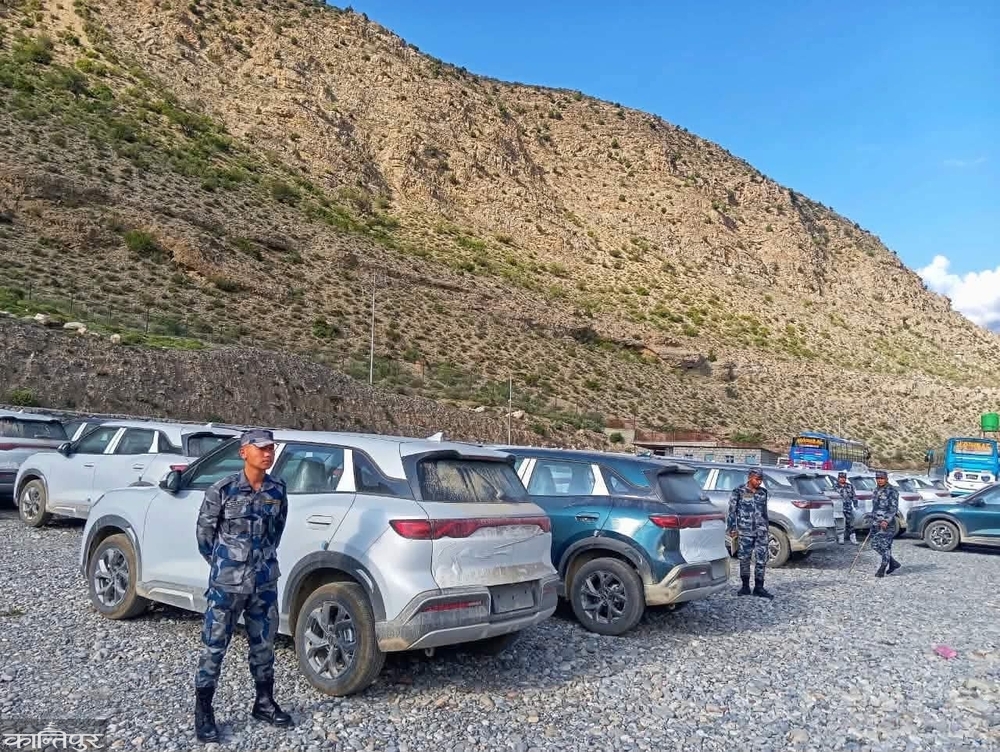
Ananda Kafle, spokesperson for the Ministry of Home Affairs, said that the Ministry of Finance is looking into the import of vehicles and related issues and that the vehicles were seized by security personnel as per the request from the Ministry of Finance to facilitate them. After seizing the vehicles, the Ministry of Finance held a meeting with customs, police and armed forces officials as soon as office hours began on Thursday. After that, an on-site monitoring and study committee was formed under the coordination of Customs Department Director Shakya.
Director General of the department Shyam Prasad Bhandari informed that the committee has been deployed in the field and further decisions will be taken based on the committee's report. It is not a new phenomenon for businessmen to increase or decrease vehicle imports due to the expectation of changes in tax rates before the budget. Businessmen had imported a large number of electric vehicles (EVs) on the expectation of a tax increase in the budget for the fiscal year 2082/83. Before the budget was made public from 15 Baisakh to 15 Jestha 2082, 1,050 EVs were inspected and kept at the Chobhar dry port. More than a thousand EVs were kept at the Tatopani checkpoint for inspection. But after the government kept the tax rates unchanged, the vehicles were stuck at the port for a long time.
Officials of the Customs Department say that in previous years, electric vehicles were imported in large numbers before the budget was made public. ‘If the government officials are raising the tax rate so that vehicles can be imported quickly, this is a serious crime,’ an official from the Customs Department told Kantipur. ‘But it has become a common practice to stock up on alcohol, cigarettes and vehicles with the expectation of a tax increase before the budget is made public. It is not uncommon for vehicle importers to import more vehicles before the tax increase. But the government can investigate this, and it must be established that this investigation is wrongly targeted. Otherwise, business people should not be harassed.’
Vehicle importers have objected to this. ‘If information is leaked, the Ministry of Finance is responsible, not the traders. What would have happened if it had decreased, the traders would have suffered losses. Imports can be made at the same price until the night of 14 Jestha,’ said an importer. ‘Is it a crime for us to import according to the rules?’
The budget for the upcoming fiscal year has changed the customs duty on electric vehicles (EVs) and other fees levied at the border. In the fiscal year 2082/83, EVs up to 50 kW had a 15 percent customs duty and 5 percent excise duty. EVs between 51 and 100 kW had a 20 percent customs duty and 15 percent excise duty. EVs between 101 and 200 kW had a 30 percent customs duty and 20 percent excise duty. EVs between 2010 and 300 kW had a 60 percent customs duty and 35 percent excise duty. Road construction fee and value added tax on all types of vehicles remained unchanged at 5 percent and 13 percent.
Through the budget for the upcoming fiscal year, the government has removed the excise duty on electric vehicles and imposed a Clean Infrastructure Investment Fee (CIIF). According to the Finance Bill 2083, customs duty has been fixed at 20 percent on all types of vehicles. Electric vehicles with a transaction value of up to Rs 2 million at the customs point will be charged a 2.5 percent clean infrastructure investment fee. Such vehicles will be charged a 20 percent customs duty.
A 20 percent clean infrastructure investment fee has been set for vehicles with a transaction value of Rs 2 million to 3 million. Other taxes, including customs duty, remain the same. Electric vehicles with a transaction value of Rs 3 million to Rs 4 million will be subject to only 35 percent clean infrastructure investment fee. Electric vehicles with a transaction value of Rs 4 million to Rs 5 million will be subject to 90 percent clean infrastructure investment fee. Electric vehicles with a transaction value of Rs 5 million or more will be subject to 130 percent clean infrastructure investment fee. All vehicles will be subject to customs duty of 20 percent, road construction fee of 2.5 to 5 percent, and VAT of 13 percent. However, Finance Minister Swarnim Wagle said that a 'small footnote' was missed and has now made the road construction fee of 2.5 percent for vehicles up to Rs 2 million.