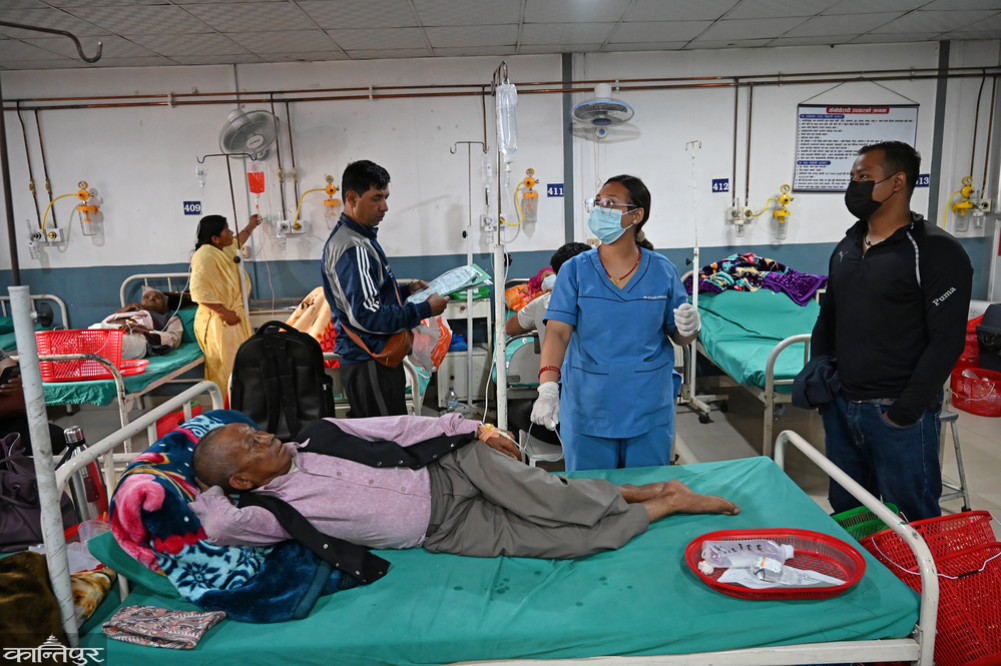
There is an acute shortage of platinum-based chemotherapy drugs, including carboplatin, cisplatin, and oxaliplatin, with suppliers saying they cannot bring in and sell the drugs at the prices set by the government 11 years ago.
We use Google Cloud Translation Services. Google requires we provide the following disclaimer relating to use of this service:
This service may contain translations powered by Google. Google disclaims all warranties related to the translations, expressed or implied, including any warranties of accuracy, reliability, and any implied warranties of merchantability, fitness for a particular purpose, and noninfringement.
The family of Mithu Kumari Sapkota, who is undergoing treatment for lung cancer at Patan Hospital, was asked by hospital doctors to bring carboplatin medicine last Tuesday. There is an acute shortage of this medicine required for chemotherapy in the market.
The family members gathered in search of carboplatin, which is used in the treatment of most cancers. ‘My brother-in-law and husband had to struggle a lot to get a dose of carboplatin,’ said Mithu Kumari’s daughter-in-law Shobha Devkota, ‘We had to persuade and beg a lot. Finally, a dose of the medicine was found in Kuleshwor.’
Like Mithu Kumari’s family, thousands of relatives of cancer patients have been struggling a lot to get a dose of chemotherapy medicine for the past three months. This medicine is not available in hospital pharmacies and private pharmacies. Due to the increase in the price of raw materials, drug manufacturers have reduced production and increased the price of the medicine. Family members of cancer patients encountered during the reporting said that they were forced to pay up to 15,000 rupees to buy 150 mg of carboplatin, which costs around 1,400 rupees. Despite such a high price, it is not easily available.
Anupa Thapa, head of the nursing department at Bharatpur Cancer Hospital, where more than a hundred patients arrive for chemotherapy every day, recounted the suffering faced by the families of the patients, “How many patients are leaving the hospital and running to India to buy medicine.” She said that some patients who need to complete a course of different medicines are using only the medicine that is available due to shortage of medicine. She said, “This practice does not make the treatment of the patient effective.” Thapa, head of the nursing department, says that the relatives of the patients are buying medicine from the black market. “The person who brings the medicine does not have the bill for it. This also shows how the medicine is being bought and sold,” she said.
In 2072, on the recommendation of the Department of Medicines, the government had fixed the price of 150 mg of carboplatin at 1,393 rupees and 87 paise. Similarly, the price of the same medicine for 450 mg was fixed at Rs 4,130.77. The price of Oxaliplatin 50 mg was Rs 4,35.8. The government has not adjusted the price since then. The government has not looked for any alternative to make the medicine easily available.
Drug suppliers are not ready to bring and sell the medicine at the old price fixed by the government. Cancer patients and their relatives are suffering the direct impact of this. Black marketing is flourishing in the market. Devkota, who was met at Patan Hospital, said that getting medicine is more important than the price in times of crisis. She added, "No matter how high the price, treatment has to be done." Such medicines that are not produced in Nepal are mainly imported from India and Bangladesh. According to Biplav Adhikari, President of the Nepal Pharmaceutical Manufacturers Association, Nepal does not have the expensive technology to produce such medicines, and since the selling price is lower than the production cost, manufacturers are not interested in producing such medicines within Nepal. He said, “This situation has arisen because of the government’s practice of fixing prices but not adjusting prices from time to time.”
When Kantipur reached Patan Hospital’s Cancer Day Care on Tuesday, 45 cancer patients were waiting for chemotherapy. Some of them had their relatives pay a high price to get the medicine after much hassle and hassle. Some were waiting for their relatives at the hospital in the hope of getting the medicine.
Five cancer specialists who spoke to Kantipur there said that platinum-based chemotherapy drugs like carboplatin, cisplatin and oxaliplatin, which are used to treat various types of cancer, are not available in the hospital and this is causing suffering to patients. Drugs like carboplatin, cisplatin and oxaliplatin are used to treat most cancers including ovarian, lung, head, neck and breast cancer.
According to doctors, such drugs are neither available in the hospital pharmacy nor are they being sold by private pharmacies. The relatives of the patients said that they are bringing the medicine from different places at high prices. Some of the relatives of the patients said that they brought the medicine from Sundhara, Tripureshwor, Teku, Kuleshwor, Mahabouddha, which are suppliers of chemotherapy drugs, while others said that they brought it from the warehouses of companies that import and sell medicines from India.
Some said that they brought it from relatives and acquaintances who came from India. Executive Director of Bhaktapur Cancer Hospital Dr. Ujjwal Chalise said that patients are being forced to rely on the black market for chemotherapy medicines. He said, "Our pharmacy does not have the medicine. Suppliers have not brought it because they cannot bring it at the government price. Due to this shortage, the black market has flourished. The relatives of the patients are not getting the medicine easily."
More than 60 cancer patients visit this hospital every day for chemotherapy. According to hospital administration officials, the company that has been contracted to bring the medicine has said that it cannot bring the medicine due to the increase in price. It has stopped the supply of medicine for three months.
According to Chalise, the ongoing tensions in West Asia and the rise in the value of the dollar have led to a sharp increase in the price of raw materials for medicines. Some companies have reduced their production of medicines, while those who do produce them are not selling them at the old rate. ‘Businessmen are not ready to sell them at the old government price, which is directly affecting patients. Black marketing of medicines is taking place,’ he said.
According to Umesh Nepal, executive director of Bharatpur Cancer Hospital in Chitwan, patients have paid high prices as they are forced to rely on the black market. On the other hand, they are not getting quality medicines. He said that although such medicines should be stored at a certain temperature, the storage standards of medicines purchased from the black market do not seem to be met. This has reduced the quality of the medicines. He said, ‘A relative of a patient had bought medicines with a broken seal.’
The Bharatpur Cancer Hospital had written to the World Health Organization office in Nepal 10 days ago to address the acute shortage of medicines. However, the hospital stated that it has not received any response from there. Due to the black market, some patients' relatives are forced to buy more or less medicine than required. 'When 150 ml of medicine is needed, the relatives of the patients are bringing 450 ml of medicine. The excess medicine is being wasted,' said a doctor at Patan Hospital.
Sandhya Chapagain, a senior cancer specialist at Bir Hospital, said that no matter which cancer specialist she asks, the story of pain related to cancer patients is the same. 'Even young patients who have a chance of complete recovery after treatment are struggling without getting medicine,' she said. She said that the patients and the relatives of the patients are forced to struggle without getting medicine. She also said that she is putting the relatives of many patients in touch with drug suppliers who know them.
Krishnamurari Karki, executive director of Yetikem, an organization that supplies medicines and surgical supplies, said that relatives of cancer patients are now calling her every day and visiting her office in anticipation of medicine. Yetikem is one of the companies that import cancer-related medicines in Nepal. “My company has not imported chemotherapy drugs for three months. The manufacturing companies have told us that they cannot provide us with the drugs at the old price. Every day, half a dozen people come to ask whether the drugs are available and our answer is no,” he said.
According to the Department of Drug Management, the Ministry of Health and Food Hygiene is in discussions with suppliers to facilitate the supply of cancer drugs. “I have received news that the ministry is in discussions with the businessmen supplying the drugs,” said Shivani Khadgi, acting director general of the department. “We expect the ministry to call us soon and decide on the price limit. We are trying to address this drug crisis as soon as possible.”
According to the department, the decision on price adjustment should be made by a meeting of the Council of Ministers. The decision should be published in the Gazette for implementation. Before this, the ministry should take a proposal for price adjustment to the Council of Ministers. There is no exact data on cancer patients in Nepal. However, according to the ‘Global Cancer Observatory’, more than 22,000 cancer patients are added in Nepal every year. Similarly, 14,000 people die every year. It is estimated that 60 percent of cancer patients undergo chemotherapy.