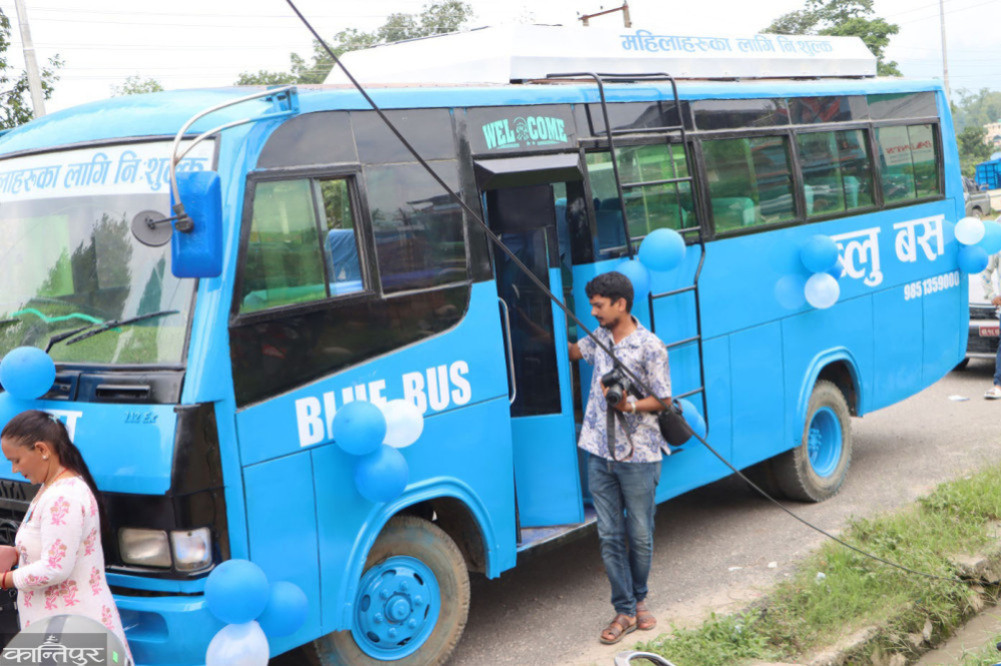
Stakeholders have stated that studies are underway regarding the responsibilities, routes, cost management, passenger numbers, and operating procedures for the 'Blue Bus' operation.
We use Google Cloud Translation Services. Google requires we provide the following disclaimer relating to use of this service:
This service may contain translations powered by Google. Google disclaims all warranties related to the translations, expressed or implied, including any warranties of accuracy, reliability, and any implied warranties of merchantability, fitness for a particular purpose, and noninfringement.
The government has started preparations to operate the 'Blue Bus' service targeting women. The Department of Transport Management and Sajha Yatayat are doing their homework to develop a procedure for operating the service, which was announced through the budget for the fiscal year 2083/084. Stakeholders have said that a study is being conducted on the responsibility, route, cost management, number of passengers and operating procedure for the service.
The 'Blue Bus' service was included in the 100 agenda for governance reforms made public by the government on 13 Chaitra 2082. According to the same agenda, the target was to operate at least 25 buses within 100 days in the first phase. Presenting the budget for the upcoming fiscal year, the Finance Minister announced that a 'Blue Bus' service with a CC camera will be operated for women. The government has said that a budget has been allocated for that.
Ramhari Pokharel, spokesperson for the Ministry of Physical Infrastructure and Transport, said that the government has allocated a budget for the operation of the 'Blue Bus' and preparations have begun. He said, ‘Homework is being done between the Department of Transport Management and Sajha Yatayat on the procedure to be followed, how to operate it and who will operate it.’
Ganeshman Singh Rai, Information Officer of the Department of Transport Management, said that various aspects of the ‘Blue Bus’ service are being studied. According to him, studies are being done on the operating costs, possible routes, number of passengers, management process and the body operating the service. He said, ‘The department has been given the responsibility of coordinating the operation of the Blue Bus.’ But the department does not have its own vehicles. Therefore, the homework of collaborating with Sajha Yatayat for its operation has been accelerated.’ He said that although it was mentioned in the government’s 100-day agenda, it could not be brought into operation immediately and that it took time because a study had to be done for that. He informed that discussions are being held with the government transport as it was not possible to collaborate with the private sector immediately due to the announcement of providing free services for women.
He said that a preliminary proposal has been sent to Sajha Yatayat and based on that, the organization is preparing a preliminary draft of the working procedure. He said that since the responsibility for determining the transport routes lies with the provinces according to the constitution, coordination is also being done with Bagmati Province for this.
Bhupendra Aryal, Chief Executive Officer of Sajha Yatayat, says that a preliminary draft regarding the operation of the service has been prepared. He said that ensuring its continuity and effectiveness is more important than operating the bus service. He says, ‘Operating the bus is not a big deal, but how to sustain it after operation is important.’ For this, discussions are being held on the number of passengers, route requirements, operating expenses and budget management.’ He argues that if the service is to be provided free to women, the source of the operating expenses should be clear.
He said that a budget is required as fuel, drivers, co-drivers, maintenance and administrative expenses are required to operate the bus. He said that there is a need for expenditure management and specific procedures to determine through which body the budget allocated by the government will come and how it will be spent. He said that various practical problems may arise during the implementation of the system allowing only women to board. Stating that they may be traveling with members of the same family, he said, ‘Husband and wife will come together, how will they travel in a bus that allows only wives? Even if the government announces it, practical challenges are visible.’ He said that even if the bus is operational, not all women will be able to use the service and women from all areas will not be able to be served. He informed that the government is preparing to operate it on a trial basis in Kathmandu rather than starting it in all provinces immediately. He said, ‘There is a plan to provide the service as per the government’s announcement, but after operating it as a pilot project for some time and evaluating its effectiveness, further plans will be made.’
The concept of the ‘Blue Bus’ targeting women was first put forward by the President of the National Independent Party, Ravi Lamichhane. The service was launched in 2080, on the occasion of 100 days since he was elected as a member of the House of Representatives from Chitwan-2. The service, which was operated in Bharatpur and Narayangadh areas via Kalika Municipality, was free for women. The service was operated using blue buses, and was named 'Blue Bus'. The bus in which Lamichhane himself boarded the bus and inaugurated the service also stopped after about a month and a half. At that time, problems related to the number of passengers, operating costs and management were seen in the operation of the service. After the service was stopped, questions were raised about its effectiveness. The Rashtriya Swayamsevak Sangh (RSS), which currently has a two-thirds majority in the government, has taken it forward as a government plan.
The government's impractical plan: Sitaula
Saroj Sitaula, president of the National Federation of Transport Entrepreneurs, said that the plan put forward by the government was not practical. He says that there is a practical difficulty in providing a separate bus service to the target group. He said, ‘Blue bus for women, white for senior citizens, yellow for children, every person needs one! Has it become very popular?’ According to him, although attempts have been made to operate women-only vehicles in the Kathmandu Valley in the past, he says that it was not long-term. About 5 years ago, a vehicle that allowed only women to ride was operated in Kathmandu from Kalanki to Kandaghari. However, he said that the bus had to be stopped when women did not come, women did not reach the same route, and it was difficult to raise the operating costs of vehicles that only carried women, so it had to be closed.
Women's rights activist Sarita Tiwari said that the first 'Blue Bus' service targeted at women was operated in the Kalika area of eastern Chitwan, which is a settlement near the forest, with the aim of making it easier for women there to travel to Bharatpur, but it has not achieved the expected success in practice.
She said, ‘Women are not the only ones who can leave the house, they also have husbands, brothers or other family members. Although it looks good from the perspective of positive discrimination, this concept has not been successful in practice.’ She said that as the current society is moving towards inclusive practices, coexistence, equal opportunities and respectful behavior between women and men should be developed.
Stating that women still face various discomforts and insecurities in public transport, she said that the solution lies in making the entire public transport system women-friendly and respectful rather than operating separate buses. She said, ‘It is necessary to create an environment where women can travel safely and respectfully. The concept of operating separate buses does not seem practical and I do not believe that it can be sustainable in the long term.’