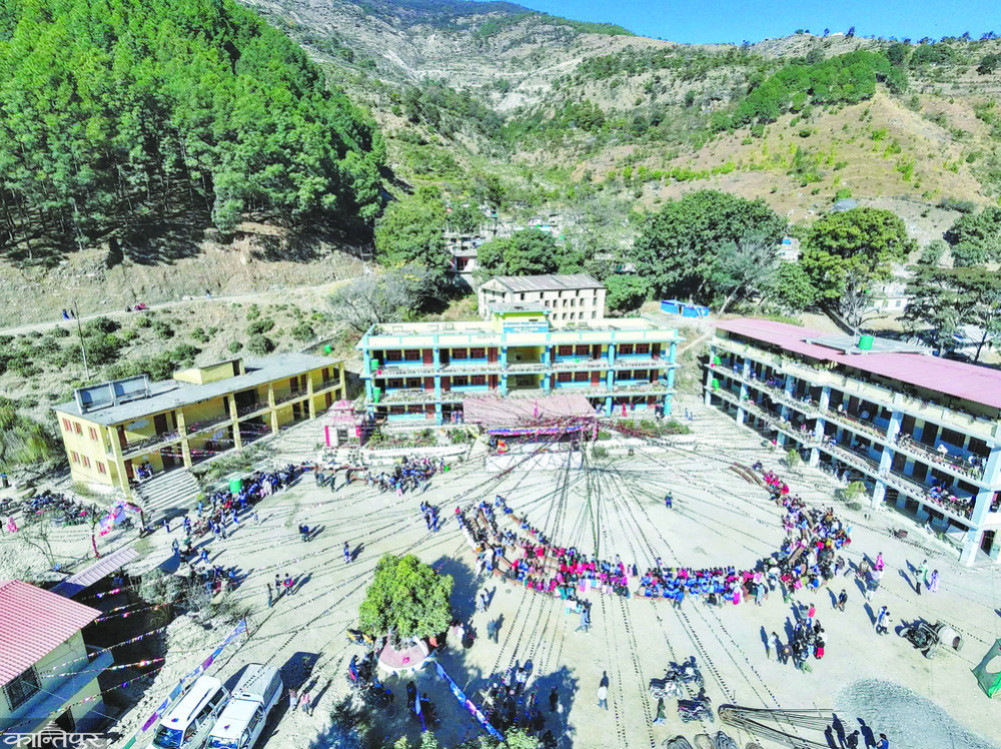
According to the Economic Survey 2082/83, 62 percent of students study in community schools and 38 percent in private schools. A decade ago, the figure was 80 percent in community schools and 20 percent in private schools.
We use Google Cloud Translation Services. Google requires we provide the following disclaimer relating to use of this service:
This service may contain translations powered by Google. Google disclaims all warranties related to the translations, expressed or implied, including any warranties of accuracy, reliability, and any implied warranties of merchantability, fitness for a particular purpose, and noninfringement.
The number of community schools across the country is decreasing and the number of private schools is increasing. In the last five years, the number of students studying in community schools has also contracted, while the number of students studying in private schools has increased.
According to the Economic Survey 2082/83, there are 35,951 schools across the country. Of these, 25,623 are community schools, 8,941 are private schools, and 1,387 are traditional/religious schools. In 2077, there were 27,813 (78 percent) community schools, 7,221 (19 percent) private schools, and 3 percent are religious schools.
In 2082, the number of community schools has shrunk to 71 percent. Private and religious schools have expanded to 25 and 4 percent, respectively. “The share of private schools is increasing. The number has decreased due to the merger of community schools,” said the Economic Survey report released by the government on Wednesday.
For a decade, the government has been adopting a policy of integrating community schools with small student populations, and the number of community schools has been gradually decreasing and the number of private schools has been increasing. Stakeholders and educationists have been expressing concern, saying that this has promoted privatization in school education.
There are statistics that as the number of schools decreases, students studying in community schools are decreasing and those studying in private schools are increasing. There are 700,000 children studying in grades 1-12. Of these, 4,383,655 (62 percent) study in community schools and 2,657,170 (38 percent) in private schools. A decade ago, there were approximately 80 percent students in community schools and 20 percent in private schools.
Professor Peshal Khanal of the Central Department of Education at Tribhuvan University says that due to the government's own policy, community schools are weakening and the private school sector is becoming stronger. 'Many basic level schools are closing. The government's policy is to close schools with small student populations. "The municipalities have launched a school adjustment campaign," he said, "This is leading to further inequality in access and quality of education." Khanal said that small schools have been closed due to the decrease in population growth and migration from the hilly areas. "The concept of developing large schools based on the number of students in the city has been put forward. This may lead to the closure of many more small schools," he said, "This has not been able to conduct research on the inequality in access and quality of education." Professor Dahal said that the closure of community schools will give the private sector a boost.
Although the number of community schools has decreased, the number of Early Childhood Development Centers (ECD) has increased. In 2081, there were 41,284 centers across the country, but in 2082, their number increased to 42,619. 1,335 centers have been added in one year. Of these, 81 percent are community-based child development centers and 19 percent are private child development centers. The Economic Survey states that 1,220,538 children are studying in these centers.
Despite the increase in the number of child development centers, the number of students is decreasing. In the academic session 2081, 1,311,428 children were enrolled in child development centers. The number of students studying in ECD is 80,890 fewer than the previous year. 77.5 percent of children are enrolled in grade 1 with ECD class experience. The percentage of students enrolled in grade 1 with ECD experience is increasing every year. Five years ago, in 2078, the number of students enrolled in grade 1 with ECD experience was 75 percent. The Economic Survey states that 55 percent of girls and 45 percent of boys are enrolled in ECD.
Number of students enrolling in higher education increases
The number of students studying higher education is gradually increasing. According to the Economic Survey, the number of students enrolling in higher education has increased by 10.9 percent in 2081/82 compared to the fiscal year 2080/81. In the academic session 2081, 672,489 students were enrolled in higher education, while 745,770 were enrolled in 2082. It has been found that 50.5 percent of the students enrolled in higher education choose subjects under the faculty of management. In the technical stream, 20 percent are enrolled in the technical stream including medical, medicine, science and technology, agriculture, and 80 percent are enrolled in the general stream including management, education, and humanities. Although the government has emphasized education in the technical stream, the attraction of students towards it has not increased.
According to the Economic Survey, there are 21 (15 central and 6 provincial) universities and 8 (6 federal and 2 provincial) health science institutes for higher education across the country. In recent years, 6 provincial universities and 2 provincial health science institutes have been added. Despite the addition of universities and institutes, 75.3 percent of students are studying at Tribhuvan University.
Improvement in health indicators
In the last five years, the number of 1,755 government health institutions has been added across the country. The Economic Survey 2082/83 states that there were 8,976 government health institutions across the country in 2082. In the Economic Survey 2077, the number was 7,221. Only 230 government health institutions have been added from Falgun 2081 to Falgun 2082. There are 420 hospitals, 181 primary health centers, 3,603 health posts, 426 Ayurvedic dispensaries and 4,346 other health institutions across the country. In 2077, there were 125 hospitals, 205 primary health centers, 3,870 health posts, 395 Ayurvedic dispensaries and 2,626 sub-health posts.
The number of government health institutions has been expanded in accordance with the government's policy of providing hospitals to all local levels and one health institution in each ward. The Economic Survey states that as per the policy of constructing 5/10/15-bed basic hospitals at the local level as per the requirement, 121 have been completed and 313 are under construction.
The Economic Survey has shown improvement in health indicators including maternal mortality. ‘There has been a significant improvement in maternal mortality. Neonatal mortality, infant mortality and under-5 child mortality have decreased. The proportion of pregnant women delivering in health facilities has increased,’ the survey said. The number of fully vaccinated children has also increased, the survey said.
The maternal mortality rate (per lakh live births) was 539 before 2000 and is now 151. Neonatal mortality rate has decreased from 33 per thousand live births in 2011 to 17. The fully vaccinated children have reached 92 percent.
90 percent of pregnant women deliver in health facilities. In 2011, only 35 percent of women received maternity services in health facilities. The number of pregnant women who have had at least four antenatal check-ups has increased from 50 percent in 2011 to 88 percent now, the survey said. ‘Infant mortality rate has decreased from 46 (per thousand live births) in 2011 to 27 in 2025. Similarly, the under-5 child mortality rate has decreased from 54 to 31 (per thousand live births) in 2025, the Economic Survey states.