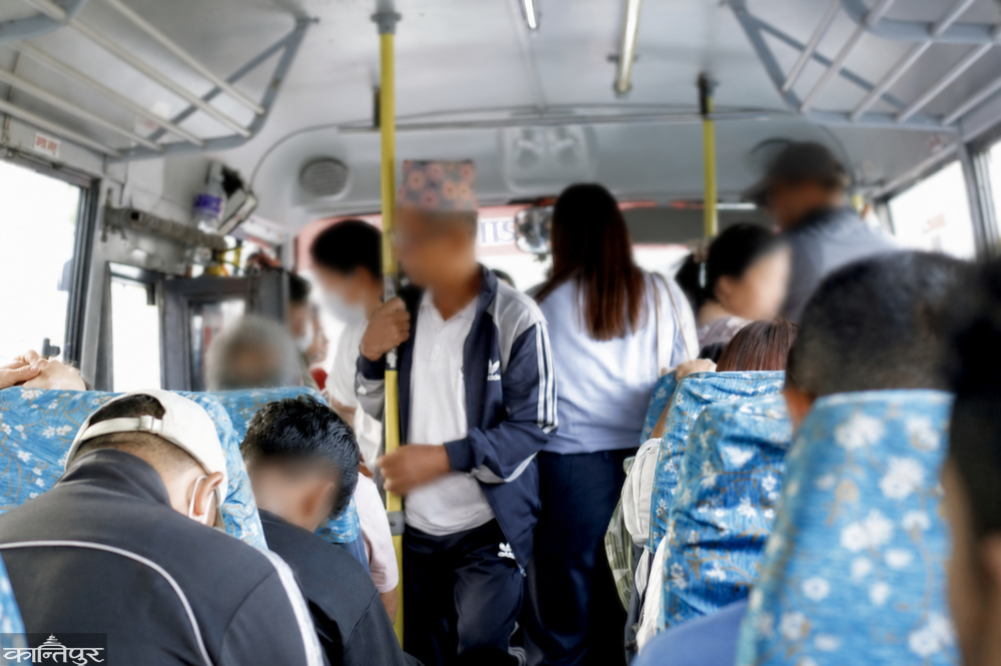
Women are frequently subjected to harassment on public transport, but due to social silence, legal complications, and 'victim blaming', most cases go unreported.
We use Google Cloud Translation Services. Google requires we provide the following disclaimer relating to use of this service:
This service may contain translations powered by Google. Google disclaims all warranties related to the translations, expressed or implied, including any warranties of accuracy, reliability, and any implied warranties of merchantability, fitness for a particular purpose, and noninfringement.
A young woman recently shared a video of being abused on public transport. The video went viral on social media.
She said she was abused while returning from college. “I feel like cutting my chest,” she said in the video after the abuse. She said a man sitting next to her had put his hand on her body and kissed her.
She didn’t notice it at first. But when she found out later and tried to warn the man, he behaved badly. There were many passengers on the microbus, but they just kept listening to her say she was mistreated.
Many women who ride public transport say they are abused. Chandakumari Chaudhary is blind from birth. She has been living in Kathmandu for 5 years. Chanda says that she has stopped riding public transport alone due to the pain she experienced on public transport a year ago. ‘I still feel scared when I remember that incident. Since that day, I have never taken a microbus without a friend,’ she said.
She tells about the abuse, ‘I was riding the microbus alone. I was in the disabled seat. Even if we don’t see each other, we can feel how people touch us. One man was laughing at me saying that he was also disabled,’ she said, ‘I took it for granted.’ Later, when he touched and held my hand, I felt bad and slapped him twice.’
Chanda told other passengers about the abuse she had suffered. Then the person was thrown out of the microbus. 'Suddenly, he touched her with bad intentions. Later, he was scared and didn't know what to do,' she said. Chanda, who makes a living selling incense sticks, now doesn't walk without a friend.
Even if she experiences abuse on public transport, many people hesitate to file a complaint because they think they will get into legal trouble. It was a few months ago. Parvati Saud, who was on a microbus going from Baneshwor to Bhaktapur, was sitting in the seat. A man came and sat next to her.
Saud was sitting using her mobile phone. The man kept staring at her. She ignored him for a while. 'At first, I thought that was how I felt and didn't care.' But later I saw him laughing and gesturing at me,' she said, 'Then he started hitting me with his elbow. I got angry. I scolded him, 'What did you do, brother?' After some time, he fell down somewhere.' She only later realized that she should have filed a complaint with the police.
These are just representative incidents that women have been facing on public transport. The police had launched a safety pin campaign on public transport to prevent mistreatment of women. According to police data, in the fiscal year 2082/83, 1,673 people were arrested on charges of various types of mistreatment on public transport in the Kathmandu Valley. Of these, 4 were arrested for physical and sexual abuse, and 3 were arrested for indecent acts. Of them, 72 were prosecuted, while 1,611 were reprimanded and handed over to relatives.
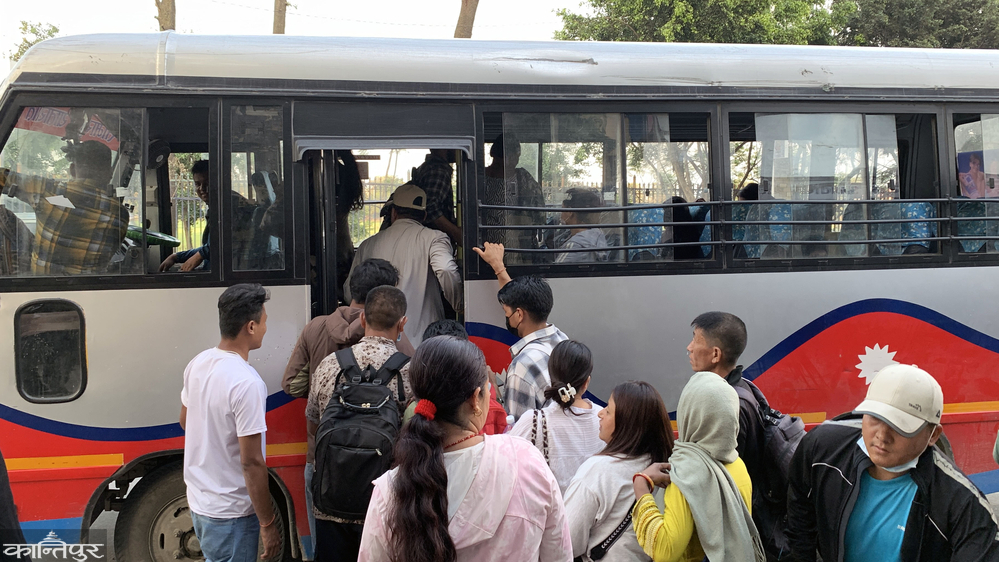
According to the statistics of the Nepal Police for the fiscal year 2081/82, 4,133 people were arrested on charges of misbehavior in the Kathmandu Valley. 43 people were arrested for indecent acts, 32 for using obscene language and obscene abuse on public transport, and 16 for physical sexual abuse. Of these, 199 were prosecuted, while 3,943 were released to their families after understanding.
SP Pravin Dhital, spokesperson for the Kathmandu Valley Police Office, says that incidents of misbehavior on public transport are still happening. “Now, if we talk about the number, it has decreased, but misbehavior on public transport is still happening,” said SP Dhital.
He said that women are more victims on public transport than men. He says that others should also try to stop them after seeing them being abused. SP Dhital says that the civil level should play a special role to prevent such abuse.
‘The biggest problem is that society tends to remain silent even when it sees something wrong.’ Even when the victim asks for help when she is abused on a bus or in a public place, other people do not help,’ he said. ‘Since the woman is the one who is being shown the wrong, it seems that she is afraid to openly express her problem and report it.’
He says that CCTV cameras are being installed in public transport to reduce incidents of abuse and that it will be a great relief. Dhital says that the Nepal Police is currently making various public awareness and reporting systems effective to reduce incidents of abuse in public places. ‘Nowadays, many complaints are coming online,’ he said. ‘Since they come with video, audio or photo evidence related to the incident, it has also become easier for the police to investigate and take action.’
However, stakeholders say that the complaints that reach the police alone cannot be considered the official number of cases of abuse. They say that only a small number of incidents are reported in the Kathmandu Valley.
Sociologist Samjhana Wagle Bhattarai says that incidents of abuse against women are increasing due to overcrowding in public transport, lack of social awareness and the tendency to take ‘harassment’ as a normal thing. ‘Since there are a lot of people in public transport, some people take advantage of it,’ she said. ‘Where no one notices the victim and the mentality of ignoring it has further increased the abuse.’
Psychiatrist Richa Amatya says that sexual violence and harassment in public transport and other public places can have a psychological impact on the victim. ‘Some victims may experience fear, stress, self-blame, and discomfort in social life due to abuse in public places,’ she said. ‘After such incidents, some are unable to respond immediately. Only later do they come to understand the incident and feel its impact.’ Richa says that ‘victim blaming’ in society creates additional mental pressure. ‘This creates a situation where many people are unable to speak out about the incident, and remain silent due to shame and fear,’ she said. ‘In some cases, they may be afraid to use public transport, and the memory of old incidents may repeatedly cause mental stress.’ Advocate Ishwori Poudel says that special laws are needed against direct or indirect violence not only in public transport but also in public areas.’
‘There is no specific legal provision regarding abuse of women in public transport,’ she said. ‘Article 38 (3) of the Constitution of Nepal 2072 BS states that women shall not be subjected to physical or mental violence or exploitation on any basis.’
Sub-sections 1 and 2 of Section 224 of the Criminal Code-2074 BS mention that sexual abuse should not be committed.’ Although there is a provision for imprisonment of up to 3 years and a fine of up to 30,000 for such an offense, advocate Poudel says that due to the lack of a specific law, the victim has not been able to get justice and the perpetrator has not been punished. ‘If the aspect of law-making is on the one hand, not carrying more passengers than the seating capacity in public transport and installing CCTV cameras in all public transport can reduce abuse,’ she said.