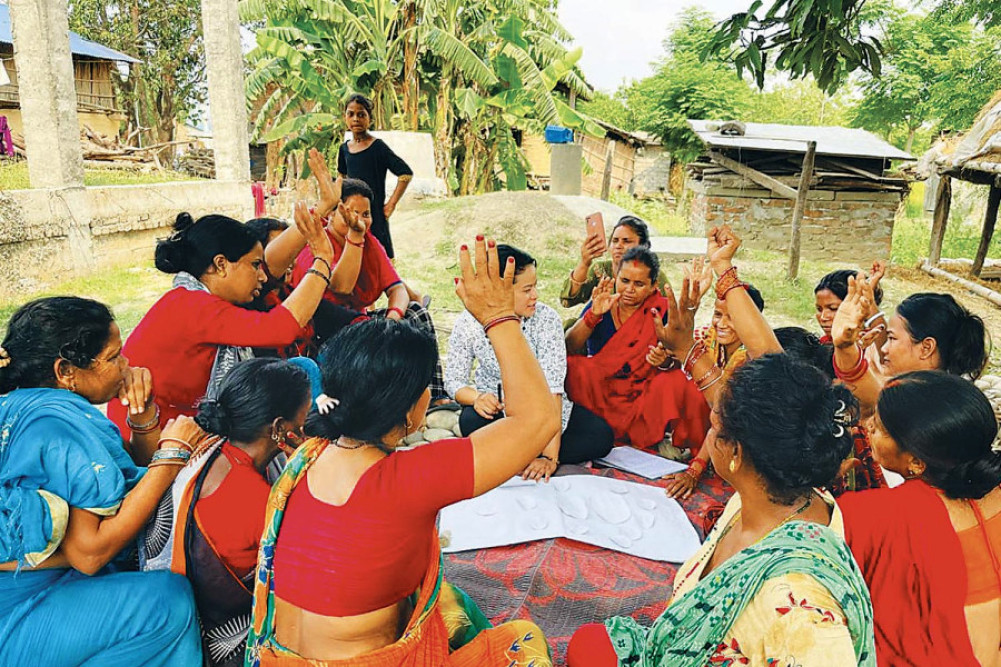
Due to the failure to spend the so-called gender-responsive budget, the problems of Dalit and indigenous women remain as they are, and they are still waiting for real support.
We use Google Cloud Translation Services. Google requires we provide the following disclaimer relating to use of this service:
This service may contain translations powered by Google. Google disclaims all warranties related to the translations, expressed or implied, including any warranties of accuracy, reliability, and any implied warranties of merchantability, fitness for a particular purpose, and noninfringement.
Dilkumari BK, a resident of Madi Municipality-3 in Chitwan, had seen many men from her community go abroad for foreign employment. That is why she felt that the Dalit women of Gulmeli Tole should do something for themselves.
Initially, she was a member of the women's group 'Sunaulo Mahila Samoor' in that area. But that group was far from her settlement and there were no Dalit women there. As time passed, she realized that Dalit women needed a separate platform based on their settlement and common experiences.
Then, she went door to door in her tole and formed a 'Milijuli Samoor', which had 22 members. All of them were Dalits and from the same tole. Most of the women's husbands were abroad.
When Madi Municipality launched a 'Panche Baja' training program targeting Dalits, Dilkumari and 15 of her members registered for it. Five days of training was not enough to build their confidence, so the women went back to the municipality and demanded more training.
The municipality listened to them. It extended the training to 10 days and provided them with a full set of bajas. This was a rare opportunity for women from the Milijuli group. The government had truly listened to them.
So far, they have performed at one wedding. They earned 15,000 rupees and shared the money among themselves. The income is modest and will probably remain so. Because, Madi municipality is dominated by the Janajati, Tharu and Madhesi communities. Panche bajas are not used much in the ceremonies of these communities.
Although the municipality provided training, it did not prepare a market feasibility report. It did not conduct any monitoring. It did not even study how the market would be accessed. Well, the training was given, the budget was spent, the process was done
The study was conducted by Himal Innovative Development and Research Pvt. Ltd. in collaboration with ActionAid International Nepal, Chitwan Active Women Foundation and Makawanpur Women Upliftment Society. The research covered three financial years from 2022-23 to 2024-25.
It involved 24 key stakeholders at both the federal and local levels and 6 focus group discussions. It involved government officials, policymakers and marginalized community groups. In addition, five in-depth case studies were selected based on budget, participation and gender equality outcomes.
The study covered the Ministry of Women, Children and Senior Citizens and three municipalities (Shankarapur in Kathmandu, Manahari in Makawanpur and Madi in Chitwan). Dilkumari Bik and Santoshi Wanakaria are among the key interviewees in the study.
Advocate Indu Tuladhar, the study’s lead researcher, says that gender-responsive budgeting is not just about women-targeted budgeting. “It’s not a separate fund set aside for women. It’s a lens used in roads, water, health, education, agriculture,” she says, “that looks at how every rupee of government spending makes a difference to women and marginalized communities.” While Nepal’s ministries and local governments claim to be gender-responsive when preparing reports, she says there is no analysis to determine whether their programs are truly gender-responsive.
Returning to the Gulmeli neighborhood of Madi, the problem Dilkumari describes is bigger than market mismatch. Budgets are said to be allocated for Dalit women, but those funds are often the first to be cut or redistributed.
Most women in her community do not know how much money is allocated to them or what they can claim. Information reaches them informally, untrustworthyly, through conversations with villagers or neighbors. That is how the ‘Milijuli group’ came to know about the Panche Baja program. They consider themselves lucky in this.
Outside the training room, the women are still called ‘Baja Bajaer Khanehar’. It is a phrase that, rather than respecting the skills they have developed, devalues them through caste discrimination.
Most members are not educated. Keeping their children in school is a daily struggle for them. Municipal scholarships are available for Dalit children, but only a few reach them. Dilkumari says she does not want any other program now. What she needs is a room, a community space, where the group can keep their instruments safe and practice without any obstacles. That room is not yet built.
In Musedhap, Manahari Rural Municipality-4, Makawanpur, two hours northwest of Madi, Santoshi Vanakaria runs a soap factory.
She is the second person from the Vanakaria tribal community to study up to grade 12. In 2024, OnlineKhabar.com included her in its list of 50 influential people in Nepal. She teaches primary school children, facilitates adult literacy classes locally called the ‘Santoshi Project’, and manages the ‘Vanakaria and Chepang Women Soap Industry’, a group of 25 tribal women. The local industry makes soap from titepati, ghee and honey.
The venture was started after the National Indigenous Women’s Forum provided training and equipment to the women. The group bought soap making materials by collecting Rs 50 each from 15 to 16 members, sold the soap produced in the first batch at a local fair and earned Rs 25,000. Manahari Rural Municipality later pledged Rs 1 lakh for the venture, of which Rs 90,000 has been received, and the municipality has instructed all its offices to buy only from the group of soap-satisfied women. Currently, about 13 women make 100 to 150 soaps as per demand and earn a profit of about Rs 5 per soap. The profit goes into a community fund, from which the women can take loans. However, the Vanakaria community has been living on rented land for generations. They do not have land titles. No matter how successful a soap venture is, it cannot be permanently registered, cannot be formally loaned, and cannot be planned for long-term. Santoshi has temporarily registered the industry with the help of the local ward chairperson.
It is clear what she needs in the future. The personal social security allowance of Rs 4,000 provided by the municipality does not meet her needs. ''Employment and income-generating opportunities are more sustainable than cash allowances,'' she said. The land ownership certificate will help her properly register the business, get loans and plan for the future.
The program to support her enterprise was coded as 'gender-responsive' by the government agency. But the land problem remains.
According to a study by Action Aid Nepal, the Ministry of Women, Children and Senior Citizens was allocated a budget of around Rs 1.78 billion in 2079/80. However, less than Rs 480 million was spent on it.
The following year, Rs 1.57 billion was allocated; Of this, about Rs 680 million was spent. In 2081/82, the budget was further reduced to Rs 1.30 billion. Only about Rs 650 million was spent. In each of those years, the entire budget of the ministry was called ‘gender-responsive’.
But none of the three municipalities surveyed by ActionAid had formed gender-responsive budget committees, which had been mandatory since 2012.
None of the municipalities were systematically using the Local Consolidated Fund Management System, a financial management system through which local governments are required to code and track gender-responsive spending. The guidelines governing this system have not been revised since 2012.
Nine years after Nepal’s federal restructuring changed the way local governments work, this situation has not changed.
‘Gender-responsive budgeting has been used as a superficial tool,’ said economist and public policy researcher Kalpana Khanal. ‘Everything from administrative costs to general programs are being counted in the gender-responsive budget based only on the fact that women are involved in it, and both its design and implementation need to be improved.’
The problem lies in how the classification is done. According to Nepal’s Gender Budgeting Guidelines 2012, each program must be given a score based on five indicators before being classified as ‘direct’, ‘indirect’ or ‘neutral’.
‘‘If the score is more than 50 percent, it is direct. If it is between 25 and 50 percent, it is indirect. Below 25 percent, it is neutral,’’ Tuladhar said, adding that ‘this process is not followed.’ Instead, the Finance Ministry codes the entire budget of the ministry as 100 percent direct gender-responsive budget without proper assessment.
Radhika Aryal, secretary of the Ministry of Women, Children and Senior Citizens, directly acknowledged the problem. ‘This point raised by Action Aid is valid. There is a lack of understanding within our ministry as well. I accept it,’ she said, ‘we are not formulating the budget based on those five indicators.’
The budget formulation process in other ministries is similar: they get a ceiling, create programmes and enter the programme titles in the system. ‘What can another ministry do if they do not enter data according to the indicators? It is not possible to analyse everything, so wherever the word ‘women’ appears, it is entered as a gender-responsive budget,’ she said.
When funds are yet to be disbursed at the end of the financial year, those funds are returned to the treasury. “Not all the allocated funds are actually spent,” Khanal said. “Currently, our development spending is often only 60 to 70 percent.”
This means that Nepal’s gender budgeting system focuses on budget classification rather than outcomes. Monitoring is weak and there is no assessment of whether or not the budget has actually reached women and marginalized communities.
Tarakumari Mahato, mayor of Madi Municipality, confirmed the study’s findings on the coding of the Local Consolidated Fund Management System (SUF). “We are not doing that specific coding yet,” she said. “In terms of data entry, it may be, as they say, not coded.”
She said municipalities would internally review programs in their areas, but would not formally categorize them using gender-responsive budget indicators. “Even though we don’t explicitly write it in the system, we know internally what kind of budget it is,” she said.
No one has checked at the national level either. ‘The National Planning Commission doesn’t do that. The Ministry of Finance does,’ said Reshu Aryal, a member of the commission. The Planning Commission sets the budget limits and macroeconomic indicators. Once they go to the Ministry of Finance, the sectoral analysis is done from there.
The government has already made the national budget public on Jestha 15. Tuladhar does not expect the new budget to improve the situation created by decades of neglect. ‘It is not possible to correct this immediate budget because the entire gender-responsive budgeting exercise has been ignored,’ she said. ‘For next year, they have to follow the full process.’
Khanal said that simply adding the word ‘women’ to a program is not enough. ‘To be truly accountable, it has to have a broad and positive impact on society,’ she said. ‘Gender equality and social inclusion have to be included from the perspective of the planning stage itself.’ This ensures that the design includes accessibility, female toilets, and changing stations. Without responsive planning, these needs are often overlooked.’
In Madi, Dilkumari Bik needs a room to store her tools. In Manahari, Santoshi Wankariya needs a land certificate.
Both women have benefited from a program that the government has classified as directly gender-responsive. They are waiting for government interventions to truly address their realities.