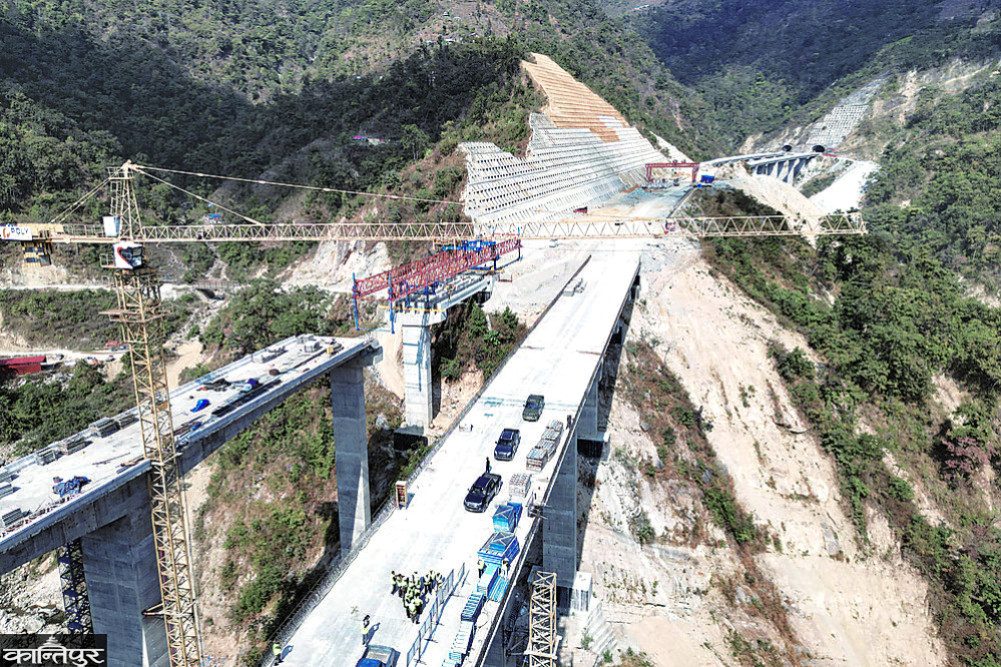
Stakeholders have commented that the budget has been allocated to ensure that projects that were budgeted for completion in the current fiscal year will also be completed in the next fiscal year.
We use Google Cloud Translation Services. Google requires we provide the following disclaimer relating to use of this service:
This service may contain translations powered by Google. Google disclaims all warranties related to the translations, expressed or implied, including any warranties of accuracy, reliability, and any implied warranties of merchantability, fitness for a particular purpose, and noninfringement.
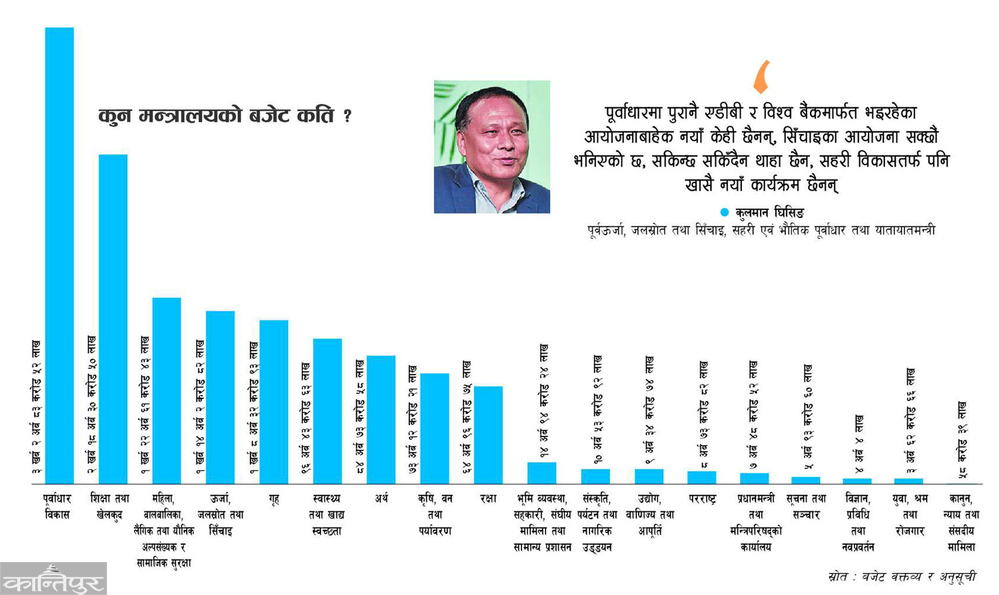
The Balendra Shah-led government has reduced the number of ministries and merged some, and has also increased the budget for those ministries. The Ministry of Development is the one that receives the most budget. Earlier, there were 22 ministries including the Office of the Prime Minister and the Council of Ministers. Now, it has been reduced to 18 including the Office of the Prime Minister.
The Ministry of Infrastructure Development has been formed by merging Physical Infrastructure and Transport, Urban Development and Drinking Water. This ministry is the one that receives the most budget, and the ministry has received a budget of 302.8352 billion rupees for the upcoming fiscal year 2083/84. That is, out of the total allocated budget of 202.3444 billion, infrastructure development occupies 14.25 percent of the budget.
The new programs of the ministry for the upcoming fiscal year are not included in the budget. It seems that continuity and priority have been given to old projects. A high-level employee of the Ministry of Finance claims that there are many integrated plans in infrastructure. Projects that were included in the budget to be completed in the current fiscal year have been included on the grounds that they will also be completed in the upcoming fiscal year. The budget for the current fiscal year mentioned that the construction of the Kathmandu/Terai-Madhesh Expressway (Fast Track) would be completed by 2083/84. Accordingly, the completion time is by mid-Chait 2083.
The budget for the current fiscal year mentions the completion of the construction of a 37-kilometer road, a four-kilometer tunnel, and 60 bridges. But the work has not been done as stated in the budget. 24.49 billion rupees have been allocated for this. It is mentioned that 40 bridges and 5.4 km tunnels will be completed in the upcoming fiscal year 2083/84. The completion time of the project has not been specified in the budget. 17.64 billion rupees have been allocated to start the construction of the link road of the expressway.
It is seen as a 'game changer' among the projects being constructed with government investment. The total cost of the project is estimated at 2011.93 billion. It is the costliest project among the projects under construction so far. The total distance of the expressway is 70.977. Once its construction is completed, it is estimated that it will take one hour and two minutes to reach Nijgadh in Bara from Kathmandu.
The budget for the current fiscal year mentions that the construction of three tunnels, Nagdhunga-Sisnekhola, Siddhababa and Fast Track, will be completed. However, none of the tunnels have been completed. Reiterating this issue, it has been included in the budget for the next fiscal year. The budget statement mentions that the Nagdhunga-Sisnekhola tunnel, 98 percent of which has been completed, will be put into operation from next Shrawan.
It was mentioned in the budget statement for the fiscal year 2081/2082 that the process of shifting the intake to a safe place would be taken forward to operate the Melamchi Drinking Water Project sustainably. This work has not yet started. It is mentioned that the study work will be completed in the upcoming budget to construct a structure to transport the water of Yangri and Larke rivers to Melamchi.
A budget of Rs 1.7 billion has been allocated for the new city in the current fiscal year. The current government, like the previous government, has continued this and allocated Rs 1.83 billion for the coming year. The budget has been set for 12 new cities. The allocated budget does not seem sufficient even for 12 cities. But the number of new cities and smart cities has been increased to 54 with each change of minister.
Former Secretary Tulsi Sitaula said that the three ministries that are now the Ministry of Infrastructure Development were merged in 2068 BS. ‘I was the secretary at that time, keeping the three ministries in one place is very good in terms of coordination,’ he said, ‘In the meantime, the ministry was split to ensure political distribution, and in 2068 BS, three ministries were in one place for only one year.’ He expressed disappointment that even though the merger created a powerful ministry, the old program continued in the budget.
‘The burden of old programs and projects in the budget is very high. Some old programs should have been removed and withdrawn to bring new programs, but that did not seem to have been done,’ Sitaula said, ‘There was no room for new programs, if the budget is spread across all projects in the traditional way, there will be no visible development.’
He said that some important projects should be selected and carried forward in a fast-track manner. Since there was a lot of budget allocation under the Ministry of Infrastructure Development, everyone expected that some new infrastructure construction plans would come. This was also the expectation of the concerned bodies. The concerned bodies say that new projects under the previous Ministry of Urban Development and Water Supply did not get priority in the budget.
‘Many expected that this government would bring budget focusing on big infrastructure, but it did not happen,’ said former Secretary Sitaula, ‘The current government had a great opportunity, if it had brought new programs, no one would have opposed it. Plans that could have seen immediate results could have been brought, but that did not happen.’
There does not seem to be any new programs in the education sector either. Some of the programs planned in the current fiscal year have been continued in the budget for the next fiscal year. The current budget mentions that schools will be re-mapped based on the number of teachers and students, geographical distance, and transportation facilities. With some modifications to this issue, Rs 1 billion has been allocated in the budget for the next fiscal year to map the infrastructure needs of community schools across the country.
While the Ministry of Development is receiving a lot of budget, the Ministry of Health and Food Hygiene, which is directly concerned with people, has received a budget of Rs 96.43 billion. That is, the ministry has received only 4.53 percent of the total allocated budget. The government has mentioned in the budget for the next fiscal year to expand telemedicine services in remote areas including Karnali and the Far West and ensure specialist health services through video consultations.
Former Vice-Chancellor of the Karnali Institute of Health Sciences, Mangal Rawal, said that the budget has been very Kathmandu-centric. ‘There is a matter of making Patan Institute of Health Sciences, National Institute of Medical Sciences (BIR) and Tribhuvan University Teaching Hospital universities,’ he said, ‘Karnali Institute of Health Sciences, the former BP Koirala Institute of Health Sciences have not been addressed in the budget.’
Rawal says that MBBS and MD education was started in Karnali 6 years ago and 7 years ago. ‘We have started the system of going to villages after completing specialist education, but now, on the contrary, telemedicine and air services have started in Karnali, air ambulances have been operating since 2016,’ he said, ‘Telemedicine is not needed here.’ He suggests that arrangements should be made for specialist doctors to go there and provide treatment, even if it is paid a monthly salary of 3-4 lakh rupees in Dolpa and Humla.
‘There are two hundred specialist doctors at Bir Hospital, even if 5-5 are sent to Karnali districts on rotation, the specialist doctors reach them,’ he said, ‘Stop arranging specialist doctors and talk about Western modality telemedicine in Karnali.’ He understands that there is no budget that can analyze and solve the causes of health problems. ‘The budget has been spent only on infrastructure, will development be achieved only by erecting buildings
and building roads?’ He said, ‘That is why a budget has been brought that will increase inequality, I also had high hopes and expectations from this government. But the budget has disappointed.’
Land Management, Cooperatives and Poverty Alleviation and Federal Affairs and General Administration have been merged to form a single ministry. Now, the ministry that has been merged to form Land Management, Cooperatives, Federal Affairs and General Administration has been allocated Rs 14.94 billion 24 million for the coming fiscal year. The Ministry of Science, Technology and Innovation has been created by separating the former Ministry of Education, Science and Technology. 4.4 billion rupees have been allocated for this ministry in the coming fiscal year. The budget also mentions the construction of old hydropower projects and the completion of irrigation projects under the Ministry of Energy, Water Resources and Irrigation.
Although the budget for the current fiscal year mentions the completion of land acquisition and construction of the 670 MW reservoir-based Dudhkoshi Hydropower Project, there has been no progress so far. Similarly, the much-talked about Budhi Gandaki Hydropower Project of national pride to be built through public-private partnership is mentioned in the current year's budget. In the coming fiscal year's budget, it is mentioned that the construction work will be carried out under the authorized authority model for the construction of the 1,200 MW Budhi Gandaki Reservoir-based Project and the contract process will be started after completing the financial closure of the Dudhkoshi Reservoir-based Project.
Former Minister for Energy, Water Resources and Irrigation, Urban and Physical Infrastructure and Transport Kulman Ghising said that there is nothing new in the budgets of all three ministries except for continuing the old plans. ‘The Budhi Gandaki project has been made a mess again in the budget. When I was the minister for three months, it was passed by the Council of Ministers to bring it into the company model and finalize its financing modality,’ he said. ‘Now, it has been put in the budget to form an authority again and carry out financial closure, this is only adding to the confusion in the Budhi Gandaki project.’ He commented that there is nothing new in energy except for the continuation of old projects.