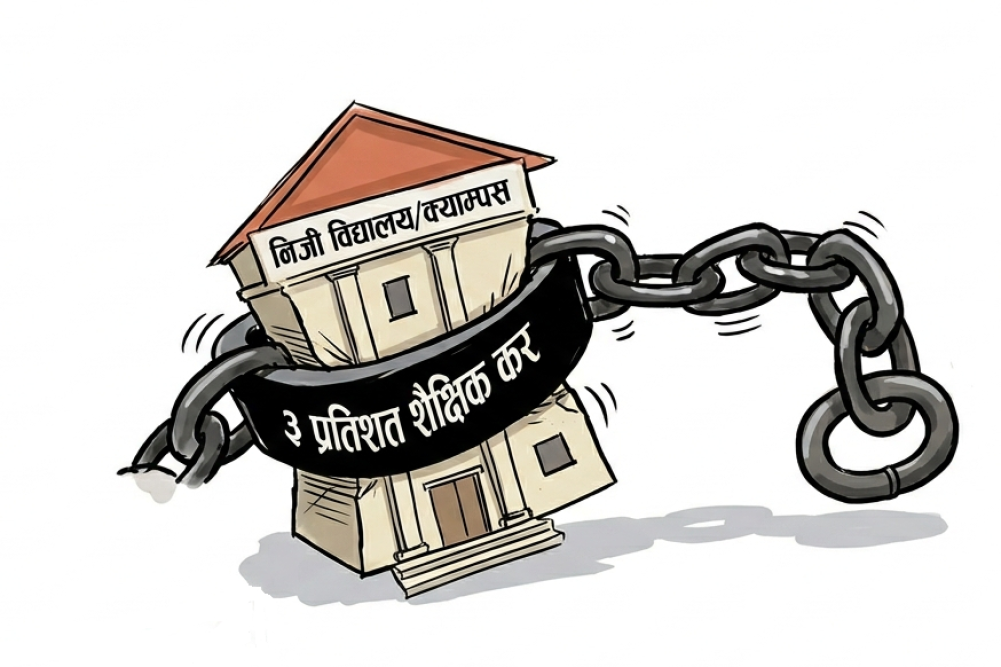
They complain that the private education sector is in a lot of trouble due to the requirement to update quarterly statements and pay a 15 percent fine for failure to do so.
We use Google Cloud Translation Services. Google requires we provide the following disclaimer relating to use of this service:
This service may contain translations powered by Google. Google disclaims all warranties related to the translations, expressed or implied, including any warranties of accuracy, reliability, and any implied warranties of merchantability, fitness for a particular purpose, and noninfringement.
Stakeholders have expressed dissatisfaction with the system of imposing a 3 percent education tax on private schools and campuses.
Stakeholders in the private sector have expressed their disagreement with the government's plan to impose a 3 percent education tax on the fees charged by private educational institutions through the budget. Speakers at the third general convention of the Association of Pre-School Educators Nepal (APEN) held in Kathmandu on Saturday said that the provision of the tax has discouraged and frightened the private educational sector.
N-PABSON President Subash Neupane said that it is unfortunate that a country has become a taxing country in the education sector despite high hopes from the new government. He said, "We did not expect such a decision to come from policymakers who are considered sophisticated." The policy of having to update the details every 4 months and paying a 15 percent fine if not paid has put the private education sector in a very difficult situation.
The financial bill presented by Finance Minister Swarnim Wagle in Parliament on Friday mentions that 3 percent will be collected from private educational institutions and health institutions on a quarterly basis on each fee they charge. The tax is being collected under the title of education and health equity.
Hisan General Secretary Ramhari Silwal complained that it was ironic that confusion and instability persisted in the education sector despite a strong government in the country. 'Imposing a 3 percent tax on the private sector when the education budget has not increased has strangled the throats of private educational institutions,' he said.
APN President Badri Prasad Dahal claimed that the current government appears to be lenient towards the private education sector. He pointed out that such behavior of the state will discourage private investment and put the entire education sector at further risk.
At the program, PABSON General Secretary RB Katuwal, N-PABSON General Secretary Prakash Khadka, Kathmandu University Associate Dean Professor Dr. Binod Prasad Panta, Nepal National Schools Federation's Rajkumar Karki, and educational figure Sanu Amatya also criticized the government's policy arrangement and expressed the view that it will have a long-term negative impact on the education sector.