3 percent tax on all types of fees charged by schools, colleges, and hospitals for education equity and health equity fees
We use Google Cloud Translation Services. Google requires we provide the following disclaimer relating to use of this service:
This service may contain translations powered by Google. Google disclaims all warranties related to the translations, expressed or implied, including any warranties of accuracy, reliability, and any implied warranties of merchantability, fitness for a particular purpose, and noninfringement.
The government is going to collect taxes from private schools, colleges and hospitals. The financial bill presented by Finance Minister Swarnim Wagle in Parliament on Friday mentions collecting education equity and health equity fees from private educational institutions and health institutions. 'Education equity fees will be collected at the rate of three percent on all types of fees collected from students by educational institutions run by the private sector,' the bill states.
Similarly, it is mentioned that health equity fees will be collected at the rate of three percent on all types of service fees collected from patients by people operating health services run by the private sector. The tax has been spent on quality education, expanding access to health and building infrastructure.
3 percent tax on all types of fees charged by schools, colleges and hospitals for education equity and health equity fees. The bill provides that such fees should be collected by issuing invoices and that the fees should be submitted through the Internal Revenue Office after collection. According to the bill, if the tax amount is not paid every quarter, a fine will be imposed. Dr. Gyanendra Man Singh Karki expressed dissatisfaction over the tax arrangement without informing the stakeholders. ‘There was a 5 percent tax on hospitals before. It was withdrawn due to lack of implementation,’ he said, ‘We will collect money from students and patients and pay the tax. Treatment for general patients will be more expensive.’
Even though such a tax has been proposed in the education and health sectors in the past, officials from the Ministry of Education and Health admit that the implementation is weak. When Baburam Bhattarai was the Finance Minister, a 1 percent tax was imposed on private educational institutions and before that, a 1.5 percent tax was imposed on private institutions for contributions to the Rural Education Fund, but it was not implemented. Former Secretary Hari Prasad Lamsal said that the burden of the tax will fall on the parents and general patients.
‘It seems that the government is trying to indirectly encourage government hospitals and educational institutions instead of private ones,’ he said, ‘If we go to private schools and hospitals, we may have been told to pay taxes, but the burden of this will fall on the parents and general patients.’ The 3 percent education tax to be paid by students and parents going abroad for higher education has also been kept unchanged in the bill.
The government, which has announced attractive slogans for the education sector in its policies and programs, has been seen to be generous in its budget allocation. The government had announced in its policies and programs to increase investment in education, implement compulsory and free education, and start AI-centered teaching. However, the government has failed to allocate the necessary budget to implement those announcements. The legal system for compulsory and free education has not been completed for a decade due to budget shortage.
The education sector budget for the coming fiscal year presented by Finance Minister Wagle is less than the current fiscal year. Rs 218.3 billion has been allocated for the education sector. This is 10.27 percent of the total budget. The education sector budget has not increased by more than 11 percent in a decade. Last year, 10.75 percent of the total budget, or Rs. 211.17 billion, was allocated. Although the budget has increased this year, the percentage of the education budget has decreased compared to that due to the increase in the size of the total budget.
Earlier, there was a 5 percent tax on hospitals. It was withdrawn due to lack of implementation. We will pay taxes by collecting money from students and patients. Treatment for ordinary patients will become more expensive: Dr. Gyanendraman Singh Karki, President, Private Medical College Operators Association Educationist Manprasad Wagle commented that the Rashtriya Swayamsevak Sangh (RSS) promised to invest the most in education during the elections, but it has not fulfilled it. ‘There were rumors during the elections that the most investment would be made in education and that teachers would be paid more.’ The promises of the Rashtriya Swayamsevak Sangh (RSS) leaders to increase the quality of public education by investing in it for two decades were not fulfilled,’ he added. ‘Public education was neglected. Investment was skimped on. There was only talk of providing technical education and improving quality. The education budget is disappointing. The dream of uplifting public education is a blow.' Educationist Wagle said that despite the increase in the education sector budget of about 7 billion, investment in education will continue to decrease due to the increase in the salaries of teachers and employees.
The policy and program mentioned emphasising digital and AI-focused learning. But there is a shortage of subject-specific teachers in community schools. Teacher posts have not been added for three decades. There is a government data that there is a shortage of about 56,000 teacher posts. Large and well-known community schools have not been able to receive even the necessary operating expenses from the government. The government provides only Rs 30,000 per month for operating expenses in community schools with many students, which cost lakhs of rupees per month for electricity, internet, sanitation, and lab operations. There is no mention of any budget on these issues.
The budget includes mostly old and only a few new programs. The budget statement mentions that the quotas currently imposed in various fields of higher education, including medicine, nursing, and information technology, will be reviewed and significantly increased within the current fiscal year. Previous governments have also pushed for quota increases, but experts have been criticizing them, saying that increasing quotas indiscriminately without criteria and infrastructure will affect quality. The government has announced that it will run programs in four fields of medical education, including MBBS, at the Shahid Dashrath Chand University of Health Sciences in Geta, Sudurpaschim Province, from the academic session 2083/84. The government had been making this announcement since the past. But since a 300-bed hospital in Geta is not operating as per the criteria, there has been a delay in the teaching of medical education.
8.6 billion rupees have been allocated for targeted student scholarships from school level to higher education. This is a continuation of the previous program. Under the scholarship, students are given 400 rupees annually. Such a small amount of scholarship has been criticized for being distribution-oriented rather than yield-oriented.
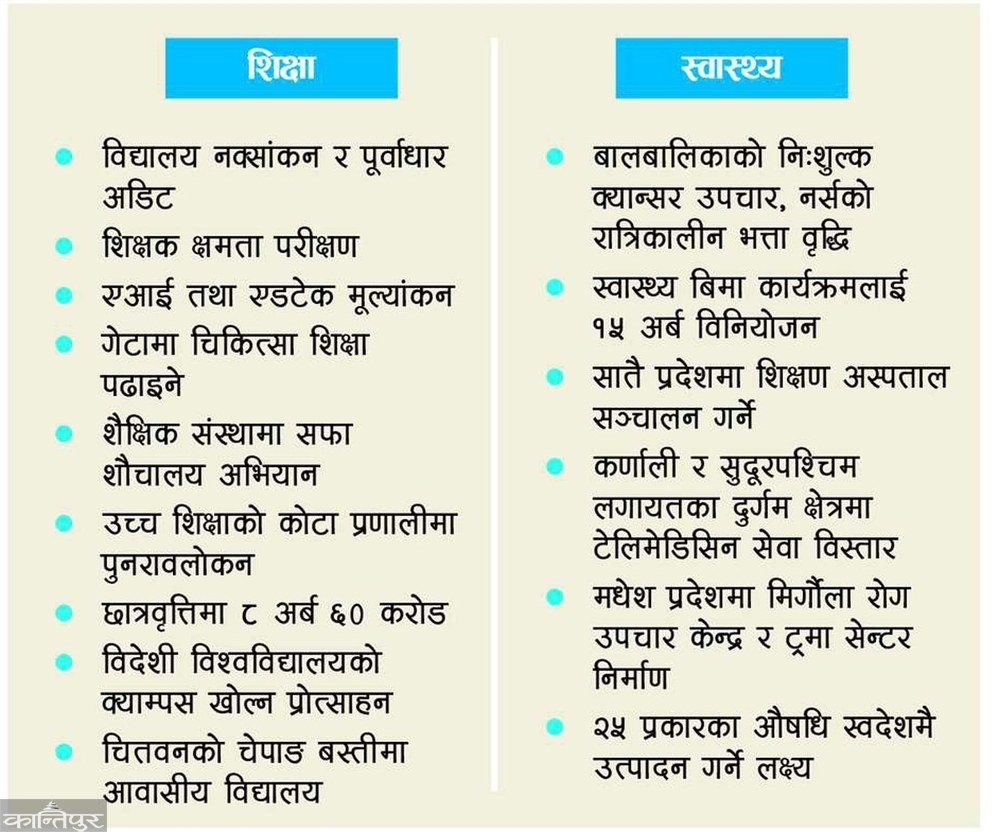
Finance Minister Wagle said that policy arrangements and incentives will be made for international-level universities to operate campuses in Nepal. Meanwhile, questions are being raised about the educational quality of more than four dozen campuses currently operating in Nepal under affiliation with foreign universities. Similarly, there is no clear law for operating foreign campuses in Nepal. Foreign campuses have been operating on the basis of guidelines since 2059 BS. The government has announced that it will amend the Education Act and formulate regulations to regulate foreign campuses. Education Minister Sasmit Pokharel had said last week that preparations are underway to take the Council of Ministers to approve the regulations.
With the aim of making public health services effective and quality, the government has announced to double the night duty allowance for nurses, from free treatment for children with cancer. ‘I have made arrangements for free treatment of cancer in children in government hospitals,’ said Finance Minister Wagle, ‘I have doubled the night duty allowance of nursing staff.’ The transportation expenses provided to women health volunteers have been increased by fifty percent.’
The government has announced that it will amend the Education Act and formulate regulations for the regulation of foreign campuses. Education Minister Sasmit Pokharel had said last week that preparations are being made to take the Council of Ministers to approve the regulations. It has also been announced to establish a ‘National Health Accreditation Authority’ to measure, certify and accredit the quality of health institutions and services. The budget statement mentions the expansion of telemedicine services in remote areas including Karnali and the Far West, ensuring specialist health services through video consultations, and establishing a burn treatment unit in federal specialized hospitals. ‘We will start the construction of kidney disease treatment centers and trauma centers in Madhesh Province,’ said Finance Minister Wagle, ‘We will expand high altitude sickness treatment services.’ We will mobilize a rapid response team in the affected areas for epidemic prevention and response. Similarly, it is said that the infrastructure development work of Narayani Hospital, Gajendra Narayan Singh Hospital and Ram Raja Prasad Singh Institute of Health Sciences in Madhesh Province will be taken forward.
The government has announced that it will encourage health institutions established at the citizen level and providing exemplary and accessible health services that are renowned in the international arena. Under which, a budget has been allocated for the upgrading of Dhulikhel Community Hospital and Kathmandu Institute of Child Health. Similarly, tax concessions have been provided to Tilganga Eye Institute to encourage lens production. Institute Dr. Sanduk Ruit, Institute Dr. Bhagwan Koirala and Dhulikhel Hospital Dr. Ramkantha Makaju.
It has been announced to establish a ‘Food and Drug Administration’ to ensure the quality and regulation of medicines, diagnostic and other health food products produced or supplied within the country. The government has stated that the capacity of Nepal Drug Limited will be enhanced to produce 25 types of medicines domestically among the free medicines distributed by the government. The government has been providing medicines for communicable and non-communicable diseases free of charge for decades. Until 2015, 70 types of medicines were available free of charge. After the implementation of federalism, the number of free medicines has been increased to 98.
The budget statement mentions the operation of Sulabh Pharmacies in all health institutions in collaboration with the community, cooperative and private sectors and the upgrading of the National Drug Laboratory. The government has announced to implement the ‘One Citizen, One Digital Profile’ system to address the complaints of citizens regarding overcrowding and inconvenience in accessing health services in government hospitals. The government has announced the launch of air ambulance services in remote areas of Karnali Province.
‘We will develop Tribhuvan University Teaching Hospital, National Institute of Medical Sciences and Patan Institute of Health Sciences as international-level universities and enable them to provide education to foreign students.’ Under the public-public partnership model, major government hospitals in all seven provinces will be converted into teaching hospitals and specialized health service centers in a phased manner. We will mobilize investable resources in the Employees Provident Fund, Citizen Investment Fund and Social Security Fund for the expansion of health infrastructure, medical education and specialized services,’ the budget statement said.
The government has set a goal to restructure the health insurance program, which has been hit by the economic crisis, and bring 90 percent of the population under the insurance net in the next three years. Due to lack of funds, the Health Insurance Board has announced the suspension of services in government and private hospitals. 15 billion has been allocated for the program. Finance Minister Wagle said, 'We will comprehensively restructure the health insurance program. We will adopt a single payment method by integrating the scattered social health security programs and health-related obligations.'
It has been announced that the construction of 336 basic hospitals whose construction has begun will be completed in the next three years. It is stated that a basic hospital will be built at a suitable location in one local level of each province with a low human development index, and in the case of hospitals whose construction has not begun, it will be built only after scientific mapping.

