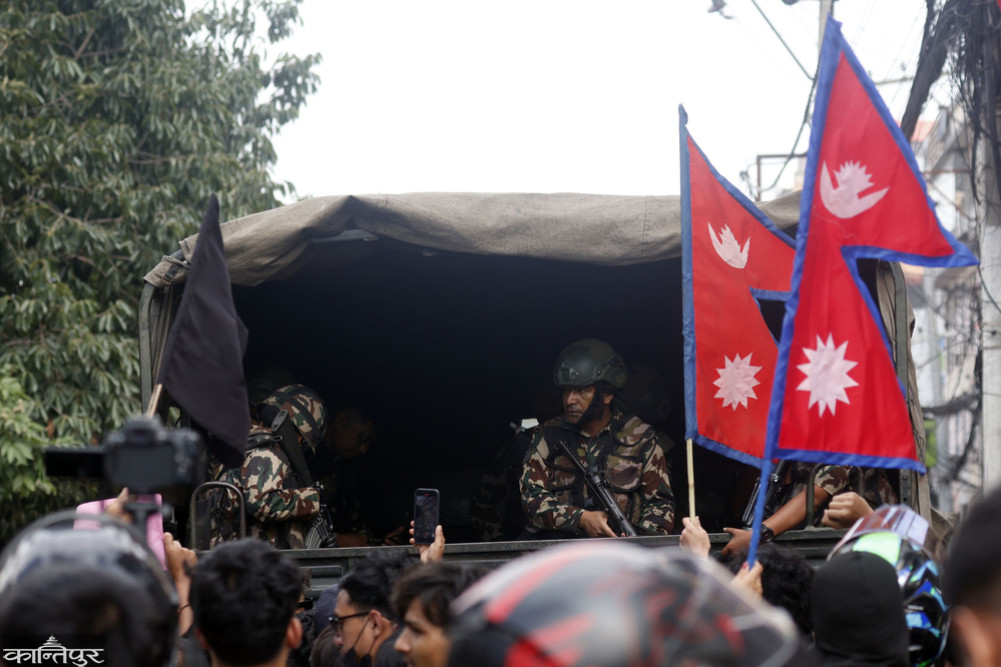
The government's attention has been drawn to instructing the Chief of Army Staff to prioritize the protection of national property and the responsibility to protect the human rights of citizens, and to alert the then military commanders assigned to the security of Singha Durbar and Rashtrapati Bhavan.
We use Google Cloud Translation Services. Google requires we provide the following disclaimer relating to use of this service:
This service may contain translations powered by Google. Google disclaims all warranties related to the translations, expressed or implied, including any warranties of accuracy, reliability, and any implied warranties of merchantability, fitness for a particular purpose, and noninfringement.
The National Human Rights Commission has raised questions about the role of the Nepali Army during the Gen-G protests. The commission has raised questions saying that the Nepali Army has failed to play its role as expected by the people when national property and heritage, commercial and private property were looted, vandalized and set on fire during the protests. Stating that the army has not cooperated in the investigation, the commission has recommended an investigation into human rights issues regarding the then army commanders deployed in the security of Singha Durbar and Rashtrapati Bhavan, including Army Chief Ashok Raj Sigdel.
The report of the Commission's Investigation and Investigation Committee, made public on Wednesday, mentions the army in point number 4 of the recommendation section. 'The human, physical and economic damage caused across the country by vandalizing and setting fire to Singha Durbar, the Supreme Court, and Rashtrapati Bhavan during the protests on 23 and 24 Bhadra, shows the weaknesses of the Nepali Army, which has failed to protect national property as expected and has not been sensitive to the protection of the human rights of the common citizen,' the report states.
The Commission has recommended that the Chief of Army Staff be directed to take such issues seriously in the future and prioritize the responsibility of protecting national property and protecting the human rights of the common citizen. The report states that the attention of the Government of Nepal will be drawn to the then Chief of the Army Battalion inside Singha Durbar and the then Commander of the Army at the Presidential Palace, Sheetal Niwas, in accordance with Section 5 of the National Human Rights Commission Act, 2068.
Section 5 of the National Human Rights Commission Act, 2068, mentions the work that the Commission can do to protect human rights. ‘The Commission may draw the attention of any body or official as required on any matter related to the protection and promotion of human rights,’ this section of the Act further states, ‘If the Commission draws attention, the concerned body or official shall take necessary action on the matter and inform the Commission.’
According to this provision of the Act, the government shall draw the attention of Chief of Army Staff Ashok Raj Sigdel to prioritize the responsibility towards the protection of human rights and inform the Commission. Similarly, the then military commanders responsible for the security of Singha Durbar and Rashtrapati Bhavan shall be drawn to the attention of the Commission as recommended and informed the Commission.
The recommendations were made in accordance with the powers granted to the Commission and the responsibilities and roles given to the Army by the Constitution, said Lily Thapa, coordinator of the investigation committee. Thapa rejected the public discussion that the report by the Commission was soft on the Army. ‘The recommendation had to be made in accordance with the law, their responsibilities, and the powers given to them. The Commission cannot write on the fly. "It is mentioned in the report that they have not fulfilled their responsibilities and given instructions," Thapa said. "This is probably the first time that the army chief has been asked to give such instructions. That is a very big deal for them. Two colonels have been asked to be warned."
The names of the chief army officers deployed for the security of Singha Durbar and Rashtrapati Bhavan are not mentioned in the summary report. According to Thapa, the names of both are mentioned in the full text of the investigation report prepared by the commission. "It is written in the full report, the 600-page report has everyone's names," she said.
Assistant Lieutenant General and Army Spokesperson Rajaram Basnet said that there is a constitutional provision for the army to operate according to the decisions made by the government. He said that the context of 23 and 24 Bhadau is different. The report questions the army for not playing a role in maintaining peace and security before that. Spokesperson Basnet reminded that five stages had passed before the army was mobilized on 24 Bhadau.
‘The Nepali Army is mobilized in accordance with Articles 4 and 6 of Article 267 of the Constitution. At that time, the Nepali Army followed five steps to be mobilized from 10 pm,’ he said. Article 4 of the said article provides, ‘The Government of Nepal may mobilize the Nepali Army for development and disaster management, including other tasks, in accordance with federal law.’
Article 6 further provides under what circumstances the Nepali Army will be mobilized. ‘If a serious crisis arises in the sovereignty, geographical integrity or security of any part of Nepal due to war, external attack, armed rebellion or extreme economic chaos, the Nepali Army will be mobilized by the President on the recommendation of the National Security Council and the decision of the Council of Ministers,’ Article 6 further states, ‘The mobilization of the Nepali Army must be approved by the House of Representatives within one month of the date of the announcement.’
The commission has mentioned in its report that the local administration had mobilized the army by issuing a curfew order on 23 Bhadra. "It is clear from the documentary evidence that the Chief District Officer was in constant contact with the Ministry of Home Affairs, Nepal Police, Armed Police Force, and even sought the assistance of the army after issuing the curfew order," the commission's report mentions this issue twice, "but in practice, it is evident from the circumstances of that day that there was no such assistance."
The commission has raised questions about the role of the army in the looting, vandalism, and arson of national heritage, property, and commercial and private property the next day. "On the 24th, while protesters vandalized and destroyed government office buildings across the country, including the Federal Parliament Building in Baneshwor, the archaeologically important Singha Durbar, the President's Residence, which is also the Supreme Court of Nepal, political party leaders and cadres, residences of government employees, private commercial buildings, and more, all security agencies remained silent spectators," the report reads. "Considering the ongoing discussion in all circles of the country that if the Nepali Army had only come out of the barracks, this level of vandalism and arson that would have caused so much damage to the nation would not have occurred, the investigation report shows that there was no cooperation from the Nepal Army when the Commission's investigation committee summoned the Chief of Army Staff and other high-ranking officials for statements."
In such a situation, the army, which was not mobilized, was mobilized only at 10 pm on 24 Bhadra without a government decision, the report reads. ‘Even after 76 people have lost their lives and all the major structures of the state and the country’s large and important commercial establishments have been set on fire and destroyed, it seems that the army was mobilized only from 10 pm on the 24th, in a situation where there is no sign of the state or the government,’ the commission’s recommendation says. ‘However, it is not mentioned in the statements that the army was mobilized based on such a decision of the government on this date.’
The commission has recommended making policy arrangements regarding the use of the army regarding the role played by the army while the country was suffering losses in the Genji movement. The commission has recommended the government to ‘immediately make legal and policy arrangements regarding whether or not to use the army in internal riots and violent movements, and if so, to make legal and policy arrangements.’
Military spokesperson Basnet said that five steps were followed before the army was mobilized. He said that these steps include a statement by the Chief Secretary, statements and calls issued by the Army Chief and the President. According to him, the first phase was the press release issued by the Chief Secretary at 3:10 pm, urging restraint, the second was a press release issued by the Nepali Army, the third was a press release issued by President Ram Chandra Poudel at 6 pm, urging everyone to exercise restraint and maintain peace, security and tranquility.
In the fourth phase, Chief of Army Staff Sigdel called for maintaining peace, security and tranquility in view of the seriousness of the situation at 8:54 pm, and the fifth was a press release issued by the Nepali Army at 9:09 pm. 'At 9:09 pm, the Nepali Army has issued a press release stating that the army will be mobilized to control the situation, maintain peace and security, and protect public property after 10 pm,' Basnet said.
The commission also noted that all security mechanisms except the Nepali Army have failed when analyzing the security situation on the evening of 23 Bhadra and the afternoon of 24 Bhadra. The report also mentions that Prime Minister KP Sharma Oli did not take any decision from the Council of Ministers to seek the assistance of the army. The commission also wrote that the army did not cooperate with the commission's investigation committee. The report also states that after the investigation committee submitted its report on 6 Chaitra, the army submitted a written statement to the commission through closed questions (including Army Chief Ashok Raj Sigdel).