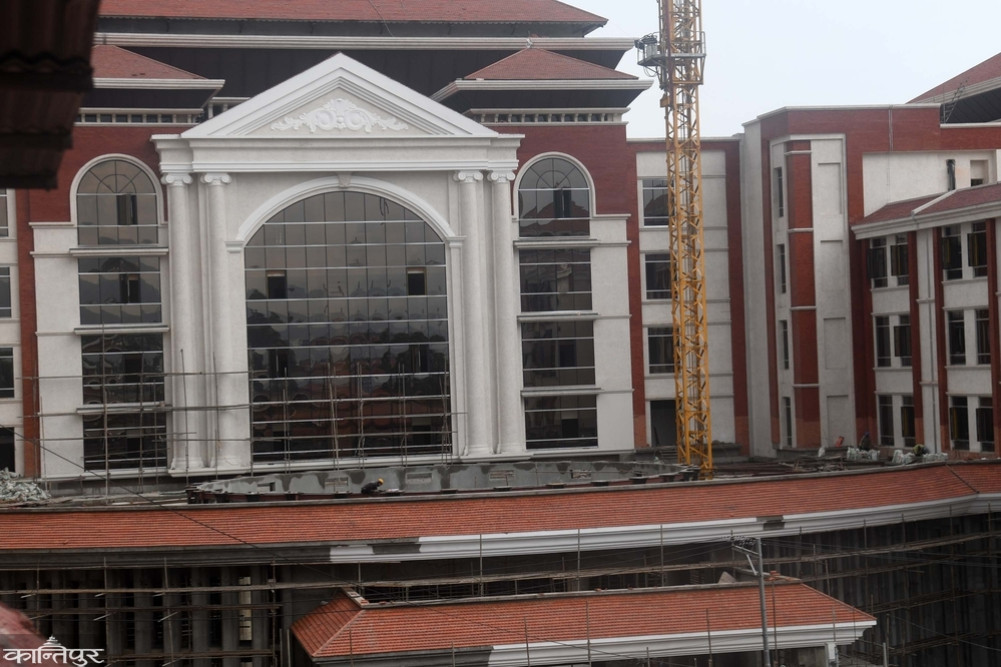
The Supreme Court's fifth five-year plan also mentions that live streaming of hearings will begin in Mangsir 2082. However, the plan has not been implemented yet.
We use Google Cloud Translation Services. Google requires we provide the following disclaimer relating to use of this service:
This service may contain translations powered by Google. Google disclaims all warranties related to the translations, expressed or implied, including any warranties of accuracy, reliability, and any implied warranties of merchantability, fitness for a particular purpose, and noninfringement.
The Supreme Court administration announced in Mangsir last year that it would make arrangements for 'live streaming' of court hearings, but it has not been completed till date . Due to the failure to implement the Supreme Court's announcement, cases of major public concern in the country have been decided without the citizens being able to hear them .
During the last parliamentary hearing on 5 Jestha, Chief Justice Manoj Kumar Sharma has again included 'live streaming' in his work plans . He has included issues such as making the judiciary technology-friendly, making it transparent, and broadcasting case hearings live in the work plan .
The Fifth Five-Year Plan of the Supreme Court mentions that live streaming of hearings will be started in Mangsir 2082 . Sharma's statement in the parliamentary hearing makes it clear how much has been achieved . The Supreme Court's plan mentions that all hearings of cases held in open court will be broadcast live . However, the Supreme Court has not been able to make even public interest cases transparent.
Many issues of public interest, including the dissolution of the House of Representatives in 2077 Poush and 2078 Jestha, the case related to transitional justice, the dispute regarding the appointment of 52 constitutional office bearers, the dispute regarding the legitimacy of the Congress, and many others, have been heard and decided without the citizens hearing them. In fact, a writ petition had already been filed in the Supreme Court on Bhadra 28, 2081, demanding that the hearing be broadcast live. In the first submission on Bhadra 31, the bench of Justice Kumar Regmi had issued a show cause order to its own administration in the writ petition filed by Vivek Chaudhary. And, it had also granted priority to prioritize the case. In which the then Registrar of the Supreme Court, Bimal Poudel, had submitted a written reply arguing that additional infrastructure and resources were required for live broadcasting and that there was no prescribed law to organize and regulate broadcasting. The writ petition was not heard thereafter. It has been delayed for 4 times.
Writ petitioner Vivek Chaudhary says he has been waiting for his turn to be heard for 2 years. In the first petition, a show cause and priority order was issued. He says that the delay by the court has now made it difficult to understand whether priority in judicial theory and priority as stated by the Supreme Court are different.
Technology has now become so powerful that 'live streaming' is a game for any social media user. However, even after 2 years of delay and even after the Supreme Court itself made a commitment, this issue has not been able to gain significance. What are the additional infrastructures that the Supreme Court has said? And how long will citizens be able to listen to debates of public interest?
Supreme Court spokesperson Arjun Prasad Koirala says that there are problems in starting 'live streaming' due to lack of technical resources and manpower. He said, 'We are trying, we will study and decide the modalities.'
There is a famous saying in the judicial circle, Justice Must Be Done. The meaning of this saying is that justice is not just about being fair, citizens should also be able to see how fair and credible the judicial process was. Legal experts have not often opposed this principle. The Nepal Bar Association has also considered the issue of live broadcasting of cases as positive.
Nepal Bar Association General Secretary Kedar Koirala believes that cases of public concern other than personal disputes and personal privacy should be broadcast live. He says that the bar has also informed the leadership of the judiciary about this issue when it submitted a 39-point attention notice. He said, 'It is a matter of the willpower of the judicial leadership.' The Chief Justice has committed to start 'live streaming' of some cases.'
Nepal's judiciary has been operating on the concept of open court constitutionally and theoretically. However, hearings are only accessible to a limited number of media persons, legal professionals and court employees. In many countries of the world, court debates and hearings are broadcast live. In the US, the audio of the debates in the Supreme Court is 'live streaming'. In India, hearings of public interest cases can be watched and listened to from home. Hearings from the UK and Brazil to the International Court of Justice (ICJ) are broadcast live.