Emphasis on government's need to increase investment in quality education and health
We use Google Cloud Translation Services. Google requires we provide the following disclaimer relating to use of this service:
This service may contain translations powered by Google. Google disclaims all warranties related to the translations, expressed or implied, including any warranties of accuracy, reliability, and any implied warranties of merchantability, fitness for a particular purpose, and noninfringement.
Stakeholders in the health and education sectors have said that the trend of going abroad for studies and treatment should end. In the ‘Budget Debate’ program of Kantipur Television, they emphasized that the government should increase investment in quality education and health in Nepal.
They suggest that the private sector should collaborate with the state in areas where state investment is insufficient. The debate was attended by physician Dr. Bishal Dhakal, professor Balchandra Luitel of Kathmandu University, President of the International Education Providers Association of Nepal, Laxman KC, and President of HAMMS Hospital, RS Bhandari.
Physician Dr. Bishal Dhakal said that the state should pay special attention to the health security of citizens. ‘Why do many patients from the Far West go to India for treatment? Why is the number of people going to India for treatment from Kathmandu high?’ He added, ‘Why are citizens not trusting their government in healthcare?’
He pointed out that patients go abroad because there is no quality service in the government health sector and there is no suitable environment for the private sector. Dr. Dhakal suggested that the private sector should be reformed in terms of policy to create an environment for investment in the health sector. ‘Private hospitals are ready to provide health services available abroad in Nepal. The government should create an environment for that,’ he said.
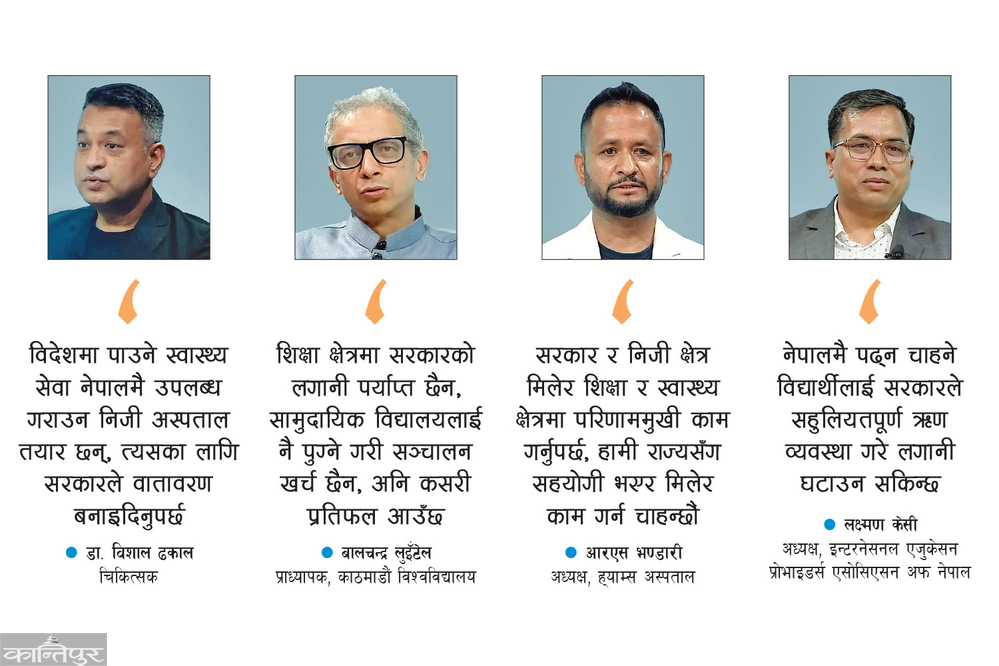 Stating that only 5 percent of the budget is allocated to the health sector, he suggested that it be increased to at least 10 percent. ‘We have high expectations from the government after the Gen-G movement. Health services should be made pro-poor,’ he said, ‘Students and youth who have been educated by the state, private sector and parents are going abroad. A policy is needed to stop that.’
He said that irregularities in the health sector should be stopped along with the budget increase. Kathmandu University Professor Luintel also complained that the budget in the education sector is inadequate. He said that only about 10 percent of the budget should be allocated, which is insufficient.
‘The government’s investment is not sufficient. The return on the investment has not been achieved. The government has not been able to provide the necessary operating expenses to community schools,’ he said. He stressed the need to increase the budget for studies, research and innovation in higher education. Professor Luintel suggested that if investment is insufficient, higher education should move forward in partnership with the private sector.
Luintel said that the amount of investment from the federal, provincial and local levels in the education sector should also be determined. ‘There is both confusion and hope with the new government. There is an expectation that university appointments will not be like the past. Leadership selection and development should be based on merit,’ he said, ‘autonomy should also be given.’
Bhandari, Chairman of HAMS Hospital, is of the opinion that the government should reconsider its health policy. ‘The general public has to reach below the poverty line to receive health services. Government hospitals are not capable of providing health services to all citizens,’ he added, ‘The government and the private sector should work together in the education and health sectors. We want to work together in partnership with the state.’
He suggested that the government should bring a private sector-friendly budget in the education and health sectors. ‘The private sector can provide quality education and health in the country. We are ready to make the necessary investment to end the situation of having to go abroad for treatment and studying,' Bhandari said. For that, he pointed out that the government should change its policy and give guardianship to the private sector.
The state should prioritize the education and health sectors and create a budget, said International Education Providers Association of Nepal President KC. 'Private sector investment is increasing from schools to higher education. But the government's priority is not seen in education and health. The government's investment in education is insufficient,' he said. 'Where the government cannot invest, it can collaborate with the private sector and parents. We are ready for that.'
He said that since parental investment in higher education is increasing, it can be minimized. 'Parental investment in students going to study abroad is increasing. If the government arranges concessional loans for students who want to study in Nepal, the investment can be reduced,' KC said.

