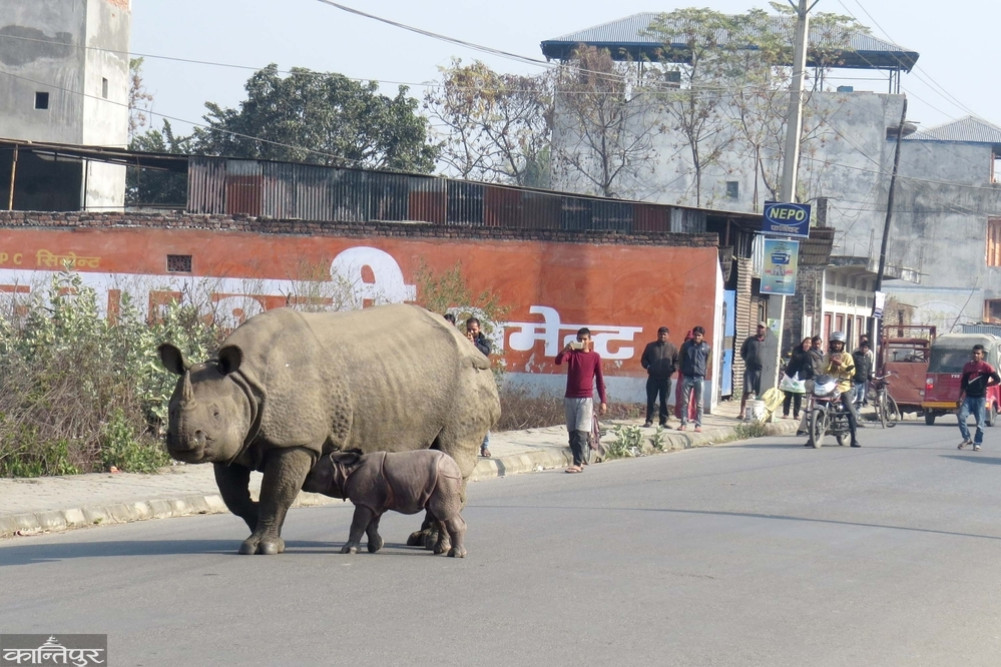
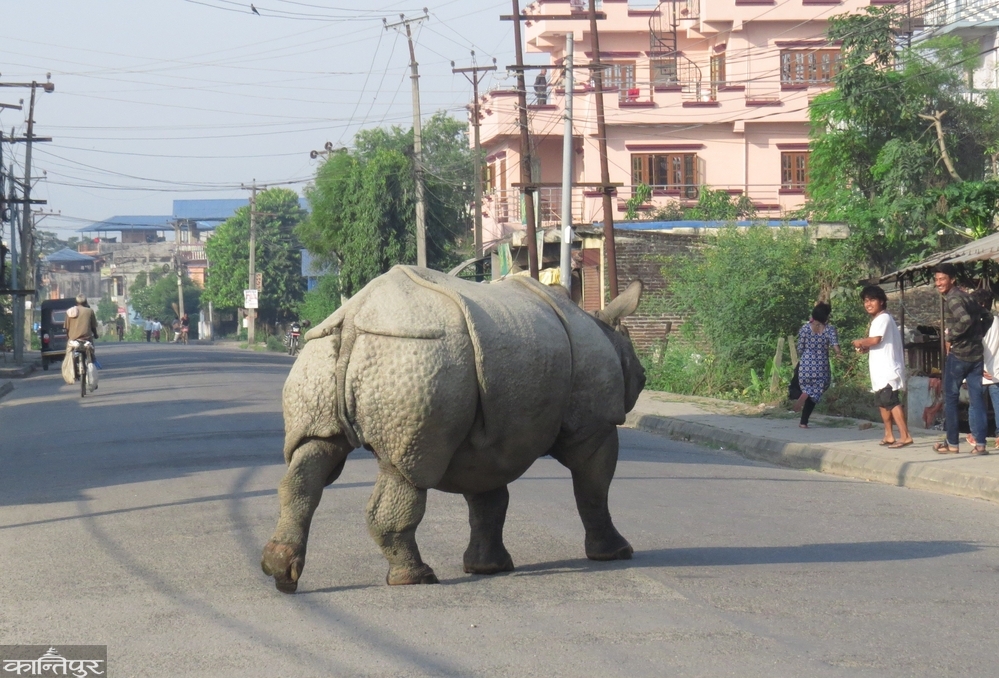
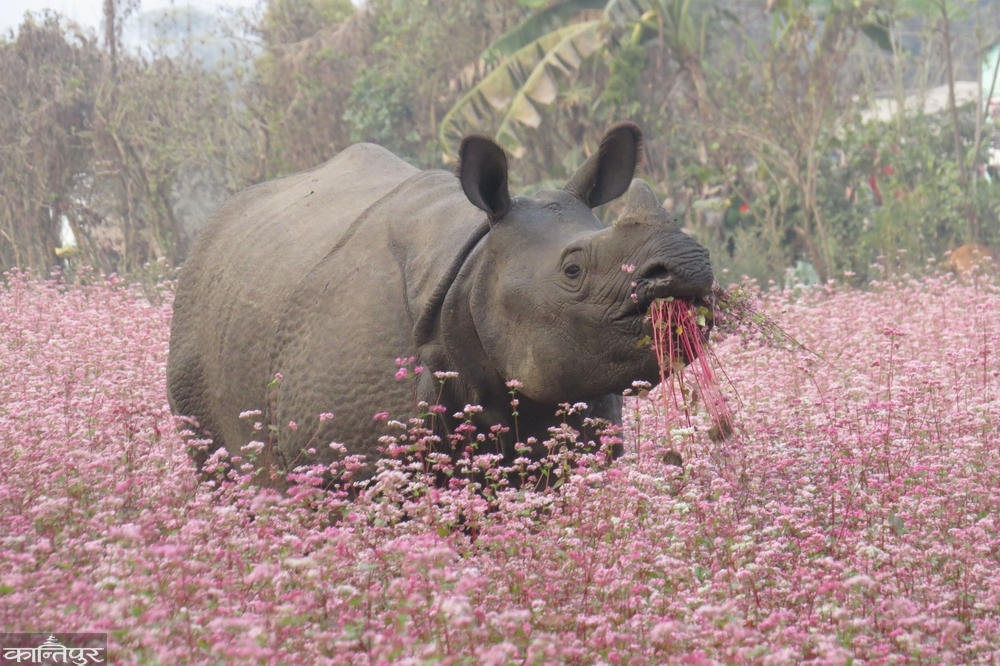
Rare wildlife roaming carefree in the city is no longer a new sight for Chitwan. Instead, the question is starting to arise - have rhinos entered the city or are humans spreading into the rhino's former habitat?
We use Google Cloud Translation Services. Google requires we provide the following disclaimer relating to use of this service:
This service may contain translations powered by Google. Google disclaims all warranties related to the translations, expressed or implied, including any warranties of accuracy, reliability, and any implied warranties of merchantability, fitness for a particular purpose, and noninfringement.
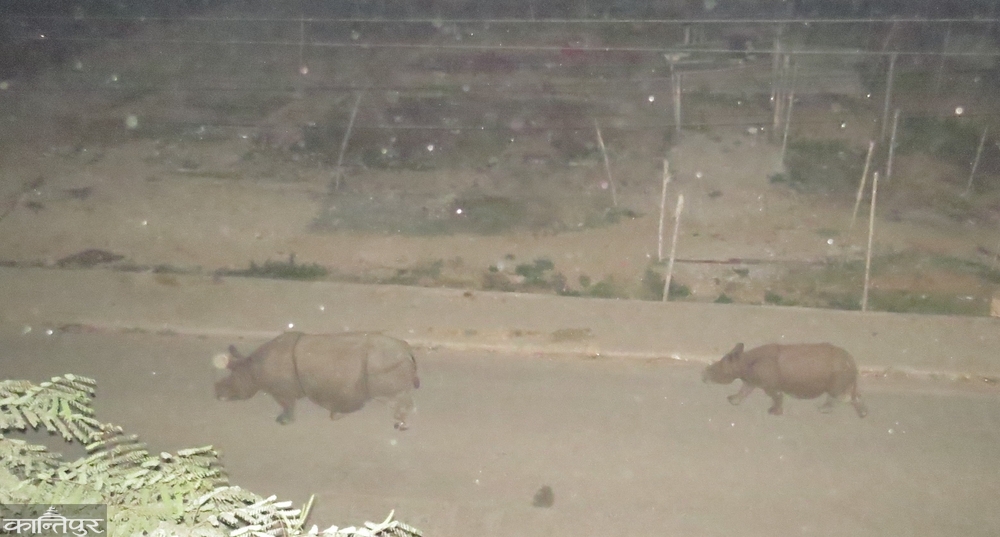
A one-horned rhino is running confidently under the streetlights. Some are taking out their mobile phones and filming, while others are running away in fear. As the night deepens, there is a sudden commotion at Chaubiskothi Chowk in Chitwan.
Rare wildlife that can only be seen by taking a jeep safari in the jungle is no longer a new sight for Chitwan. The question is on the contrary - have the rhinos come to the villages and markets, or have people spread to the rhinos' old habitat?
Chitwan National Park is the main habitat of the rhinos in Nepal. Millions of domestic and foreign tourists come to see the rhinos here.
Apil Ghimire of Bharatpur Patihani, who is running a campaign to clean the Rapti River, posted a video on social media on April 28, writing, ‘Rhinoceros can come out anytime and anywhere in Chitwan, they should be allowed to come out. This is not a new thing, it is their home. We had to walk safely.’
In the video he posted, a one-horned rhino was running in the dark at Bharatpur Chaubiskothi Chowk.
Dadi Sapkota, who has been writing a book on wildlife, posted a video of the rhino on social media on April 28, writing, ‘The rhinoceros came to the village road and fought. The rhinoceros did not actually enter the village. The village and the road entered the forest where the rhinoceros’ ancestors used to play. So it's not surprising.' In the video he posted, two male rhinos were fighting each other on the road in Sauraha.
The video of the rhinos fighting on the busy road in Sauraha that day went viral not only on social media, but was also broadcast in various media outlets in the country and abroad. The park rescued a motherless baby rhino that was swept away in the floods of 2074 BS and released it in the eastern region of Sauraha. It was named Meghauli because it was rescued from Meghauli. This rhino grew up with the care and treatment of humans.
Although it occasionally crosses the Rapti River and goes to the forest of the park, and lives in the Baghmara forest in the northwest, Meghauli usually enjoys the Sauraha market area and farmland. There was also an attempt to take it to Koshitappu. Even after reaching Koshi in Chaitra 2080, Meghauli could not enjoy it there. He did not eat grass and started banging his head on the cage. Four days after being taken, Meghauli returned to Sauraha.
Tourists are amazed when they see Meghauli wandering on the streets of Sauraha.
Meghauli is a male rhinoceros. On the afternoon of April 28, Meghauli had a close encounter with another male rhinoceros that was entering Sauraha from the forest. These rhinos came from the banks of the Rapti to the road via a hotel in Sauraha. There was a fight. Meghauli won this fight. And chasing the loser, he returned to the forest the same way he came.
After this video became a topic of discussion in the country and abroad, Sauraha tourism entrepreneur Ram Kumar Aryal, who has been involved in conservation work, says, ‘What this incident shows is that a rescued and raised rhino can even defeat another rhino of the same age but living in a completely wild environment.’
Such unexpected activities by rhinos in the market area outside their habitat are not strange and surprising to conservationists.
Locals’ lives are at risk
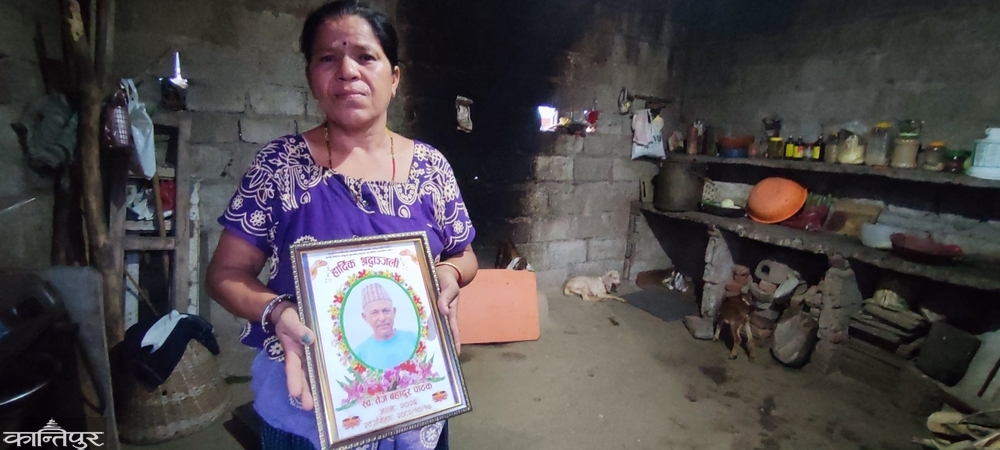
There have been incidents in Chitwan where people have lost their lives when rhinos ventured out of their main habitat without any fear. 60-year-old Ambika Pathak’s 65-year-old husband, Tej Bahadur Pathak, used to graze goats all day. He used to wander one kilometer away from his house in the evening and return home after getting drowsy. But on Magh 17, Ambika heard the bad news one morning.
Her house is in Narayani Dobhan Tol near Bahraghere, Bharatpur Metropolitan City-3. It has been 15/16 years since she started living here. This tol is located on the banks of the Narayani River, about two and a half kilometers west of Narayangadh Bazaar. When it was on the banks of the river, there was a fear of floods and inundation during the rainy season. But now there is a fear of wild animals. A rhinoceros has started walking near her house.
The same rhinoceros killed her husband Tej Bahadur. ‘Rhinoceros come near this house. Rhinoceros walk with their babies. But we found his body one to one and a half kilometers west of the house. He did not return all night. We could not even go out to call him or search for him due to fear of the rhinoceros. In the morning, the people of the river saw him and informed him,’ said Ambika. It hasn't been long since rhinos started coming around her house.
Rajendra Kandel, chairman of Bharatpur-4 Rameshwor Shanti Tol Bikas Samiti, which is located near Ambika's house, says that the number of rhinos has increased in the past seven to eight years. 'There is a city forest in the forest. We have seen seven to eight rhinos in the city forest. They weren't there before, rhinos have been coming for seven to eight years. They have been seen a lot for the past year,' Kandel said. He also raised this problem at the public hearing program of the metropolis.
'Apart from Pathak Buba, I haven't heard of any other such big incidents.' But this is an area near the market. The main market area, Pulchowk and Shahidchowk, are about two and a half or three kilometers away from here. People have to leave in the morning. They have to return home in the evening. Rhinos are also active at this time. The fear has increased,’ said Kandel.
Occasionally, a video of a rhino chasing a person out for a morning walk goes viral.
Prajapati Sapkota, 86, of Bahraghare, Narayangadh, regularly goes for a morning walk. Earlier, she used to leave her house and head south. For the past three-four years, she has been heading towards the eastern market area. ‘I leave at 4 am.’ When I first headed south, I was afraid that I would encounter a rhino near Dharapani. That’s why I started taking morning walks towards East Shahid Chowk, Sapkota said. Even when I go this way, I occasionally encounter a rhino.
He said that when he walks 500 meters from his house, a rhino would occasionally cross his path at Naughare.
Geeta Bayalkoti has been living in Naughare for 30 years. ‘Earlier, when we went to the city forest, there were no rhinos.’ Now, the rhinos live in the same forest. They come here after nightfall and return in the morning. They come out from the shelter of our house,’ she said. Her house is one kilometer away from the city forest. Locals say that the rhinos that came out of the city forest reach the Lanka area, about 3 kilometers away, through the south.
It is estimated that the rhinos reached Chaubiskothi from the city forest on April 6. There are community forests in the Barandabhar forest area, 3-4 kilometers east of Chaubiskothi. However, the forest office does not have exact details about the rhinos that reached Chaubiskothi.
According to the information released by Chitwan National Park in 2080 Jestha, rhinos are coming out of 127 places in the park. The damage caused by rhinos entering the settlements and farms in the central and forest areas of the park is not new. But the rhinos roaming around Sauraha while the rescued baby is growing up and the rhinos roaming around the city forest in Narayangadh area are strange.
The city forest is near Narayangadh Pulchowk. If you look west from the Narayani bridge, you can see rhinos grazing in the city forest. There are community forests to the west from the city forest. These forests under the Division Forest are the new habitat of the rhinos. Surbir Pokharel, former president of the Dnyaneshwor Community Forest and Community Forest Users Federation in Chitwan, said that the rhino population has increased in the last 20 years.
A new place to protect the baby
A rhinoceros giving birth needs to be protected from tigers. That is why, Pokharel said, the rhinoceros chose the Narayani Adka community forest, where tigers have not yet started to live, over the parks and forests where tigers live.
Pokharel said this because he had seen rhinos with babies in these forests. Seven years ago, a rhino living in the city forest in Poush gave birth to a baby in the bushes of a settlement outside the forest.
Pokharel says that rhinos come more in winter. ‘In winter, there is less grass in the forest. Wheat, corn and vegetables are planted in the villages.’ The rhinoceros come out to graze. They go to the Ghol of Rampur. That Ghol is 4 kilometers south of the forest. That Ghol of Rampur is called Ghoinda Ghol,’ Pokharel said.
District forest officials also admit this.
‘Dnyaneshwor block is not that wide. There is not enough grass. There is water, but when there is no grass, they come out to graze,’ said Devi Poudel, information officer at the Division Forest Office in Bharatpur. He said that since they leave the forest at night and return early in the morning, those who walk at night and early in the morning should be careful. He said that if they encounter a rhino in the city market, they do not know what to do.
Baburam Lamichhane, a wildlife expert who is also the head of the Sauraha office of the National Trust for Nature Conservation but currently works independently, says that fewer rhinos come out of the forest in Chitwan National Park than before. ‘If we look back 20/30 years ago, rhinos used to live in every place in Chitwan, and there is a history of chasing rhinos back then, just like monkeys are chased away now,’ he said.
He said that the number of wild animals entering the park has decreased due to the management of grasslands, electric fences, and construction of cement walls inside the park.
Ganesh Pant, former chief of Chitwan National Park and currently working in the Parks and Wildlife Conservation Department, says that when a male rhino fights another male in the forest, it enters the village.
‘New places like urban forests are being chosen by the rhinos. Why this is happening should be studied properly. Is this due to the effects of climate change?’ said Pant, who has a PhD in rhinoceroses.
Both Pant and Lamichhane are of the opinion that ‘Chitwan is a rhinoceros area. Rhinos can come out anywhere.’ Therefore, the locals must be aware.'
Conservationist Ram Kumar Aryal argues that if there are many rhinos in the new habitat, it would be appropriate to bring them back to their old place and release them. 'Earlier, there were many rhinos in the eastern part of the park.' The census has shown that there are fewer in the east and more in the west.' Therefore, the rhinos that are in large numbers in the eastern part of the park, the old habitat, should be brought back to new places like the city forest,' he said.
Rajendra Kandel, chairman of the Rameshwor Shanti Tol Bikash Samiti of Bharatpur-4, also says that they have the same demand.
Devi Poudel, information officer of the Division Forest, said that the budget for fencing and concrete walls is low. 'The budget has come to Rs 5 lakh.' Poudel said, 'Something has been done, but it is not enough.'
According to the results of the rhino census five years ago, there are 752 rhinos across the country. The largest number of rhinos in Nepal are in Chitwan National Park and its surrounding forest areas. There are 694 rhinos here.
In the last fiscal year alone, 10 people died in wild animal attacks in the central area of the park, spread across four districts including Chitwan, said Avinash Thapa Magar, the park's information officer.
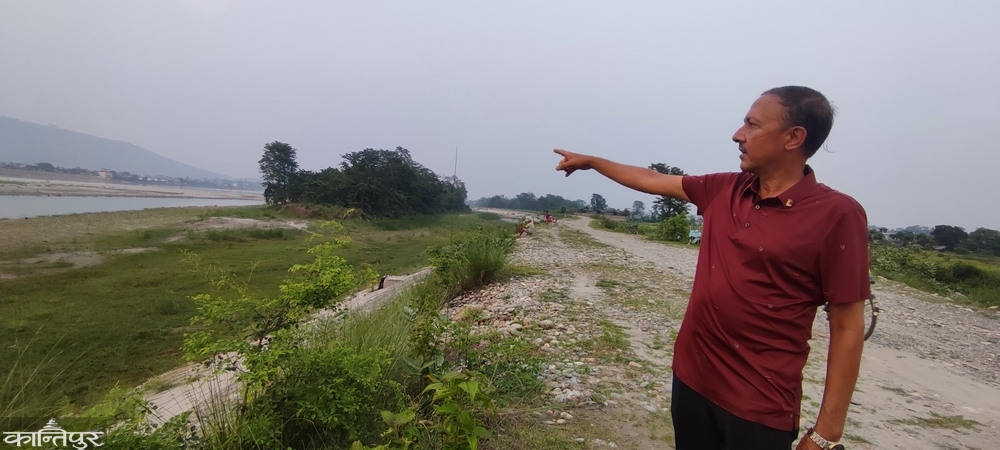
Of these, 8 people died in rhino attacks. Similarly, in the current fiscal year, two people were killed by rhinos and one by tigers, Magar said.
Not only humans, but rhinos that enter settlements for grazing are also at risk. In the current fiscal year alone, two rhinos died of electrocution while grazing in fields in Kawasoti of Nawalparasi (east of Bardaghat Susta) and Madi of Chitwan.