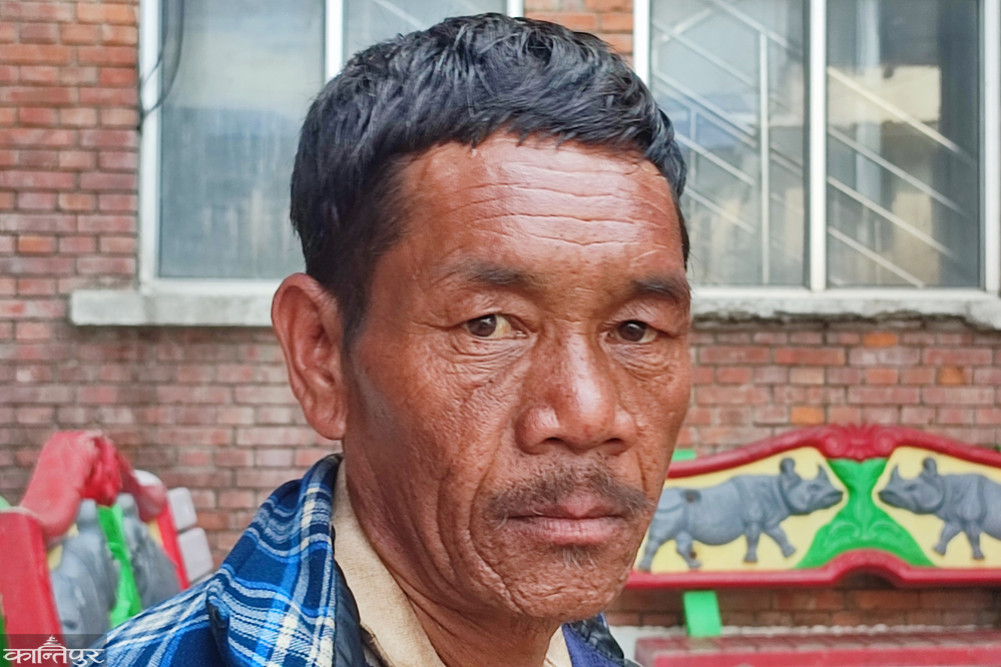
The Chepangs have an old tradition of making a living by eating yams, yams, yams, yams, yams, yams, and mushrooms found in the forest. Even though they have been eating mushrooms for a long time, they cannot distinguish which ones are poisonous.
We use Google Cloud Translation Services. Google requires we provide the following disclaimer relating to use of this service:
This service may contain translations powered by Google. Google disclaims all warranties related to the translations, expressed or implied, including any warranties of accuracy, reliability, and any implied warranties of merchantability, fitness for a particular purpose, and noninfringement.
Shyam Bahadur Chepang arrived at Bharatpur Hospital on Friday afternoon, sitting in the back of a Bolero jeep carrying goods. His neighbors were there. When the vehicle stopped in front of the emergency room, everyone pulled out the body wrapped in a dirty cloth.
It was Shyam Bahadur's 9-year-old youngest daughter, Namuna. Shyam Bahadur's two other children were being treated inside.
Namuna had already passed away, while Shyam Bahadur's 13-year-old eldest daughter, Manita, and 11-year-old son, Sajan, who were in serious condition, were rushed to the hospital for treatment by the local school principal Lok Bahadur Magar. Shyam Bahadur arrived about two hours after they were admitted to the emergency room and treatment was started.
Shyam Bahadur, who came carrying his youngest daughter's body, was hoping that his two children would recover and return home after treatment. But his son Sajan passed away on Saturday night. On Tuesday morning, the eldest daughter Manita also died. In this way, all three of her children lost their lives within five days.
‘They gradually got sick from Wednesday, April 30th, and then from Thursday. On Tuesday, April 29th, everyone slept after eating corn rice and greens. After that, they haven’t eaten anything. They even vomited when they drank water,’ says Shyam Bahadur. Shyam Bahadur and Padammaya’s condition is normal.
Shyam Bahadur, who was found in a depressed state in front of ‘B Block’ of Bharatpur Hospital on Sunday afternoon, recalled, ‘Exactly 10 days before the children fell ill, I ate bitter mushrooms brought from the forest.’ But he says this mushroom does nothing. He had brought bitter mushrooms from the forest and eaten them repeatedly last year. This year, they ate only once, and that too very little.
Bharatpur Hospital spokesperson Dr. Ram Prasad Sapkota said that all the symptoms of the deceased were consistent with the effects of eating poisonous mushrooms. But after the parents said otherwise, he said that they are going to confirm it through further tests and research. ‘The patient has all the symptoms of eating poisonous mushrooms.’ But since the parents said that they had not eaten any mushrooms immediately, we have not only done a post-mortem on the body but have taken blood samples for further tests. We have also taken some other samples,’ said Dr. Sapkota.
Senior Physician Dr. Pramod Poudel of the hospital says that some wild mushrooms contain a toxic substance called Amenita. Eating mushrooms containing such substances affects the liver. It also affects the nerves, blood and kidneys, and after complications develop, people even die. The child who came for treatment initially had a liver problem.
Wild mushrooms causing havoc is not new. Up to 8 people from the same family have died in Chitwan after eating mushrooms.
000
Soon after the SEE results were made public this year, the search for Sansar Bahadur Praja Chepang began in Chitwan. On 2067 Jestha 14, his grandfather Baburam Chepang cooked mushrooms brought from the forest and ate them with everyone in the family. Sansar Bahadur was not even a year old at that time. That is why he did not eat mushrooms. Everyone who ate mushrooms fell ill and died within a week.

Sansar Bahadur's grandparents, his mother, uncle and two sisters were in the house. Sansar Bahadur's grandparents and one sister died in the village after eating mushrooms. The remaining five people were taken to Bharatpur Hospital, but their lives could not be saved. After being orphaned, Sansar Bahadur was given an ashram by SOS Balgram in Bharatpur. From there, he passed SEE this year.
Shyam Bahadur, 55, and Padmamaya Chepang, 35, of Kulbang village in Ichchakamana-1, Kaule Hattibang, in the northern hilly region, recently lost three children, just as Sansar Bahadur lost all his parents 16 years ago.
The reason - the same wild mushroom.
000
On 31 Jestha 2069, in Chowkidanda, Kavilas, a hilly region of Chitwan, local Buddhi Bahadur Chepang brought mushrooms from the forest and ate them. He had his wife Somati and five brothers and sisters at home. Since they were the youngest of the sons, Saila and Kanchha did not eat mushrooms.
After falling ill after eating mushrooms, all five of them were admitted to Bharatpur Hospital. But none of the sick people survived. Buddhi Bahadur's eldest son, who survived because he did not eat, was two years old at the time. The youngest son was only 6 months old.
After the incident, the then Chief of Army Staff of the Nepal Army, Chhatraman Singh Gurung, took the two-year-old son and educated him. The youngest stayed with his aunt.
'The youngest is still with his aunt. The son taken by Chhatraman Sap is studying in Kathmandu. How much did he study, this time he came home. I made him a citizen and sent him,' said Lil Bahadur Chepang, the brother of Buddhi Bahadur, who died after eating mushrooms.
In two previous incidents, the child had lost his parents. In this incident, the parents have lost all their children.
The pain of a remote village
The Chowkidanda of Kavilas, where five members of a family died after eating mushrooms, is now in Bharatpur Metropolitan City-29. But this hilly area is still not easy to reach.
The Chowkidanda can be reached by going up and down the southern hilly area from Bhorle, 20 kilometers from Narayangadh on the Narayangadh-Muglin road. The distance between Bhorle and Chowkidanda is 10 kilometers. At the time of the incident, the road to Chowkidanda was more difficult than it is now. Vehicles used to ply their trade.
Even now, there is no road to reach Kandama. Bhandara Bazaar, located on the Mahendra Highway, is 25 kilometers east of Narayangadh. North of Bhandara is Lothar's Kanda. After crossing the hilly road for about two hours in a car, you have to walk uphill for at least three more hours to reach Kanda. 16 years ago, you had to walk continuously for 10-12 hours all day to reach the highway.
The Chepangs are a very marginalized tribal community. They live in a hilly area with dry and steep land.
The situation in Kulbang is similar. Shyam Bahadur's ancestral home is Kulbang. There is corn on the hill slopes. Millet planted with care also grows. There are not many other grains and vegetables. At this time, corn has grown rapidly. There is little corn left from last year. The rice that is usually cooked at home is the same.
Vegetables have not grown in the fields. They have been avoiding the shortage of vegetables by cooking the takki brought from the forest.
The village of Syarling is an hour and a half away from Kulbang. There lives a Jhakri who works as a ploughman. In the customs of the Chepangs, he is considered a great Jhakri. Shyam Bahadur decided to take the help of the same Jhakri who works as a ploughman. When it got light on Friday, he left for Syarling village. It was a little late when he brought the Jhakri. The neighbor had already rushed the patient to Hattibang for treatment.
It took one and a half hours to reach Bharatpur from Shaktibang on the Shaktikhor Fisling road via Hattibang, Banspur. There is no vehicle from Kulbang to Hattibang. Shyam Bahadur says he has to walk for one and a half hours.
Such incidents have occurred in places far from the city and the road where it is not possible to get treatment quickly. Where even if the patient is seriously ill, the practice of seeking treatment instead of taking them to the hospital still persists.
Rural Municipality's notice - 'Do not eat mushrooms'
Ichchakamana Rural Municipality issued a notice on Wednesday and appealed not to eat any mushrooms from the forest.
The rural municipality has asked to completely stop the use of wild mushrooms after three children died in Kulbang. The rural municipality has requested not to pick, sell or cook mushrooms to avoid putting the lives of families and innocent children at risk.
'Native or wild mushrooms that grow naturally in the forest can be extremely poisonous.' "Let's stop eating wild mushrooms as it is not easy to distinguish which mushrooms are edible and which are not," the notice issued by Chandrakant Basnet, the chief administrative officer of the rural municipality, states.
Similarly, the municipality has also requested that if you fall ill, you should immediately go to the nearest health facility instead of relying on Dhamijhakri or traditional medicine. After the onset of Chaitra, there is a shortage of food in Chepang village. "Now it is decreasing. But earlier, after the onset of Chaitra, there was no food at all, it was like a famine," said Santa Bahadur Chepang, general secretary of the Nepal Chepang Association.
According to him, it is an old custom for the Chepangs to survive by eating tubers, yams, gittha, bhakur, sisno, tanki and mushrooms found in the forest during this time. "They have been eating mushrooms since ancient times. But it is difficult to know whether they are poisonous or not." "Even the mushrooms you eat can sometimes be poisonous," he said. He urged everyone to work together to spread awareness about the issue.