The constitution provides for free education up to grade 12, but the number of schools operating without any fees is almost zero.
We use Google Cloud Translation Services. Google requires we provide the following disclaimer relating to use of this service:
This service may contain translations powered by Google. Google disclaims all warranties related to the translations, expressed or implied, including any warranties of accuracy, reliability, and any implied warranties of merchantability, fitness for a particular purpose, and noninfringement.
Around 8,000 students are studying at Kalika Manav Gyan Secondary Community School in Butwal. Only 350 teachers are employed. Of these, 65 are permanent. The school has arranged 288 teachers from private sources. The government provides the school with a monthly operating expense of Rs 30,000. But the school pays between Rs 3.5 lakh and Rs 1.4 lakh per month for electricity alone.
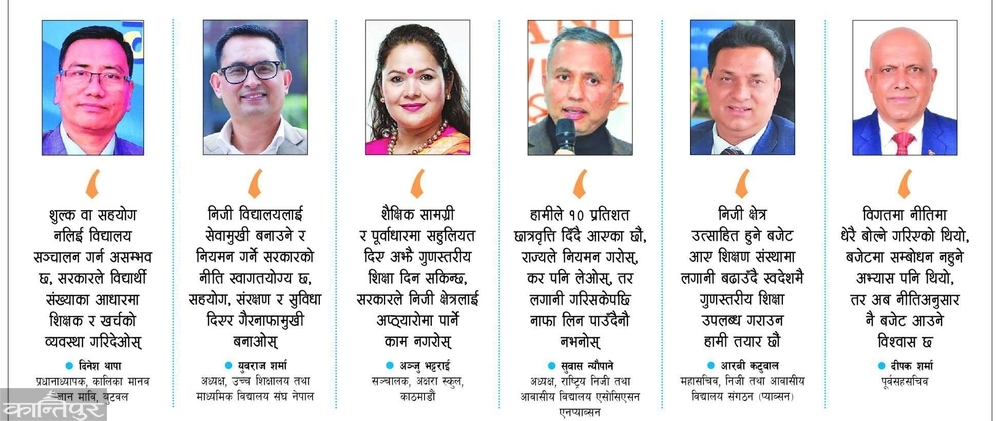
The statistics of the school with the largest number of students in Nepal show both the government's investment and the situation in public education. 'It is impossible to run a school without charging fees or support from parents. It would have been enough if the government had only arranged teachers and operating expenses based on the number of students,' said Principal Dinesh Thapa. There are 27,000 community schools across the country. The situation in almost all schools is the same.
The constitution has provided for free education up to grade 12. But the number of schools operating without charging any fees is almost zero. The government does not allocate any budget for conducting examinations. Therefore, community schools are forced to charge fees from students. Therefore, stakeholders expect the government to ensure technology-friendly learning and free education.
The constitution has provided for free education up to grade 12, but the number of schools operating without charging any fees is almost zero. The government has been investing more than 200 billion annually in education. But the legal system of compulsory education up to grade 8 and free education up to grade 12 has not been implemented. Stakeholders say that despite the government spending a lot of money, the amount is insufficient for free education.
In 2081, the Ministry of Education had projected that double the budget would be required to implement free education. The ministry's draft on the implementation of compulsory and free education states that an additional budget of 230 billion would be required. Last year, 10.75 percent of the total budget was allocated. The government's commitment to allocate at least 20 percent of the budget for education has not been fulfilled.
Educationists also point out that teachers need incentives and training programs. The government has not been able to invest in this work. ‘Quality education cannot be achieved without encouraging teachers,’ said Kalika Principal Thapa, ‘We have also provided social security facilities to private teachers. That is why a large amount of expenditure should be raised from the parents. Parents are in trouble. The government has said that education is free.’
According to educational statistics, there are 188,000 teachers working in community schools across the country. Of this, only 188,000 are permanent teachers. A large number of teachers have been appointed in schools on temporary, contract and relief. A government survey estimates that there are about 30,000 more teacher positions at the primary level. There is a shortage of teacher positions at the junior secondary and senior secondary levels. There is a shortage of 56,000 teacher positions according to government data.
Since 2057 BS, there has been no increase in teacher positions in community schools. The number of permanent teachers in grades 11 and 12 is zero. The distribution of teacher posts is also uneven. In some places, there are many teachers, few students, and in others, there is a situation where there are many students and few teachers. Less than 100 students study in 15,000 schools.
The government has been investing more than 200 billion rupees annually in education, but the legal system of compulsory education up to grade 8 and free education up to grade 12 has not been implemented. The government has been announcing that teacher posts will be allocated based on the number of students for a decade. But it has not been successful. The same has been announced in this year's policy and program. Former Joint Secretary Deepak Sharma pointed out that the government should bring a budget according to the policy and program and solve the problems that have existed since the past.
'In the past, there was a lot of talk in the policy.' There was also a practice that was not addressed in the budget,' said Sharma, 'now I believe that the budget will come according to the policy.' Former Joint Secretary Sharma said that the problem of teachers should be solved forever by adding teacher posts, adjusting schools or strictly matching teacher posts.
Sharma suggests that the budget, which is deficient in the education sector, should be increased and policies, programs and budgets should be linked together. 'The concept of cost sharing between the union, state and local governments should be given. Coordination can also be done with the private sector. There is no coordination,' Sharma added, 'Common objectives and investment in common work can also be shared.' He said that arrangements should be made to allocate the budget based on the reform plans made by the local level and schools.
The Principals' Association Nepal, the Teachers' Federation and other stakeholders have drawn the attention of Education Minister Sasmit Pokharel to the issues that should be included in the budget. Sudam Gautam, the President of the Principals' Association, pointed out that the shortage of school operating expenses is a problem for schools across the country. The lack of subject-specific teacher positions is the second major problem of community schools.
‘The 30,000 rupees given by the government per month should cover all the expenses of electricity, telephone, internet, water, audit, and sanitation.’ There is no budget for infrastructure maintenance,’ he said, ‘Schools with a large number of students are forced to collect donations, support, and fees.’ Principal Gautam complains that auditing of community schools is another major problem.
‘Community schools get audited by the private sector.’ The cost for that is not enough. Donations should be collected from parents. The system of auditing through the government mechanism should be implemented as a policy,’ Gautam said. Schools complain that there is no separate budget for extracurricular activities and sports. Gautam stressed on paying attention to teacher training and capacity building. He said that budget is needed for exams and student evaluation.
Gautam suggests that the government should focus on implementing the policy and program to provide internet to 10,000 schools. ‘The budget for digital infrastructure should be increased.’ He added, ‘Minimum digital materials including electricity, internet, smartboards, photocopying, printing have become mandatory in all schools.’
Private schools want policy clarity
Private school operators are confused due to the different policies taken by the government. Last year, when the School Education Bill was being advanced, there was a debate on the issue of taking private schools to non-profit trusts, making them service-oriented, and allowing them to operate on the company model. The government has announced in its policy and program that it will regulate private schools by making them service-oriented.
Sharma said that instead of providing scholarships to private schools of a special nature, it is possible to go for a model of directly supporting community schools. He suggested that the government should provide concessional loans to stop the trend of going abroad to study higher education. 'In the first phase, arrangements can be made for 10,000 students to study higher education in Nepal by providing concessional loans of Rs 500,000 to 1.5 million,' added Hisan President Sharma. 'Subjects such as IT and engineering, which many students go abroad for, can be taught in Nepal.' He pointed out that this would help both the government and the private sector. Hisan has also raised a demand for revising the private school fee determination criteria 2072. Although the government’s policy of making them service-oriented and regulating them is welcome, the program should be moved forward accordingly, says Yubaraj Sharma, president of the Higher Education and Secondary Schools Association Nepal (HISAN). ‘We agree with the government’s policy of improving community schools, regulating and encouraging private schools.’ He said, ‘Since privatization is rampant, it seems that they are trying to take them along with the government.’ He said, ‘The government should clearly say how to make them service-oriented.’ He said that the government can make private schools non-profit by providing support, protection and facilities. Even though the government has spent a lot of money, stakeholders say that the amount is insufficient for free education. It is estimated that private educational institutions have invested more than 600 million. According to government data, out of 700,000 children studying in community schools, more than 2.3 million are studying in private schools. 8,500 private schools and about 800 campuses are operated by the private sector. Hisan Chairman Sharma claims that they have an annual turnover of 200 million. He pointed out that since they have directly employed 350,000 people, clarity is needed about its operation, management and regulation. ‘We are giving scholarships to at least 10 percent of students.’ The government should make arrangements for students who have studied on scholarships to study in Nepal at least up to the bachelor's level,' said Hisan President Sharma. 'The trend of studying in private schools for free up to grade 12 and then going abroad is causing losses to both the government and the private sector.'
Anju Bhattarai, director of Akshara School Kathmandu, emphasizes that the private sector is a partner of the government and is ready to move forward together, so a policy should be brought accordingly. ‘Sometimes it feels like the government is trying to control private educational institutions. We want a rescue policy. We want regulation and monitoring,’ she said. ‘We want to increase investment and bring foreign students to Nepal.’ She said that there should be a simple and transparent process in establishing and operating private schools. ‘If the government provides concessions on educational materials and educational infrastructure, more quality education can be provided. The government should not embarrass the private sector,’ she said.
Private educational institutions have been influencing areas such as the expansion of medical, engineering and other technical education, modern infrastructure, use of information technology, competitive educational environment, and international-level teaching practices. High fees, inequality in education, commercialization, and low access to rural areas are the allegations against private educational institutions.
Private educational institutions expect a clear policy from the government, says Subash Neupane, president of the National Private and Residential Schools Association (NPASAN). ‘Now the government has said that it will make it service-oriented and regulate it.’ This is acceptable. But sometimes it also talks about making it non-profit. That leads to a situation of discouragement,’ he said, ‘We have been giving 10 percent scholarship. Let the state regulate. We have also been paying taxes, but don’t say that we cannot make a profit after investing.’
Pointing out the need for a clear policy, Private and Residential Schools Association (PABSON) General Secretary RB Katuwal emphasizes the need to create an environment for more investment. "Private educational institutions should be regulated and brought under the tax net," he said. "The state should encourage infrastructure development and IT-focused teaching by providing loans at a simple interest rate." He said that if the budget comes, the private sector will be encouraged to increase investment in educational institutions and provide quality education in the country.

