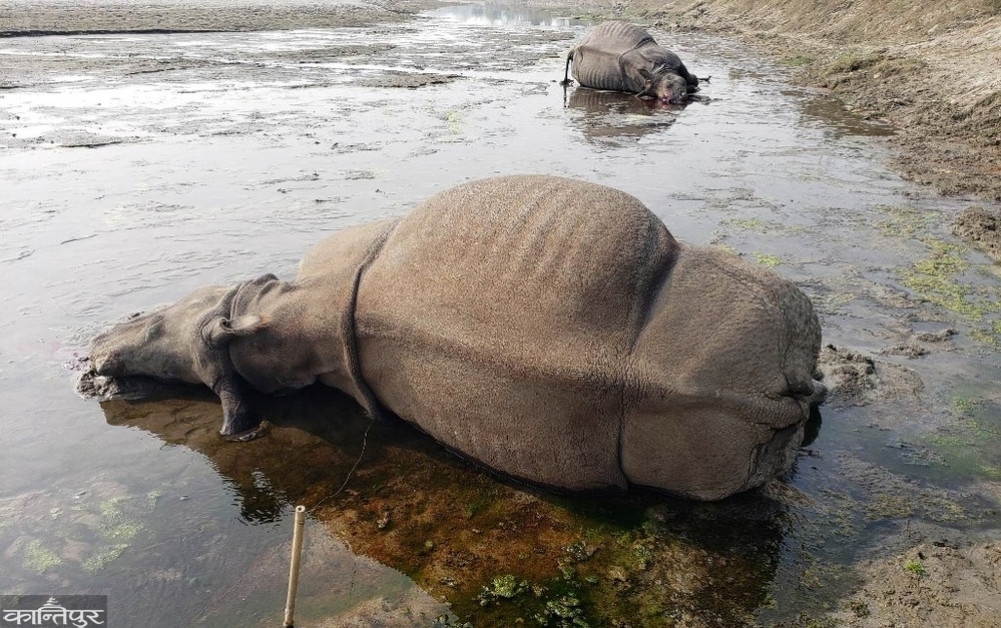
The number of rare rhinos dying has increased as smugglers use electric traps to kill rhinos for their horns and farmers turn off electricity to protect their crops.
We use Google Cloud Translation Services. Google requires we provide the following disclaimer relating to use of this service:
This service may contain translations powered by Google. Google disclaims all warranties related to the translations, expressed or implied, including any warranties of accuracy, reliability, and any implied warranties of merchantability, fitness for a particular purpose, and noninfringement.
A dead rhinoceros was found in a corn field in Syauli Tol, Kawasoti Municipality-1, Nawalparasi (East of Bardaghat Susta) last Friday morning. The place, two kilometers north of the highway, is not in the buffer zone of the park but falls under Division Forest.
The Division Forest Office of Nawalpur Kawasoti is investigating the incident. Twenty-seven bamboo poles wrapped in GI (bending) wire were found hidden in a grove of trees along the Lokaha River, two hundred meters south of where the dead rhinoceros was found.
A statement issued by Division Forest Office stated that about 13 meters of wiring wire including single-phase rings were also recovered from a house located northwest of the incident. “Based on the recovered materials and the condition of the incident, it is preliminary estimated that the rhinoceros may have died of electrocution,” said a statement issued by Division Forest Office Information Officer Subash Adhikari.
According to the forest office, the rhino may have fallen into a trap set to protect crops or for some other reason rather than for its horn. The number of rhino deaths due to electric shocks has been increasing in recent years. The number of rare rhino deaths has increased as smugglers set electric traps to kill rhinos for horn and farmers also turn off the current to protect crops.
According to the report of the Chitwan National Park, out of the 204 rhinos that died in the eight years from the fiscal year 072/73 to 079/80, 7 were due to electrocution. The number of rhino deaths due to electrocution has not stopped. The information officer said that since the place where the rhino was found dead on Friday is near the forest and buffer zone of the park, the rhinos are roaming around. ‘An investigation officer is being appointed.’ It cannot be said right now. It could also be for the horn. It could have been done to protect the corn by setting up a fence and releasing the current or to kill animals like wild boars,' he said.
A rhinoceros died after falling into an electric fence installed to protect crops in the buffer zone of Chitwan National Park on July 21. A rhinoceros was found electrocuted in the paddy field of farmer Haribhakta Shrestha of Bhairabpur, Madi Municipality-2, Chitwan. Shrestha had set up a wire around the field and released the current to protect the paddy crop. He was arrested after the rhinoceros died from the same current.
A year earlier, on July 8, 2002, a rhinoceros was found dead in a corn field after falling into an electric fence in Bhagadi, Bharatpur Metropolitan Municipality-26. At that time, the park suspected that the rhinoceros had fallen into a trap set to kill wild boars. Rhinos have been falling into electric traps like every year since the fiscal year 2079/80. 'We have been making the locals aware and alert in various ways. We have explained that if they arbitrarily release electricity on the fence, the animals will die and legal action will be taken after they die.' Since the incident has not stopped, we will intensify this campaign through the local buffer user committee,' said Conservation Officer Avinash Thapa Magar, who is also the park's information officer.
Not only animals but also humans have died due to the installation of electric fences in this way. Last year, on the day when the rhino was found dead in Madi, Lal Bahadur Moktan was also found dead in a rice field in Manahari Jogital, Makawanpur. He died after falling into the electric fence installed to prevent the rhino.
The method of installing fences in the buffer zone, which sends controlled electricity and gives a mild shock, is being used to protect crops. According to Shivaji Gaik, chairman of the Chitwan National Park's buffer zone management committee, the electric fence used to scare and scare away wild animals is powered by solar energy. It does not have a continuous flow of electricity. A system is installed to send electricity to the wire at intervals of one or two seconds. If the animal touches the wire and the ground, it gets a shock. There is no other harm. After the shock, the animal runs away in fear. Such fences are common in the buffer zone of the park. But there are no fences or any other reliable fences everywhere. Such deadly electric traps are being adopted there. In their own way, fences installed with uncontrolled electricity have killed both humans and rare wildlife. The same method is also being used by smugglers to kill rhinos for their horns.
On Magh 2079, it was confirmed that the rhinoceros that died of electrocution in Madhyabindu Municipality-2 near Bhutaha Post under Amaltari Sector of Nawalparasi was killed by smugglers as the horn was not found. The then information officer of the park, Ganesh Tiwari, had said that the rhinoceros' post-mortem also showed that it was electrocuted.
The park has a provision to provide relief if wild animals damage crops in the buffer zone. Local farmers say that they would not take the risk of setting electric traps to protect their crops by increasing the amount received for crop damage and simplifying the process. 'We are explaining this to the locals through the buffer zone for the protection of forests and wildlife. There is a provision for compensation for the damage caused by animals. Therefore, we request you not to do anything that will put yourself and the animals at risk to prevent damage,' said Gaik, chairman of the buffer zone management committee of Chitwan National Park.
Rhinos are the rarest wild animals in the world. The one-horned rhino is found in Nepal after India. There are many rhinos in Chitwan, Nepal. According to a census conducted five years ago, there were 752 rhinos in the country, but there were 694 in Chitwan National Park and its surrounding areas. There is a legal provision that if a rhino is killed, its parts are traded or transported, it will be punished with imprisonment for 5 to 15 years or a fine of 500,000 to 150,000 rupees, or both. There have also been cases of rhinos found dead in farmlands that have been investigated and punished.