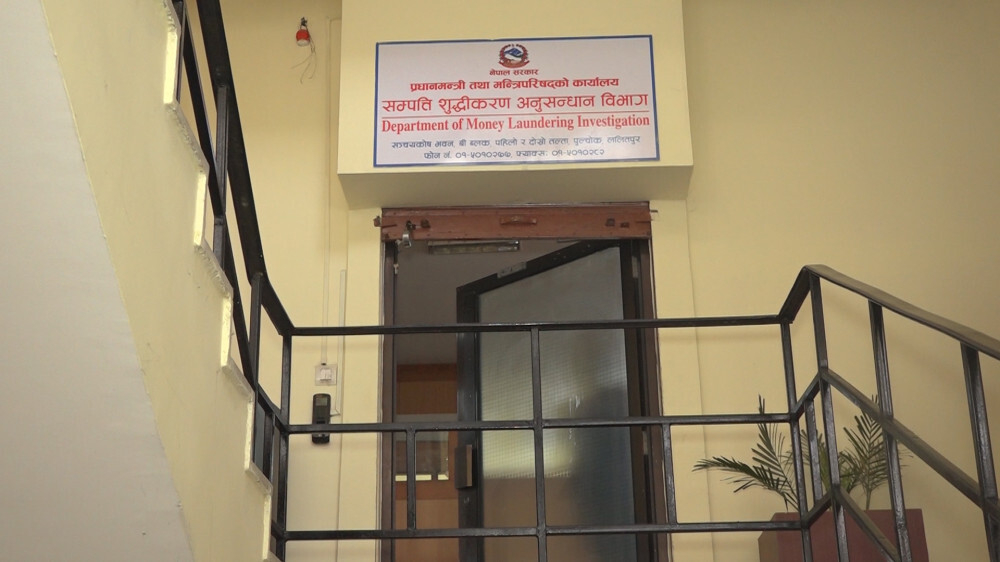
Legal experts have raised serious questions about the investigation process of the Money Laundering Department after Interpol refused to issue a red notice against the Deuba couple.
We use Google Cloud Translation Services. Google requires we provide the following disclaimer relating to use of this service:
This service may contain translations powered by Google. Google disclaims all warranties related to the translations, expressed or implied, including any warranties of accuracy, reliability, and any implied warranties of merchantability, fitness for a particular purpose, and noninfringement.
After Interpol rejected Nepal's request to issue a red notice against former Prime Minister Sher Bahadur Deuba and his wife, former Foreign Minister Arju Rana Deuba, the police have sent another letter.
The Police Headquarters had first written to Interpol in the last week of Chaitra at the request of the Money Laundering Investigation Department to extradite them to Nepal for investigation on charges of money laundering.
It is said that they had gone to Singapore for medical treatment before the 21 Falgun elections and are currently in Hong Kong. However, Kantipur could not independently confirm their whereabouts.
According to information provided by the department and the Police Headquarters, two main reasons were presented to Interpol as the basis for issuing a notice against the Deuba couple. An investigation is underway on charges of money laundering through illegal acquisition and for that, an arrest warrant was issued against both of them by the Kathmandu District Court . However, the Interpol Secretariat returned the notice against the Deuba couple, saying that the grounds for issuing the red notice were 'insufficient'.
According to the department concerned with the investigation and the Police Headquarters, Interpol has raised questions about the offenses for which the notice was issued in the past and under which law the money laundering investigation is currently being conducted. After that, the Police Headquarters has made a second request to Interpol at the request of the department, mentioning the progress of the investigation against the Deuba couple, the details of the suspicious assets in their names, the forensic report of the burnt notes found in their house on 24 Bhadra. An official at the Police Headquarters said that the second request has not been answered.
Since Interpol has not issued a notice, the government's immediate efforts to arrest and bring them from abroad have been 'broken'. Along with this, the investigative agency has been criticized for being hasty in immediately arresting Deuba, who has been at the center of power for nearly three and a half decades, and this has led to procedural errors. Similarly, some legal experts have also expressed doubts that the case was not being moved forward by reaching conclusions in advance. In addition, the question has been raised whether Interpol's interpretation of the prerequisites required for an investigation into money laundering is different from that of Nepal's investigative agencies.
Deputy Attorney General Sanjeev Raj Regmi says that if the investigative agency makes procedural errors, the case against the accused will be weakened and even if the proceeds of crime have been laundered, there is a risk that the culprit will be acquitted.
'The essence of the law does not mean that the suspect should be detained and investigated,' Regmi says, 'The law says to first collect evidence and then prosecute in money laundering cases. But looking at some recent incidents of the department, it seems that it is better to arrest and collect evidence first.'
He believes that the context of Interpol's refusal to issue a notice against the Deuba couple should be viewed in conjunction with the department's procedural error. He says, "The investigating agency should answer why this happened."
The Prevention of Money Laundering Act defines money laundering as the act of hiding the source of, changing the nature of, or defrauding the transactions of assets acquired through illegal activities to make them appear legitimate. According to this definition, two conditions are essential for money laundering to occur. First, acquiring property from a crime. For example, earning property through crimes such as corruption, revenue fraud, human trafficking, etc. - which are called predicate offenses in money laundering cases - is a crime. Second, making such property appear legitimate and entering the financial system and purifying it. This second stage of work is mentioned in the judgment of the full bench of the Supreme Court in 2081 Kartik.
Similarly, the Supreme Court of India, in its July 2022 ruling, has set the criteria for the detection of proceeds of crime to be considered money laundering. Accordingly, money laundering is not a predicate offense in itself, but a secondary offense as a by-product of the main offense.
Similarly, the United Nations Convention on Transnational Organized Crime has defined money laundering as the transfer, transfer or conversion of property with the intention of concealing the source of the proceeds of crime.
There was no law in Nepal before 2064 BS to prosecute such offenses. After the enactment of the Act, the Money Laundering Investigation Department was given the responsibility of investigating such offenses.
The department has always been under the direct control of the government. Initially, this body, which was under the Ministry of Finance, was transferred to the Prime Minister's Office in Falgun 2074 BS during the tenure of KP Sharma Oli. The last time the department was brought back under the Ministry of Finance during the electoral government formed after the Gen-G movement on 23 and 24 Bhadra.
If officials and employees holding public positions acquire illegal assets, the Commission for the Investigation of Abuse of Authority investigates and prosecutes them. However, legal provisions were made to investigate the assets of persons who do not hold public positions whose sources are not disclosed. However, on 30 Chaitra 2080, the Prevention of Money Laundering Act-2064 was amended to allow the Authority and other investigative bodies to investigate crimes related to money laundering.
This provision was made because any crime of illegally acquiring assets can be a related crime and the investigating and prosecuting bodies differ depending on the nature of those crimes. For example, crimes related to forests or parks are investigated and prosecuted by the Forest or Park Office, or cases related to revenue embezzlement by the Revenue Investigation Department, or corruption cases by the Authority, so if the assets earned from those crimes are laundered, those bodies will investigate and prosecute the assets themselves. The law has been amended to also investigate money laundering.
The Act has made provision for 32 different types of crimes to be investigated by the relevant agency, and if illegal assets are found to have been acquired from the crime, the same agency can investigate and prosecute them separately as money laundering. This includes crimes such as human trafficking and smuggling, sexual exploitation, drug trafficking, illegal arms trafficking, corruption or bribery, fraud, forgery, and counterfeit currency. If it is found that money laundering has also taken place during the investigation of these crimes, there is a provision for considering it as a related crime and conducting a separate investigation into money laundering.
Legal experts say that it is generally not necessary to arrest to gather evidence in the investigation of money laundering crimes. Deputy Attorney General Regmi says that although a person can be arrested if there is a risk of escape or if there is a possibility of losing evidence, there is no point in showing haste in arresting him in a money laundering case. According to him, this crime It is not something that happens overnight and tomorrow, and therefore, investigative agencies should not misuse the legal provisions related to arrest for their own convenience.
Section 19C of the Prevention of Money Laundering Act-2064 states that special investigative methods will be adopted during the investigation. Under this, it is mentioned that methods such as mobilizing leads, secret investigative actions (covert cover operations), obtaining telephone or media details, not making immediate arrests for the purpose of obtaining additional evidence and information, and accessing the structure or system of computers or other electronic devices should be adopted in the investigation. However, in recent days, the department has been accused of arresting people and only gathering evidence.
Advocate Subhash Acharya says that the investigation has not been result-oriented and effective because the investigation related to money laundering has been used as a weapon to target individuals in the past. Acharya, who said that the red notice process against Deuba was natural, arrested He said that it is wrong to say that the case will be investigated only after doing so. ‘Burned notes were found in the house, but since there was no investigation from other bodies, it had to be done by the department, it happened, it cannot be said otherwise .’
On the other hand, he also argues that those in power have made the department a source and means of gaining power . However, he said that the arrests and attempts to arrest seen in recent days should be taken positively .
‘The department was made a tool to gain power, the directors general used the department as an opportunity to get close to the power center. It was made a means to intimidate those who have money,’ Acharya said, ‘The current government should end such a trend.’
While investigating such crimes, the method of first collecting evidence and only then arresting should be adopted, and the investigative agencies should improve their tendency to arrest people and try to gather evidence . Stating that investigations should be conducted by the authority in the case of people holding public positions, he said, ‘But, that did not happen in the past. Therefore, in the recent events, the Money Laundering Investigation Department has been used against leaders I understand that it has become proactive.’
With the amendment of the Money Laundering Act on 30 Chaitra 2080, the department is not allowed to directly investigate the complaints filed with it. An investigation officer currently investigating leaders and businessmen also says that the law, which was amended two years ago, does not allow the department to investigate and prosecute subsequent complaints. He understands that the law has clarified that only in the previous cases can the department investigate the complaint. The amendment had removed the department’s jurisdiction. This means that the department can conduct a preliminary investigation and send the person to the relevant body for investigation. According to this provision, even though the department arrested former minister Deepak Khadka on money laundering charges last month, it was handed over to the Revenue Investigation Department after the preliminary investigation.
In the case of the Deuba couple, the department itself has been involved in the process from writing for arrest to placing them on the absconding list. This not only leads to procedural errors but also to the related offenses. Senior advocate Khamma Bahadur Khati, who was the Attorney General when Deuba was the Prime Minister (2078), said that the jurisdiction of the investigating agency has also been ignored. The government has recently amended the Money Laundering Act through an ordinance, giving the department the power to investigate financial crimes by considering them as related offenses. The police said that the amendment of the law to give the department such power was also mentioned in the second letter sent to Interpol for a red notice against the Deuba couple. The director of the department, Uttam Kumar Ghimire, said that he was not aware of the investigation. He said, "We can say anything only after the investigation is completed, we do not know about it before that." Police spokesperson DIG Abinarayan Kafle said that the investigation is being conducted by the department and that the police are only involved in correspondence. Constitutional scholar Bipin Adhikari said that investigations into money laundering offenses are carried out under the direct control and convenience of the executive branch, so he is not aware of this matter. संसदमा व्यापक छलफल गर्नुपर्ने बताउँछन् ।
‘अपवादलाई छाड्ने हो भने कार्यकारी र विभागीय निर्णायधिकारीको इच्छामुताबिक अनुसन्धान गर्ने, आरोपितलाई थुन्ने अनि मात्र सुन्ने प्रवृत्ति झाँगिदो छ,’ अधिकारी भन्छन्, ‘सम्पत्ति शुद्धीकरण जस्तो विशिष्टीकृत र जटिल किसिमको अपराधमा त झन् थुनेर अनुसन्धान गर्ने वा प्रमाण खोज्ने भन्ने कुरालाई प्रोत्साहन दिनुहुँदैन।’
पछिल्लोपटक देउवा दम्पती र पूर्वमन्त्री खड्कामाथि भ्रष्टाचारमा अनुसन्धान नगरी सिधै सम्पत्ति शुद्धीकरणमा अनुसन्धान थालिएको विषयलाई अधिकारीले यसअघि रास्वपा सभापति रवि लामिछानेको सहकारी ठगी र त्यसमा लगाइएको शुद्धीकरणको मुद्दासँग तुलना गरे। कार्यकारी अधिकारसहितका निकायले शक्तिलाई दुरुपयोग गर्ने जोखिम कस्तो हुन्छ भन्नेबारे यी उदाहरणले प्रस्ट पार्ने उनको भनाइ छ।
‘भ्रष्टाचारको अनुसन्धानमा अख्तियार हुँदाहुँदै त्यसभन्दा एककदम अघि बढेर सरकारले विभागमार्फत मुद्दा चलाउन सुरुमै दृष्टिकोण बनाउने, त्यसपछि पक्राउ गरेर मात्र प्रमाण संकलन थाल्ने प्रवृत्ति घातक छ,’ अधिकारी भन्छन्।
विभाग स्थापनायताको डेढ दशकमा सम्पत्ति शुद्धीकरणसम्बन्धी १२१ थान मुद्दा अदालत पुगेका छन्। त्यस्तै सम्वद्ध कसुरको अनुसन्धान तत्तत् निकायलाई दिइएपछि अख्तियारले ६ वटा र प्रहरीमार्फत २१ मुद्दा दायर भएका छन् । राजस्व अनुसन्धान र वन कार्यालयबाट पनि केही मुद्दा अदालत पुगेका छन्। तर, सम्पत्ति शुद्धीकरण कसुरमा मागदाबीअनुसार फैसला भने भएका छैनन्।
अख्तियारजस्तो छुट्टै संवैधानिक निकाय नभएको बरू अर्थमन्त्रालयमातहत रहेकाले सरकारले चाहेमा जुनसुकै बेला आरोपितविरुद्ध शुद्धीकरणको डण्डा चलाउने बाटो खोलिदिएको भन्दै कानुनविद्हरूले चिन्ता जनाएका छन्।