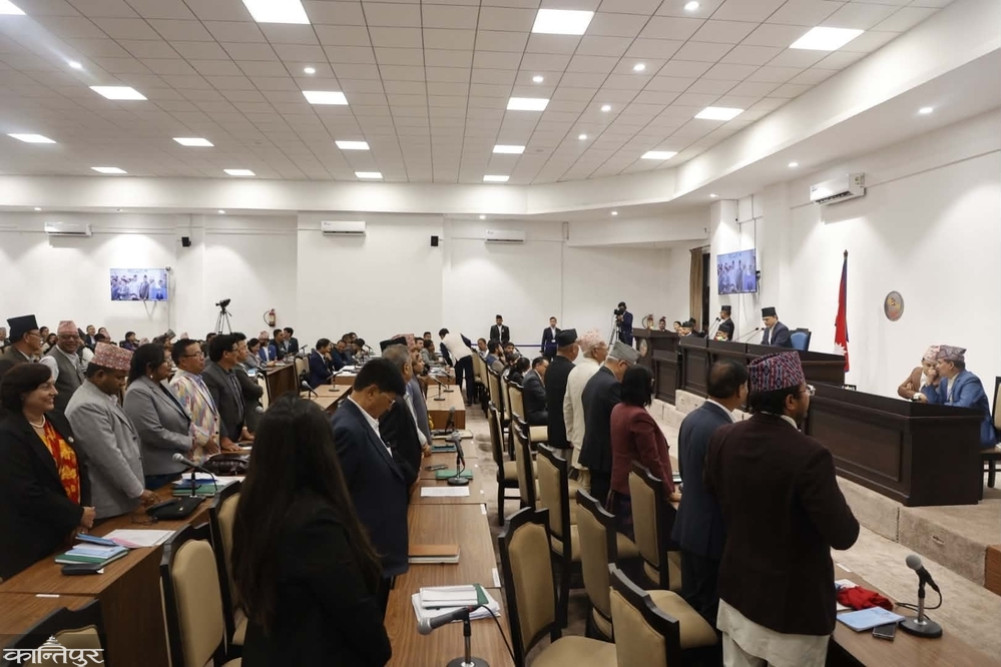
Article 76 (10) of the Constitution states that 'the Prime Minister and ministers shall be responsible to the Federal Parliament', but discussions on policies and programs were held without the Prime Minister's presence, and the opposition party's demand for a 'ruling' was not even heard.
We use Google Cloud Translation Services. Google requires we provide the following disclaimer relating to use of this service:
This service may contain translations powered by Google. Google disclaims all warranties related to the translations, expressed or implied, including any warranties of accuracy, reliability, and any implied warranties of merchantability, fitness for a particular purpose, and noninfringement.
Opposition parties strongly criticized the absence of Prime Minister Balendra Shah during the discussion in the House of Representatives on the government's policies and programs for the upcoming fiscal year. They also urgently demanded that the Speaker 'rule' the Prime Minister to attend the parliament meeting. But neither the 'ruling' was done, nor did Prime Minister Shah attend the meeting.
The government's policies and programs were passed on Thursday amid the opposition parties' obstruction and boycott in the House over Prime Minister Shah's absence. Finance Minister Swarnim Wagle answered the questions raised in the parliament meeting on behalf of the Prime Minister. Prime Minister Shah had assigned him the responsibility on Tuesday to participate in the discussion on the policies and programs and answer the questions of the lawmakers.
Why didn't Speaker Dol Prasad Aryal 'rule' the Prime Minister to attend even when the lawmakers were continuously raising their voices? Speaker Aryal, however, has said that the Prime Minister will attend even if he does not come, citing Rule 38 of the House of Representatives Rules, 2079 BS. The House of Representatives, formed after the February 21 election, is currently operating according to the 2079 rules as new rules are yet to be drafted. Rule 38 of the rules provides that the Prime Minister or a person designated by him can respond during discussions on policies and programs.
The ruling Rashtriya Swayamsevak Sangh (RSS) lawmakers are also citing the same rule and saying that the Prime Minister's mandatory presence is not necessary. The Constitution, however, provides that the Prime Minister and ministers shall be accountable to the Parliament. Article 76 (10) of the Constitution states, 'The Prime Minister and ministers shall be collectively accountable to the Federal Parliament and the ministers shall be individually accountable to the Prime Minister and the Federal Parliament for the work of their ministries.'
Experts in parliamentary practice say that the Speaker should rule because the parliamentary system is devalued if the Prime Minister does not come to the parliament and participate in the discussion on policies and programs and does not respond. Experts on parliamentary practice say that the Speaker should 'rule' since the Prime Minister's failure to come to Parliament and participate in discussions on policies and programs and not respond will devalue the parliamentary system. They say that the Speaker should act according to his official role and advance parliamentary practice.
According to former Secretary General of the Parliament Surya Kiran Gurung, since 2048, the Prime Minister has not been absent from the discussion on the government's policies and programs in Nepal's parliamentary practice. 'I do not remember the Prime Minister leaving the meeting while the policies and programs were being read out before,' he said. 'The Prime Minister would come when the discussion on policies and programs begins. If he is unable to stay for the whole day, the ministers will stay. But the current Prime Minister has completely ignored it. At such times, the Speaker should have ruled and called the Prime Minister to the parliament.'
Even if the Speaker rules, if the Prime Minister does not come to the house, a regret motion can be passed, says Gurung. ‘The Constitution itself has created a situation where the Prime Minister and ministers are accountable to the House,’ he said, ‘but it seemed that the Speaker (DP Aryal) had a different wish.’ Aryal was elected Speaker from the Rashtriya Swayamsevak Sangh (RSS).
The Prime Minister should be present as the policy and program are important announcements of the government for the coming year, and the leader of the main opposition party, Bhishma Raj Angdembe, had repeatedly repeated in Parliament. ‘His presence is a must in the discussion because the policy and program that he himself has decided will be taken to such a prestigious place. His future depends on its success. Was it difficult for him to be present and express his views and answer the questions raised?’ He said, ‘I request that a ruling be made. He should be present in this discussion. We have allowed it to be tabled.'
NCP Chief Whip Yubaraj Dulal had asked, 'Will the Prime Minister not be heard for 5 years by showing Rule 38 of the House of Representatives Rules?' 'The provisions of the rules are for when the Prime Minister goes abroad, is ill, and is in an uncomfortable situation, so that other work is not stopped. Article 76 (10) of the Constitution states that the Prime Minister and ministers will be accountable to the Federal Parliament, hasn't that been mocked?'
RPP Parliamentary Party Leader Gyan Bahadur Shahi also said that the provision of Rule 38 is not permanent. 'What does Rule 38 say? What is our practice? In practice, ministers are appointed only if the Prime Minister falls ill or leaves the country. The Prime Minister is sitting in Singha Durbar wearing dark glasses, while here in Parliament we are looking for answers.'
Speaker Aryal had argued that he could not decide whether or not the Prime Minister or the MPs would come to Parliament. ‘You are saying that the Prime Minister must be ensured to come. I do not see any basis or authority for the Speaker to decide the agenda for tomorrow, not just the Honorable Prime Minister, but any Honorable Member of Parliament,’ he had said. As the Speaker was saying this, the RSP MPs clapped in support.
In the third meeting of the House of Representatives on Wednesday, the Speaker had said that he would consult the Prime Minister about his presence in Parliament. ‘There are some issues mentioned in the Rules and the Constitution, which we cannot stop. Therefore, let us sit down and help conduct the meeting,’ he had said, ‘I also do not want a situation where we have to rely on the Rules and forcefully run the House. That is why I am making this request.’
Before adjourning the meeting on Wednesday, the Speaker had said, ‘I would like to inform you that 31 Baisakh has been set as per Sub-rule 1 of Rule 38 of the House of Representatives Rules 2079 to present the amendments to the annual policy and program of the Government of Nepal for the fiscal year 2083/84 and to receive a response from the Honorable Prime Minister.’
Former Secretary General of Parliament Surya Kiran Gurung says that the Speaker should coordinate with the Prime Minister through the Minister for Parliamentary Affairs on this issue. ‘It does not mean that the Speaker will talk to the Prime Minister in the parliament meeting itself. Even after coordinating with the minister, if the Prime Minister does not come, the Speaker will rule.’
Former Speaker Taranath Ranabhat says that it is the Prime Minister’s duty to be present in Parliament except in special circumstances. ‘The Prime Minister is the leader of the Parliament. He should not ignore or evade the House. The Prime Minister must be accountable to the House. The Prime Minister cannot bypass the House even in accordance with international practice, values, the Constitution and the rules,' he said.
Former Speaker Ranabhat said that after sitting in the chair, he should operate the House within the scope determined by parliamentary values, rules and the Constitution. Former Speaker Ranabhat said that after the Speaker took the chair, he should operate the House within the scope determined by parliamentary values, rules and the Constitution. 'The Speaker is the hero of the House. After sitting in the Speaker's chair, one cannot say that he is the leader of a particular party. The dignity of the position should be maintained outside the House as well,' he said, 'Opposition parties can demand to call the Prime Minister to Parliament by ruling, but the Speaker should act in accordance with parliamentary dignity, values and norms and the practice of the Constitution and the Rules.'
Rashtriya Swayamsevak Sangh (RSS) Joint General Secretary Bipin Acharya, on the other hand, says that the Prime Minister's failure to come to Parliament is a disruption of continuity. "If the opposition party members feel that the Prime Minister, who exercised the authority granted by the House of Representatives Rules, was not accountable to the sovereign Parliament, they should know that there is a legal way to directly question the Prime Minister in Parliament by relying on Rule 56 of the House of Representatives Rules," he said. "Has the act of going beyond the rules and creating a forced situation by adjourning the Parliament without using it proved that the opposition party friends are accountable to the sovereign Parliament and the people?"
UML MP Rajendra Rai commented that the RSVP has become weak as a party by not being able to call the Prime Minister to the House. "You are weak, there is no doubt about it. No matter what excuse you make, the Prime Minister did not turn you down, no matter what happens," he said.
Ever since the proposal to table a discussion on policies and programs was to be discussed in the first meeting on Wednesday, the opposition party leaders had urged the Speaker to call the Prime Minister. Congress MP Arjun Narsingh KC had said that other ministers could propose a discussion on policies and programs, but the Prime Minister should answer.
RPP parliamentary party leader Gyan Bahadur Shahi had said, ‘If it is a people’s government, people’s accountability is sought from Parliament, not from Ratna Park. This is not just our issue, it is also a question of the existence of the Speaker. It is also a matter of the existence of the 181 MPs of the ruling RPP. Where else is the Prime Minister busy?’