The ruling party has come under legal and political pressure after the UML, Congress, and NCP filed a notice in the National Assembly to reject eight government ordinances.
We use Google Cloud Translation Services. Google requires we provide the following disclaimer relating to use of this service:
This service may contain translations powered by Google. Google disclaims all warranties related to the translations, expressed or implied, including any warranties of accuracy, reliability, and any implied warranties of merchantability, fitness for a particular purpose, and noninfringement.
The ruling party has come under legal and political pressure after opposition parties registered notices to reject all eight ordinances in both houses of the federal parliament with a strategy to defeat the ordinances brought by the government in the National Assembly. Opposition parties UML registered notices to reject eight ordinances, NCP four, and Congress two on Wednesday.
Even if the ordinance is rejected, the recommendation of the Chief Justice and the appointments that were canceled will not be returned. New appointments will be made according to the old law. Legal experts say that if the ordinance is invalidated, the message will be that even though the Rashtriya Swayamsevak Sangh (RSS) has about two-thirds of the votes in the House of Representatives, it cannot do whatever it wants since its presence in the National Assembly is zero.
According to Clause 'A' of Article 114, Clause 2 of the Constitution, an ordinance brought by the government must be accepted by both houses of the federal parliament. Even if only one of the two houses rejects it, the ordinance will automatically become invalid. ‘The ordinance will be presented to both houses of the federal parliament after its promulgation and will automatically become inoperative if both houses do not accept it,’ the section states. If the ordinance is automatically inoperative, the legal provisions amended through the ordinance will revert to their original status. Since the ruling Rashtriya Swayamsevak Sangh (RSS) has a strong majority in the House of Representatives, the ordinance will be easily approved. However, since the RSSS has zero presence in the National Assembly, the opposition parties are adopting a strategy to reject it from there.
The government is open to moving forward with a replacement bill within 60 days only for ordinances accepted by the National Assembly. In the case of rejected ordinances, a new bill must be brought to implement the same provisions. If not, the old act will be activated as per the established precedent of the Supreme Court.
In the case of bills that come through the regular process, the ruling party is not obliged to accept them from both houses as in the ordinance. Even if the National Assembly rejects the amendment bill, there is a constitutional provision that after the House of Representatives passes it, it can be sent to the President for certification.
There is no common understanding among the Congress, UML and NCP on whether to reject all of the eight ordinances brought by the government in one go or to selectively reject some. The Congress has registered a notice rejecting only the bills related to the Constitutional Council and amendments to some Nepal Acts. The notice was registered on Wednesday afternoon with the signatures of all the Congress MPs present in the National Assembly, including parliamentary party leader Kamala Panta and whip Padam Pariyar. The UML MPs have registered a notice rejecting all eight ordinances. The NCP has given a notice of rejection only for four.
The government had brought ordinances amending the Constitutional Council, the removal of public officials, public procurement, cooperatives, universities, health sciences institutes, money laundering and some Nepal Acts by postponing both sessions of the federal parliament that had been called on April 17. The UML has made a policy that all of them should be rejected, saying that the adoption of the ordinances by postponing the convened session was a serious procedural error.
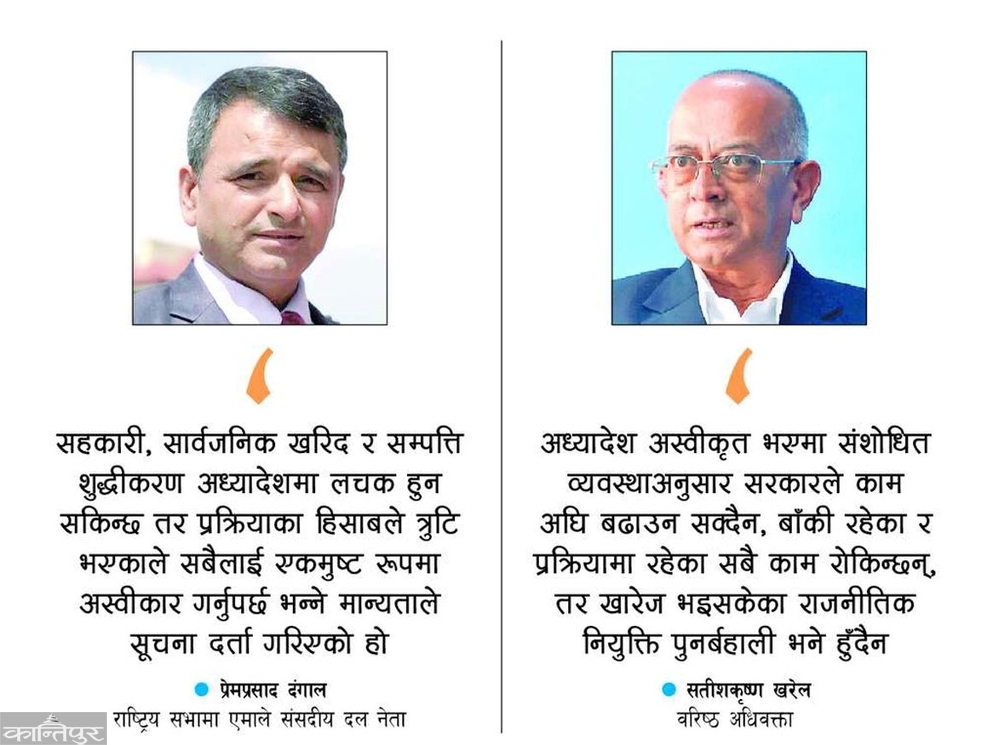
UML parliamentary party leader in the National Assembly, Prem Prasad Dangal, said that there could be flexibility in the cooperative, public procurement and money laundering ordinances. However, he said that the information was registered with the belief that all of them should be rejected unanimously because of procedural errors. ‘In the meantime, we will try to form a common opinion with other parties,’ Dangal said, ‘If not, we can consider some. We will reject all of them that are serious in nature. The three parties are in agreement on that.’
According to Jhakku Prasad Subedi, leader of the NCP parliamentary party in the National Assembly, the information has been registered to reject the Constitutional Council, some amendments to the Nepal Act, the dismissal of public officials and the ordinance related to universities. He said that the three parties will move forward by forming a common opinion.
Congress parliamentary party leader Pant said that since the UML has registered the information to reject all the ordinances, they will also discuss them. ‘Even if we reject all of them now, they can pass the bill they want after two months. The recommendation of the Chief Justice has been made. Political appointments have been canceled. "They (the ruling party) wanted it for one day," Panta said. But she said that discussions are ongoing on the information submitted by other parties as it can also be taken forward.
National Assembly Speaker Narayan Prasad Dahal said that a possible agenda has been set for discussion on the registered rejection notices on Jestha 7. After discussing it and submitting it for decision, if the proposal to reject the notice is passed by a majority, the ordinance will become inactive from that day. "Jestha 7 is only a possible agenda, it does not mean that it will be finalized on that day. There is a time limit of sixty days for the ordinance. Before that, the principles and priorities of the budget and the pre-budget issues are discussed," Dahal said. "Once all these work is completed, the discussion will also take place on the same day. Otherwise, there may be ups and downs for one or two days."
After the ordinance was issued, Prime Minister Balendra Shah, who is also the Chairman of the Constitutional Council, has decided to hold a council meeting and recommend Judge Manoj Sharma, ranked number four, as the Chief Justice of the Supreme Court. The parliamentary hearing process for it has already begun. Similarly, the government has initiated the process of new appointments in the universities, health science institutes, tourism and culture sectors on the basis of the ordinance. The government has revoked 110 political appointments made by the previous government through the ordinance made to make special provisions for the removal of public officials and 20 amendments to some Nepal Acts.
Senior advocate Satish Krishna Kharel says that if the National Assembly rejects the ordinance, the government will not be able to proceed with the work as per the amended provisions it has made. 'Whatever work has been done, will continue until it is revoked by the court or any other system, but all the work that is pending and in process will be stopped,' says Kharel. He says that if the ongoing appointment process is not completed and the ordinance is deactivated, those works will be stopped from the point where they reached. 'Then the government will either have to bring a new bill, or else the appointments will have to be made according to the provisions of the old act,' he added. Kharel says that the political appointments that have been revoked according to the ordinance cannot be reinstated because the ordinance has become inactive.
Regarding the dismissal of public officials and some amendments to the Nepal Act, most of the 20 amendments to the Act have not made any provision for new appointments. ‘The main objective of the government was to eliminate political appointments. Even if the ordinance is inactive, it cannot be reinstated. Appointments can be made according to the old Act,’ said Kharel. ‘The government does not seem to have much difficulty in this unless the Supreme Court deems the ordinance to be malicious and reinstates it.’
Although the three major parties have registered their own notices to reject the ordinance, all three parties have reached a common understanding regarding the Constitutional Council and the ordinance to amend some Nepal Acts. Congress parliamentary party leader Pant said in the National Assembly that discussions will be held on the issue of forming a single opinion while discussing others.
She said that efforts were made to bring not only the three parties but also the Rastriya Janamorcha, JSP Nepal and LOSPA, which are represented in the National Assembly, to an agreement. Janamorcha and LSP have one MP each and JSP Nepal has two MPs in the National Assembly. If even the small opposition agrees, the ordinance will be rejected unanimously.
The main target of the opposition is the ordinance related to the Constitutional Council. The government has amended the quorum and decision-making process in the ordinance brought to amend the Constitutional Council (Work, Duties, Powers and Procedures) Act, 2066 BS.
Amending the relevant provision in Section 6 of the Act, the government has made a provision that if four members including the chairman are present, a quorum is considered to be present and a decision can be made by a majority of those present, i.e. three. The opposition has expressed serious objections to the definition made in the ordinance related to the majority. The ordinance states that in a meeting where six members including the chairman are present, the decision of at least three members including the chairman will be considered the decision of the council. The opposition parties have been objecting to the provision that the side taken by the Prime Minister will be the majority if there are three members each in the council meeting and the opposition, as it is against the principle of majority.
The government has made a provision to abolish trade unions through an amendment to the Civil Service Act under the amendment of some Nepal Acts. The Congress has objected to this, saying that it is against the spirit of the constitution. Another Congress MP said that by opposing this provision, the amendments to 20 acts under the Some Nepal Acts have been repealed.
Some Nepal Acts brought by the government have been amended in the Ordinance on Amendments 2083, including the Employees Provident Fund Act, 2019, the Land (Survey) Act, 2019, the Land Act, 2021, the Education Act, 2028, the Land Revenue Act, 2034, the Technical Education and Vocational Training Council Act, 2045, the Citizens Investment Fund Act, 2047, the Nepal Academy of Science and Technology Act, 2048, the Civil Service Act, 2049, the University Grants Commission Act, 2050, the Health Service Act, 2053, the Foreign Employment Act, 2064, the Federal Parliament Secretariat Act, 2064, the Contribution-Based Social Security Act, 2074, the National Medical Education Act, 2075, the Land Use Act, 2076, and the Forest Act, 2076.
Advocate Pratap Poudel says that if the opposition party in the National Assembly rejects the ordinance, the government should bring a new bill to continue the arrangements established by the ordinance. Even if the Constitutional Ordinance is inoperative, the process of appointing the Chief Justice will not face any difficulties, but a new bill will have to be brought to make it easier for the appointment of other constitutional officials. The old Act provides that the presence of the Chairperson and four other members constitutes a quorum, and if the Council is unable to make a decision unanimously, a decision can be made only by a majority of the total number of members.
Even though the process of appointing the Chief Justice has moved forward, 17 posts of officials are vacant in 13 constitutional commissions. The National Natural Resources and Finance Commission, the Muslim Commission, the Tharu Commission, the Madhesi Commission and the National Inclusion Commission are without a chairperson. It is difficult for Prime Minister Shah to get the Council to decide on filling the posts in all these commissions without the support of the opposition parties.
The repeal of some amendments to Nepal Acts may immediately hinder the government in resolving the problems of landless squatters, landless Dalits and unorganized people. By amending Sub-section 3 of Section 52A of the Land Act, the government has revoked more than 450 political appointments at once, and has also amended other provisions. For the purpose of providing land under the said section, the Government of Nepal has made arrangements to form a commission, committee or task force by publishing a notification in the Nepal Gazette.
The then government had formed a Land Problem Resolution Commission at the Centre and committees in the districts. The previous government had appointed more than 450 people by forming a central commission and committees in 77 districts.