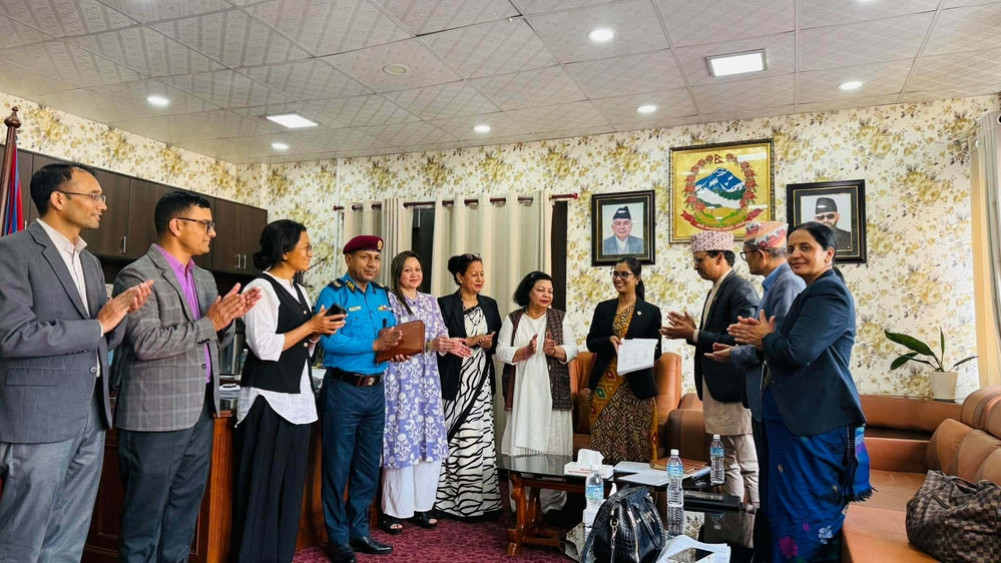
On March 10, Law Minister Gautam formed a study committee to address the problems that arise when development projects cannot be completed for a long time due to litigation and when development-related cases remain unresolved in the courts for a long time.
We use Google Cloud Translation Services. Google requires we provide the following disclaimer relating to use of this service:
This service may contain translations powered by Google. Google disclaims all warranties related to the translations, expressed or implied, including any warranties of accuracy, reliability, and any implied warranties of merchantability, fitness for a particular purpose, and noninfringement.
The study committee formed by the Ministry of Law, Justice and Parliamentary Affairs has suggested that an infrastructure court (tribunal) should be formed to hear development construction cases separately, saying that they have been stuck in court for years.
The committee, formed by Minister for Law, Justice and Parliamentary Affairs Sobita Gautam under the leadership of Ministry Secretary Parashwar Dhungana, has suggested in its report that an infrastructure tribunal should be formed to dispose of cases within three months with the involvement of expert judges and experts with technical knowledge in a specific area of jurisdiction.
On Chaitra 10, Law Minister Gautam had formed a study committee to solve the problems that arise when development projects cannot be completed for a long time due to litigation and when development-related cases are not resolved in the courts for a long time. The committee's report states that an 'infrastructure court' is needed in Nepal to resolve litigation problems related to development projects.
The report states that it would be appropriate to have an expert member in finance and an expert member in engineering in the Infrastructure Tribunal, chaired by a High Court judge, who has gained experience and expertise in the field of project management. The committee report states that it would be appropriate to create a roster of engineers so that engineer members can be assigned based on the subject matter of the case, and that arrangements should be made to appeal the decision of the Infrastructure Tribunal to the Supreme Court. The report states that it would be appropriate to designate a separate dedicated fast-track infrastructure bench to hear appeals in the Supreme Court with expert judges and set a time limit to decide within two months. The Law Ministry is preparing to submit the report prepared by the Law Ministry to the Council of Ministers and move forward with the proposal to form such a court. The Constitution provides for the formation of specialized courts. The Infrastructure Court will be formed according to that provision. The task force formed under the coordination of Secretary of the Ministry of Law, Dhungana, had representatives from the Supreme Court and various ministries, the Ministry of Physical Infrastructure and Transport; Ministry of Urban Development; Ministry of Energy, Water Resources and Irrigation; Public Procurement Monitoring Office; Office of the Attorney General; and Office of the Investment Board as members.