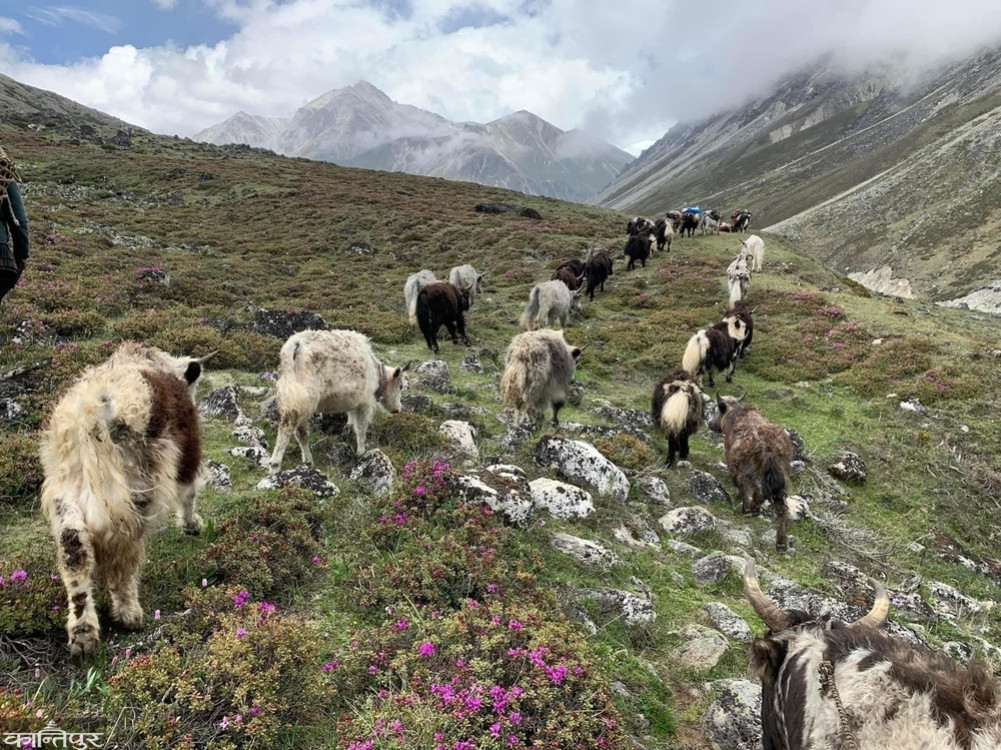
Around 400 yaks, buffaloes, and 40-50 horses are taken from the border village of Lapchi in Dolakha to the pastures of China for grazing.
We use Google Cloud Translation Services. Google requires we provide the following disclaimer relating to use of this service:
This service may contain translations powered by Google. Google disclaims all warranties related to the translations, expressed or implied, including any warranties of accuracy, reliability, and any implied warranties of merchantability, fitness for a particular purpose, and noninfringement.
The residents of Lapchi, a village bordering China, are currently driving yaks and buffaloes carrying sacks of ghee towards the Chinese pastures. 7 herds of Lapchi have reached the Chinese pastures, and others are also on their way. By the end of Jestha, about 400 yaks and buffaloes from 13 herds will reach the Chinese pastures.
The main grazing area of the Lapchi residents is the grasslands of Ramdung in China. They take their yaks and buffaloes and put them in the Chinese pastures for 4 months. They must carry a border pass. Shepherds without a pass are not allowed to go to the Chinese pastures. They have to pay revenue for using the Chinese pastures, but the local government there does not accept cash. For that, ghee from the buffaloes is needed. The herds, yaks and buffaloes are counted in the pastures. On that basis, local Kunjok Sherpa says that 750 grams of ghee should be paid as revenue for each yak and buffalo.
In China, you have to pay revenue for using the grazing area, but the local government there does not accept cash. For that, you need the ghee of the buffaloes. The pastures count as cattle, yaks and buffaloes. ‘After the snow melts, we go to the big pastures of Parika to graze yaks and buffaloes,’ he said. ‘We graze there for four months and return after paying the ghee revenue.’ He said that while more than 2,000 yaks and buffaloes were taken to the pastures of Parika a decade ago, that number has now decreased. ‘We have been carrying the yaks and buffaloes’ dhutti and the shepherd’s food and even bringing horses there for grazing,’ he said.
‘In the past, there were many, 60/70 yaks and chauris were taken to the market in the pasture, Chinese people used to come to the pasture to buy ghee,’ he says, ‘Government officials from other countries would come to the pasture to get ghee for revenue, it was very fun.’ He said that since the time of his grandfather Baraju, government officials from other countries have been paying ghee for grazing. ‘It has been a tradition for many years, the custom of giving ghee for grazing yaks and chauris,’ he said, ‘Even weddings were held there, relatives used to be there, our main market for salt, clothes and food is there too.’
But he said that the government there has stopped weddings for more than a decade. Local Tenzing Sherpa said that he has known about the tradition of paying ghee for taking yaks and chauris to the pasture in China since he was a child. ‘When I was young, I used to go with my father to graze yaks and buffaloes in the pastures there. At that time, my father would give ghee to the Chinese people,’ he said. ‘This is a tradition that has been going on since ancient times, and it is still going on.’
He said that the ancestral profession of Lapchi residents is in crisis as it has become difficult to earn a living from yak and buffalo farming as in the past. He said that every year, about 400 yaks, buffaloes, and 40-50 horses from Lapchi reach the pastures on the Chinese side for grazing. He said that as it has become difficult to make a living from yak and buffalo farming, the ancestral profession of the Lapchi people is facing a crisis. ‘Until a decade ago, there were many yak and buffalo herds, and the income was good,’ he said. ‘We used to take them there for grazing, sell ghee and calves there, and bring food from the local market in China, but now the business is not that good.’
The main source of income of the locals of Lapchi is yak and buffalo farming. . The locals of Lapchi earn income by selling ghee and calves in foreign markets. But recently, as the demand for calves and ghee has decreased in the Chinese market, the Sherpa said that the locals are fleeing from this business. ‘Ghee is sold for up to 1800 rupees per kilo in the foreign market, and even calves are bought by amateurs,’ he said, ‘In the past, the earnings were good, now it is only enough to pay for the grazing of the pasture.’ There is a rule that the revenue of horses taken for grazing must also be paid in ghee. But he said that the grazing revenue of calves does not have to be paid.
The population of Lapchi, which has 48 households, is 130. Local Karma Vice Sherpa says that despite repeated requests to the government to make the grazing area easier, they are forced to move towards China as it has not been made easier yet. “We had also requested them to take the initiative to waive grazing revenue,” he said. “Although the local government raised the issue of village problems and revenue in the border meeting, it has not been heard.”