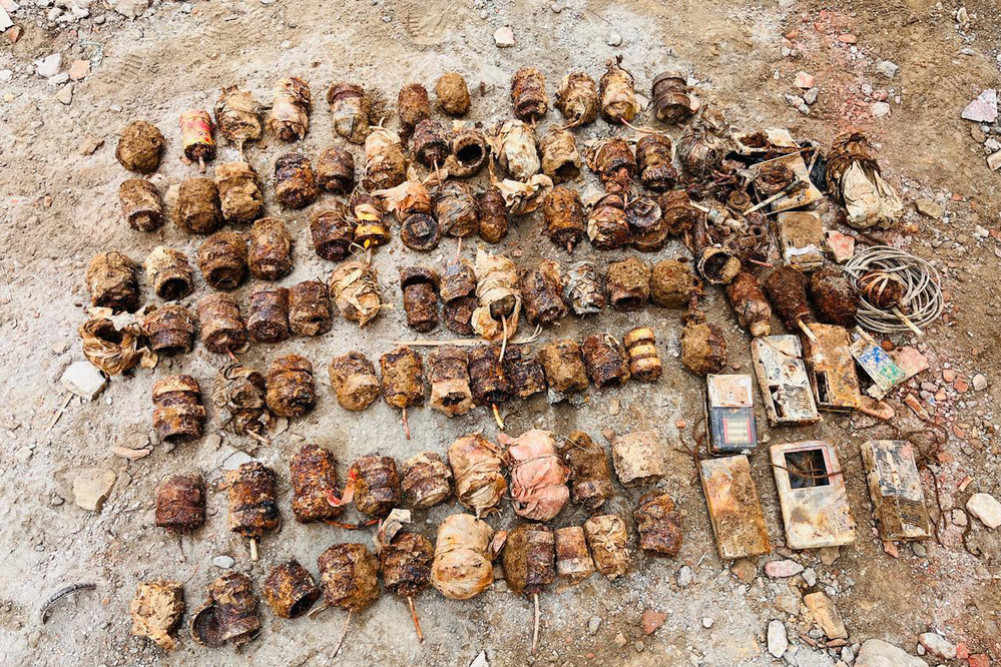
Nepal is not completely free from the threat of grenades and socket bombs. Unclaimed bombs pose a greater risk to the general public and children: Retired Assistant Lieutenant Colonel Suresh Sharma
We use Google Cloud Translation Services. Google requires we provide the following disclaimer relating to use of this service:
This service may contain translations powered by Google. Google disclaims all warranties related to the translations, expressed or implied, including any warranties of accuracy, reliability, and any implied warranties of merchantability, fitness for a particular purpose, and noninfringement.
On 23 Falgun 2058, Bhagwati Gautam was on her way from Rukumkot to the former district headquarters, Musikot, for her work. When she reached a place called Sankh, a huge explosion suddenly occurred. She was unconscious. When she regained consciousness, she was at the Teaching Hospital in Maharajgunj, Kathmandu. She was taken to Kathmandu by security forces for treatment. A bomb planted on a public walkway had blown off her leg. The bomb shrapnel was all over her body. She was seriously injured and returned home with the help of an artificial leg after spending six months in the hospital. The incident still haunts her.
‘I was walking on the road. I didn’t know anything when the bomb exploded. When I regained consciousness, I was in a bed in the Teaching Hospital. The bomb had blown off one leg. There were bomb shrapnel in my body,’ she said. Recalling the tragic day, she said, "We, the common people, are suffering because we are caught in the trap set by the war." Even now, she is scared when she hears news of bombs being found somewhere.
Similarly, on Bhadra 13, 2001, two children were killed when an explosive device exploded in the courtyard of Gyan Bahadur Rai's house in Prangbung, Phalelung Rural Municipality-5, Panchthar. Dipson Sanwa, the 11-year-old son of Gyan Bahadur Rai's neighbor Dilip Sanwa, and his two-year-old daughter Prinsa Sanwa were killed in the explosion in the courtyard of the house where Gyan Bahadur Rai's family lived.
From 2010 to 2019, 651 people were killed and 2,899 injured in landmine and bomb explosions. Landmines and bombs planted and hidden during the 10-year armed war led by the then rebel force Maoists are still being found. Even after years of the Comprehensive Peace Agreement and the integration of combatants and weapons management, the common people are terrified when bombs are found in settlements. Even as the scars of war fade, the weapons and bombs used by the warring parties against each other remain deadly to civilians.
Security officials have said that informing the police is the safest course of action if bombs planted during the war are found. The last time, on April 19, 86 bombs of various types were found inside the premises of the District Police Office in Bayaldanda, Sharda Municipality-3, Salyan. The bombs were collected by the police after the peace agreement and buried underground. The bombs were found while digging the foundation of a new building. The bombs were deactivated by an army team.
Similarly, on 12 Pus 2082, a socket bomb was found while digging the foundation of the house of Dhiraj Bahadur Chhetri of Rukum West Chaurjahari-1. On 6 Jestha, two socket bombs were found abandoned inside a school premises near Dahawan in Rolpa. A large area of Bhagwati Secondary School in Nuwagaun, Triveni Rural Municipality-2, Rolpa was buried underground.
On 18 Mangsir 2081, two grenade bombs were found in Kalika Municipality, Chitwan. The bomb was found while digging the ground of the Chaturmukhi Temple premises in Kalika Municipality-3. On 30 Pus 2072, 360 socket bombs were found in Jhimpe-Kharsubang, Salyan.
According to security agencies, caution is necessary as bombs can still be found underground and in remote areas during wartime.
After the peace agreement, Maoist fighters were kept in camps No. 7 and No. 21. At that time, the weapons and other war materials of the fighters were stored in the camps. The United Nations Mission in Nepal (UNMIN) had collected about 52,000 pieces (about seven tons) of explosives.
In 2066, UNMIN expert teams had deactivated those bombs and useless weapons in camps in Shaktikhor, Jhapa, Kailali, Surkhet, and Rolpa in Chitwan. Experts say that there may still be bombs underground in the war-affected areas of Rukum, Rolpa, Jajarkot, Salyan, Dang, Sindhuli, and Sindhupalchowk.
Panchthar explosion: Injured siblings die
Similarly, the government and UNMIN teams had removed landmines from the country's army, police, and other areas. The then Ministry of Peace and Reconstruction and the United Nations Landmine Control Team (UNMAT) announced that 73 landmine areas in Nepal had been completely cleared. On 31 Jestha 2068, the then Prime Minister Jhalanath Khanal and Chief of Army Staff Chhatra Man Singh Gurung detonated the last landmine at a special ceremony held at Phulchoki Danda in Lalitpur. The UN Landmine Control Team presented a certificate to the government. Not only that, Nepal was declared a landmine-free country.
Purnashoba Chitrakar, head of Landmine Campaign Nepal, said that about 5,000 people were directly affected by the war and its aftermath. 'Landmine Monitor and UNICEF had monitored those incidents,' she said.
The then Home Minister Ramesh Lekhak informed the National Assembly that 651 people had died in landmines and explosions. He gave the data obtained from the Nepal Police, stating that from BS 2052 to Asar 2082, 651 people were killed and 2,899 people were injured in landmine and explosive incidents.
On Kartik 15, 2068, based on the proposal put forward by the army itself, an agreement was reached on various issues including the adjustment of combatants, the government, and the constitution.
Retired Assistant Lieutenant General of the Nepal Army, Saresh Sharma, said that the risk from bombs and explosives planted during the war has not been eliminated. ‘In a country where there has been an armed conflict, the remnants of war remain. There are landmines, grenades, and socket bombs planted by the state and the rebels to use against each other. Grenades and socket bombs are still being found in Nepal,’ he said, ‘Even after the peace process, there are incidents of human casualties and injuries. Nepal is not completely free from the risk of grenades and socket bombs. Bombs found unattended pose a greater risk to the general public and children. Chitrakar said that the government should be aware of its complete control as grenades, socket bombs and explosives placed during the Maoist war pose a risk to the general public.
Nepali Police Central Spokesperson DIG Avinarayan Kafle said that even if bombs from the conflict period are found scattered, they are being deactivated in a timely manner. 'Recently, there has been no major incident due to bombs found during the conflict period,' he said. 'If they are found anywhere, the Nepali Army has been deactivating them in a timely manner.'
Deepak Chalaune, the then Maoist 3rd Division Assistant Commander in Chitwan, said that bombs dug during the war may still be there. 'Bombs made by the bomb-making technical team were placed in various districts. "There may still be some unused bombs left after digging a ditch," he said. "It appears that they were found recently because they were still in the same place they were placed after the peace process began."