Collectors are disappointed as the price of bunches of rice, which used to sell for up to 43,000 per kilogram, has now dropped to 9 to 13,000.
We use Google Cloud Translation Services. Google requires we provide the following disclaimer relating to use of this service:
This service may contain translations powered by Google. Google disclaims all warranties related to the translations, expressed or implied, including any warranties of accuracy, reliability, and any implied warranties of merchantability, fitness for a particular purpose, and noninfringement.
Until three years ago, the family of Jovan Bohara of Dhalaun, Saipal Rural Municipality-1, used to roam the forest in search of guchchiyau. All day long, all the family members would be busy searching for guchchiyau in the forest, cleaning it, and stringing it on threads to dry it like a garland.
Drying and selling the guchchiyau, which is freely available in the forest, used to bring in good income. ‘I have even found a single head in one place,’ said Jovan. ‘Some years, we even sold three or four kilos of dried guchchiyau from my house.’ He said that in the years when the price was good, he earned 80 to 90 thousand from selling mushrooms. ‘Those who picked a lot sold up to 1.5 lakh,’ he said.
Normally, since the guchchiyau picking season is from Baisakh to Asar, Jovan’s family would go to the forest every day during this period. Since the fields on the banks of the lake are sparsely cultivated, picking and selling mushrooms at a high price was a source of income for other Saipal residents like Joban. But in recent years, locals have stopped looking for this mushroom, which is found everywhere in the forests of Saipal.
They say that not all the mushrooms collected are sold, and even when they are sold, they stop picking them after they stop getting good prices like before. Traders who were previously willing to pay up to 43,000 rupees per kilogram for dried mushrooms are now offering only 9 to 13,000 rupees per kilogram, which discourages Saipal residents from picking mushrooms. 'Four/five years ago, even a tola (11.66 grams) used to sell for 500 (about 43,000 per kilogram)'. People from Humla and Jumla used to come from house to house to buy mushrooms,’ said Rina Bohra of Saipal-3, ‘Nowadays, people do not come from outside to buy them. Even if the herbalist in the village buys them, they do not give more than 150 tola.’ She said that local collectors have stopped collecting mushrooms because they have to go to forests far from home to find them, there is a fear of being attacked by wild animals, and they do not get the price they deserve.
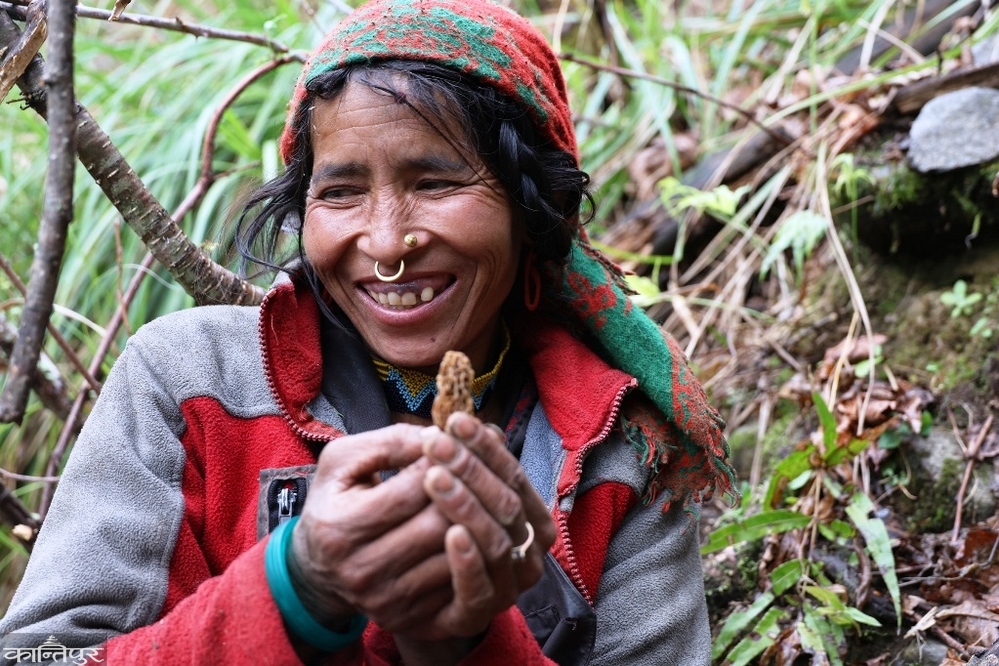
Guchchichayu is a fungus that grows in forests where organic matter such as rotten wood, firewood, and leaves accumulate before the onset of the monsoon. The upper part of the Guchchichayu, which looks like an umbrella but is not fully opened, is called a capsule in English and the lower part is called a stipe. This plant, whose stipe is two to three centimeters thick, is found in forests at an altitude of 1,800 to 3,500 meters above sea level.
Although it is abundant in all forests of Saipal Rural Municipality, which covers almost half of the area of Bajhang, the interest of locals in collecting it has been decreasing since it has lost its value. ‘Some people pick it for food when they go to the forest for other work,’ said Dhanlal Dhami of Saipal’s Jima village, ‘Unpicked mushrooms rot in the forest.’ He said that these mushrooms rot and are destroyed within a week of sprouting.
Due to lack of collection, the price and demand for the Guchchi mushroom, which is found rotting everywhere in the forests of Saipal, is high in the world market. Shiva Devkota, who has been researching wild mushrooms for two decades, said that they are also abundant in Nepal and have the potential to earn foreign exchange by exporting them. ‘This is a rare mushroom that is not cultivated and is found naturally only in the forest,’ said Devkota. ‘It tastes like meat and is rich in nutrients, so its demand in Europe is very high.’
According to a study conducted by the Asian Network for Sustainable Agriculture and Bioresources (ANSAW), an organization working on the study and sustainable management of herbs found in the Himalayan region of Nepal, 8 species of Guchchichayu are collected in Nepal out of the 14 species found in the world. This mushroom is more common in the mountainous districts of Karnali and Sudurpaschim Provinces, said Devkota, a mushroom researcher. This mushroom is found in large quantities in forests with trees such as Bhojpatra, Chimal, Gobresalla, and Khasru.
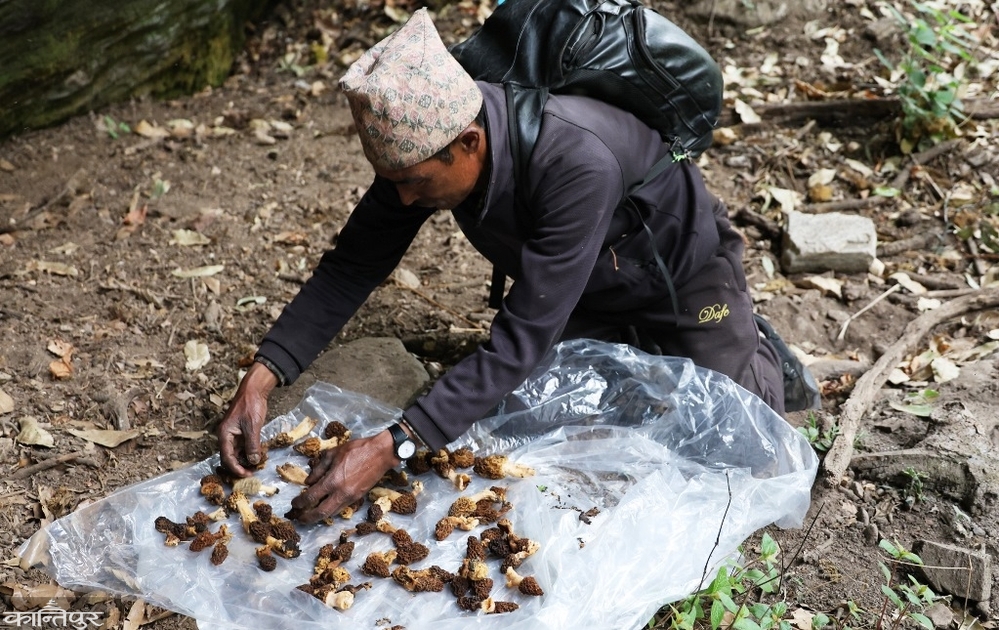
Guchchichayu is called ‘Merail Mushroom’ in English. Its scientific name is Mochaila. It is called Guchchichayu in Nepali. In colloquial language, it is also called Gucci mushroom, Khoya mushroom, Fuikhane mushroom, and Chhohada mushroom. It is famous in the world market as Himalayan mushroom.
It is widely traded in China, India, Pakistan, Turkey, Mexico, and the United States, according to a study titled "Trade and Conservation of Guchchiyu in Nepal" published in the international journal "Natural Resource Ecology and Management" in 2019. About 6.5 tons of dried Guchchiyu are exported abroad from Nepal annually. Of which 58 percent are exported from Karnali and 29 percent are exported from Sudurpaschim Province. The price of dried Guchchiyu, which is sold mainly in the markets of Europe, America, Japan, and China, is sold at a price of 150,000 to 200,000 rupees per kilogram.
This mushroom is also sold in India for 50 to 60 thousand rupees per kilogram, said Pushpa Ghimire, deputy director of ANSAB. ‘Currently, since there is no trade network to send it directly from Nepal to third countries, it seems that collectors sell it to India at a cheap price and Indian traders send it to third countries,’ he said about the reason for the non-increase in the price of guchchiyaw, ‘There are many levels from the collector to the main trader.’ That is why its collection has stopped because the collector gets a very low price. If it can be exported directly from Nepal to third countries, there is a possibility that collectors and traders can get a good price.’
This mushroom, found in the northern Himalayan and hilly areas of Bajhang, is found in abundance in the forests, but herbal traders say that locals are not interested in collecting it. ‘Until four or five years ago, I used to sell 50/60 kg of dried mushrooms every year,’ said Rajendra Dhami, former chairman of Saipal Rural Municipality, who is also an herbalist. ‘Nowadays, there are no buyers. Since the season for picking guchchichayu and yarsa starts at the same time, people spend more on yarsa than mushrooms (because they earn more). Mushrooms rot in the forest.’
He said that more than 100 kg of dried guchchichayu can be collected every year in Saipal alone.
According to the records of the Division Forest Office, 65 kg of dried guchchichayu were exported outside the district in the fiscal year 2075/076. According to forest data, the last time 15 kg was exported was in the fiscal year 2079/080. Since then, no export has been done with permission. Dhami, former chairman of Saipal, says that the forest records show less because those transporting small quantities do not take permission and that the collection was more before 2076 BS.
Although it is unfortunate that the mushrooms, which could be a reliable source of income for the locals of Saipal, are rotting in the forest due to the inability to find a suitable market, the local government has not been able to find a solution to market them. ‘Mushrooms are also abundant, they say they are sold at high prices in other countries, but we do not have a solution to sell them,’ said Dolma Tamang, vice-chairman of Saipal Rural Municipality. ‘If these mushrooms could be sent abroad, they would have been a source of employment and income for the locals. They have been rotting because they do not know the idea. This is our misfortune.’ She said that although the municipality contacted various traders in Kathmandu to find a market for the mushrooms, they could not find anyone who would pay the price they said.
A 2019 study titled "Trade and Conservation of Cauliflower in Nepal" concluded that if Nepal can promote marketing by developing a regional platform for sustainable use and conservation of cassava with suppliers from Asian countries including China, India, Pakistan, Bhutan, and others, local people in the Himalayan settlements can reap enormous economic benefits.

