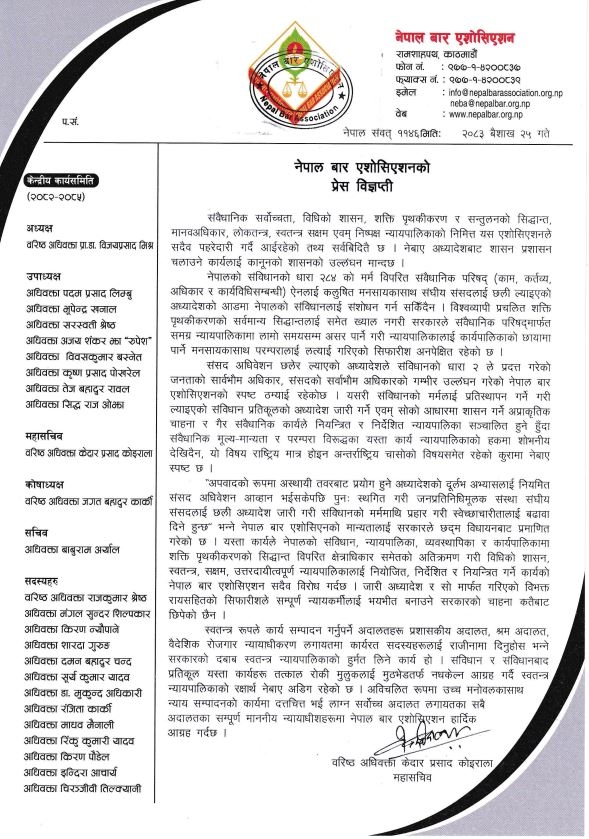
The Nepal Bar Association, in a statement, stated that the government has been working to influence the entire judiciary for a long time through the Constitutional Council, without even considering the universally accepted principle of separation of powers.
We use Google Cloud Translation Services. Google requires we provide the following disclaimer relating to use of this service:
This service may contain translations powered by Google. Google disclaims all warranties related to the translations, expressed or implied, including any warranties of accuracy, reliability, and any implied warranties of merchantability, fitness for a particular purpose, and noninfringement.
The Nepal Bar Association has commented on the recommendation process of the Chief Justice as unexpected. After the meeting of the advisory committee, the Nepal Bar issued a statement stating that the government has been working to affect the entire judiciary for a long time through the Constitutional Council, without even considering the universally accepted principle of separation of powers. In addition, the bar has commented that the recommendation of the Chief Justice was made with the intention of putting the judiciary in the shadow of the executive.
‘The Bar considers the act of running the administration through an ordinance to be a violation of the rule of law.’ The Constitution of Nepal cannot be amended under the guise of an ordinance that was brought by deceiving the Federal Parliament with malicious intent to amend the Constitutional Council (Works, Duties, Powers and Procedures) Act, which is contrary to the spirit of Article 284 of the Constitution of Nepal,' the Bar's statement states. 'The ordinance brought by deceiving the Parliament session has seriously violated the sovereign rights of the people and the sovereign rights of the Parliament as provided for in Article 2 of the Constitution.'
The Bar's statement states that issuing an ordinance that is contrary to the constitution and replacing the spirit of the constitution and ruling on the basis of it will lead to a judiciary controlled and guided by unnatural desires and unconstitutional acts, and such acts against constitutional values and traditions are not befitting for the judiciary.
Stating that this issue is not only a matter of national but also an international concern, the Bar has stated that by suspending the rare practice of using ordinances on a temporary basis as an exception after the regular parliament session has been convened, the ordinance will be issued by deceiving the people's representative institution, the Federal Parliament, and attacking the essence of the constitution and promoting arbitrariness.
The Bar comments that such actions violate the principle of separation of powers in the Constitution of Nepal, the judiciary, the legislature and the executive, and encroach on jurisdiction, and plan, direct and control the rule of law, an independent, competent and accountable judiciary.
The Bar comments that the government's pressure on members working in courts that should perform their duties independently, such as the Administrative Court, Labor Court, Foreign Employment Tribunal, etc., to resign is an act of taking away the dignity of the independent judiciary.
‘The Nepal Bar is steadfast in protecting an independent judiciary, urging the immediate cessation of such acts that are against the Constitution and constitutionalism and not to push the country towards confrontation,’ the statement said. ‘The Bar urges the judges of all courts, including the Supreme Court, to continue to devote themselves to the administration of justice with unwavering high morale.’