There is a dispute over whether a decision made by just three people in a six-member council falls within the definition of a majority.
We use Google Cloud Translation Services. Google requires we provide the following disclaimer relating to use of this service:
This service may contain translations powered by Google. Google disclaims all warranties related to the translations, expressed or implied, including any warranties of accuracy, reliability, and any implied warranties of merchantability, fitness for a particular purpose, and noninfringement.
The Constitutional Council will meet for the first time at 5 pm today to recommend the appointment of the Chief Justice after the ordinance was issued. However, even before that, a dispute has started over the interpretation of 'majority' in the decision-making process of the Constitutional Council.
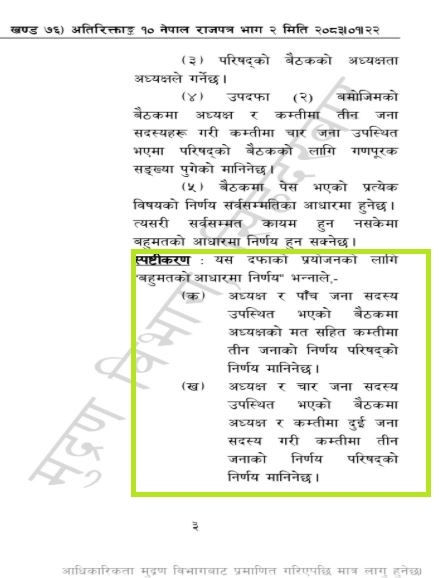
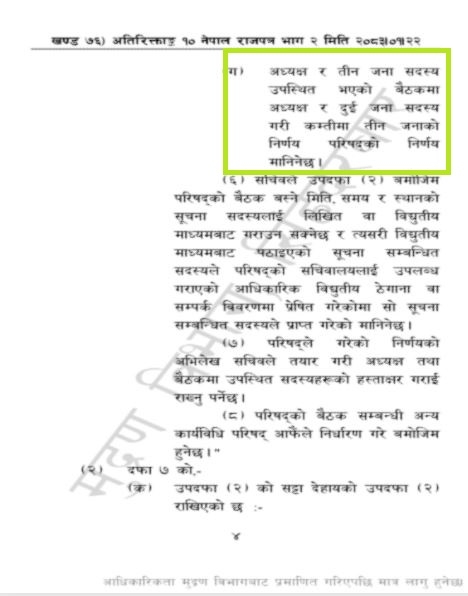
According to the Constitutional Council Act, 2066, a meeting can be held if four people, including the chairperson, are present. It is said that the decision must be made unanimously. If there is no consensus, there is a provision that a decision can be made by majority. However, the clarification of the act states that even if six members are present, the vote of three people, including the chairperson, is considered a decision. This is where the dispute has started now.
There is no separate voting system for the Prime Minister in the Council, unlike the National Assembly elections, where MPs and municipal mayors have separate voting rights. There is a provision that in a meeting attended by six people, the decision of three people, including the Prime Minister, is the decision of the Council.
If all the members present in a meeting of 6 agree, a decision is made unanimously. However, if there is no consensus, a majority of 6 is 4. The ordinance has been criticized for not falling within the definition of both consensus and majority.
Congress Vice President Bishwaprakash Sharma commented on social media today that the current system is the opposite of that, saying that a majority clearly means a larger number.
He argues that a decision by 3 members in a council of 6 cannot be called a majority. Sharma said that such a system is incompatible with global democratic norms and urged not to go towards the practice of 'North Korea style'.
'Will we bear the stain of deeds that even the Panchayat has not done in 80 years of judicial history?' He urged the government to be serious.
A similar controversy occurred 2 years ago when the Chief Minister took a vote of confidence in the Gandaki Provincial Assembly.
The Speaker had declared the votes of 30 people in the 60-member Gandaki Province Assembly as a majority. In a writ filed against it in the court, the majority shown by excluding the Speaker was rejected. The Supreme Court had explained that 30 votes cannot be considered a majority by excluding the Speaker, and that a majority of the total number of members is required.
Prime Minister Balendra Shah, however, has clarified that such a provision has been made in the ordinance so that decisions should not be blocked in the event of a tie. When sending the ordinance to President Ram Chandra Poudel, Prime Minister Shah had also sent a 2-page clarification along with it. Shah had said that it was impossible to imagine a situation where the chairman himself would be in the minority in the council.
‘Since the number is even when all 6 members are present, there is a possibility of a tie (3-3). In such a situation, an arrangement has been made for the side supported by the chairman to be considered the majority,’ Shah’s clarification said. Shah said that the purpose behind making such a provision was to prevent obstruction in the decision-making process.
Another provision in the ordinance is that the chairperson is supreme in the council. The six-member council, chaired by the Prime Minister, consists of the Speaker, Chief Justice, Speaker of the National Assembly, Leader of the Main Opposition Party, and Deputy Speaker.
A provision has been made that no decision can be taken on a proposal put forward by the Prime Minister and the Council Chair even if a majority is reached. Earlier, a provision was proposed in the bill moved by then Prime Minister KP Sharma Oli that no decision could be taken on any proposal without the consent of the Prime Minister and the Council Chair. However, the bill was not passed and the House of Representatives was dissolved.

