Participants get information about IT technology while sitting on the bus. So far, 17,000 have gained information about technology.
We use Google Cloud Translation Services. Google requires we provide the following disclaimer relating to use of this service:
This service may contain translations powered by Google. Google disclaims all warranties related to the translations, expressed or implied, including any warranties of accuracy, reliability, and any implied warranties of merchantability, fitness for a particular purpose, and noninfringement.
Yubaraj Giri, principal of Little Buddha Residential Secondary School here, was chatting at a tea shop on Wednesday morning. At that time, he heard that a bus from the technology-rich Nepal Academy of Science and Technology (NAST) had arrived in the district. After hearing the news, he became interested in more information. Then he learned that classes on subjects such as cybersecurity and the use of AI were being conducted by keeping students on the bus. At that time, the bus was kept in the premises of the Phungling Municipality.
After investigating, he found out the phone number of Pradeep Dhodari, IT head of NAST. Then he contacted Dhodari and requested him to include his students in the training. Since it was a private school, Dhodari was initially reluctant. Giri did not give up. ‘I said that these are also citizens of Nepal,’ Giri said, ‘Then he gave me time to bring the students at 10 o’clock.’ It had been raining since morning. However, Giri took the students of classes 9 and 10 to the Phungling Municipality premises with an umbrella. NAST had scheduled classes for the people's representatives of the municipality from 11 am. So, knowledge was quickly shared with 80 students before that.
Some students were placed on bus seats. Some were made to stand and taught about the use of AI, cyber security, and the advantages and disadvantages of the latest technology for children. Classes were conducted for the students until 12 pm. Since the people's representatives gathered only around 12 pm, the students had extra time.
Nepal Academy of Science and Technology (NAST), Khumaltar, Lalitpur, has been traveling to the mountains, hills, and Terai with a mobile bus since 2020. There is only one such bus, provided by the Korean government at the end of 2019. Each seat has a laptop with a table attached. All technology and facilities, including the internet, are available inside the bus. Since it has 25 seats, it can accommodate the same number of people. Engineer Manoj Kumar Shah has taken the responsibility of installing technology in the bus, its management, etc. 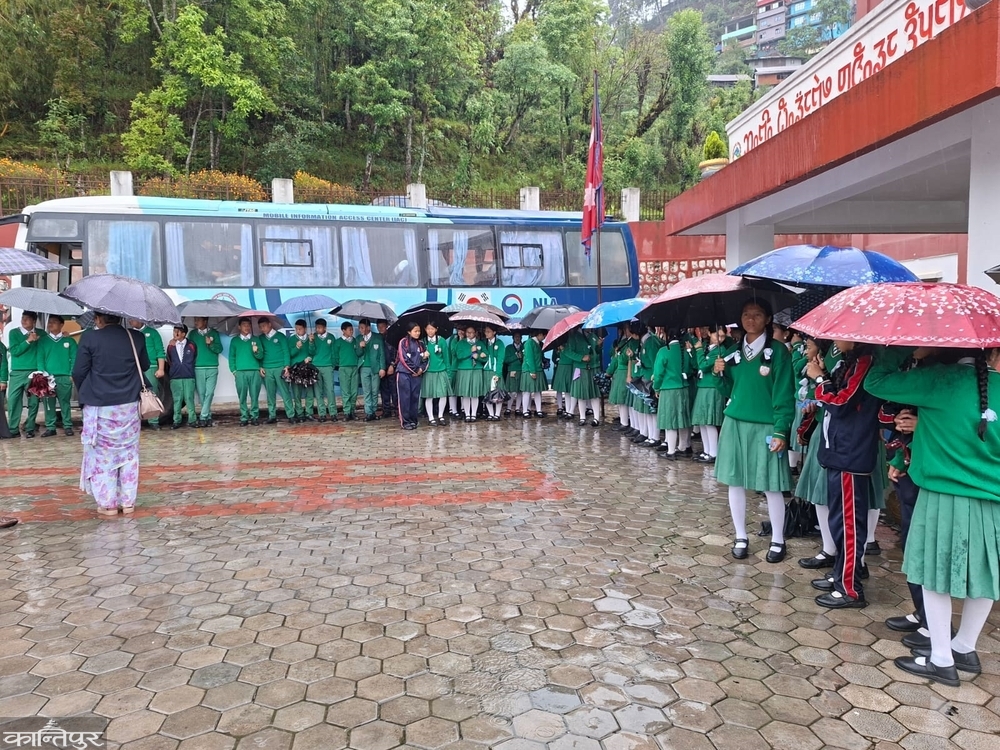
‘I look after the technical side of the bus,’ said Shah, ‘After sitting in it, the participants get all the information about IT and technology, and so far 17,000 have sat on the bus and gained information about technology.’ He said that it was difficult to reach Taplejung due to the potholes in the road. Before reaching here, a one-day class was conducted in Hilihang Rural Municipality of Panchthar.
‘Children in big cities do not get as much knowledge about technology as children in remote areas,’ said IT Chief Dhodari. ‘Our main objective is to provide information to such children who are deprived of knowledge about technology.’ Dhodari informed that science teachers were used for this.
A two-day class was conducted for 28 science teachers from community schools under Phungling Municipality. According to NAST researcher Anupraj Poudel, the class was given on topics such as facilitation of teaching and learning through the use of technology in the classroom, and how to arouse students’ interest.
‘My subject is AI,’ he said, ‘so I shared how AI is made, what is the process of making it work, how can you get the right information and how to get it.’ He informed that topics such as AI tools, notebooks made by Google for teachers, slides according to the curriculum, podcasts, video content, etc. were discussed.
Poudel said that most of the science teachers wanted to know how to make QR codes and everyone learned with enthusiasm. To participate in the NAST program, a village or municipality must make a written request. NAST Chief Scientific Officer Bimala Devkota said that the program is prepared based on the request letter, taking into account remote areas, the annual plan of the office, and the cost situation. She said that since it is difficult to explain at first, and the attraction of many increases after understanding, every employee is fully engaged when going to the district.
‘We are people who reach the number on the road and if we have time, we give classes even if it is only for half an hour,’ she said, ‘Our main goal is to ensure that people do not go down the wrong path due to the misuse of technology, and that they can use technology correctly.’ She said that she has traveled from Karnali in the west to Taplejung in the east to share AI knowledge.

