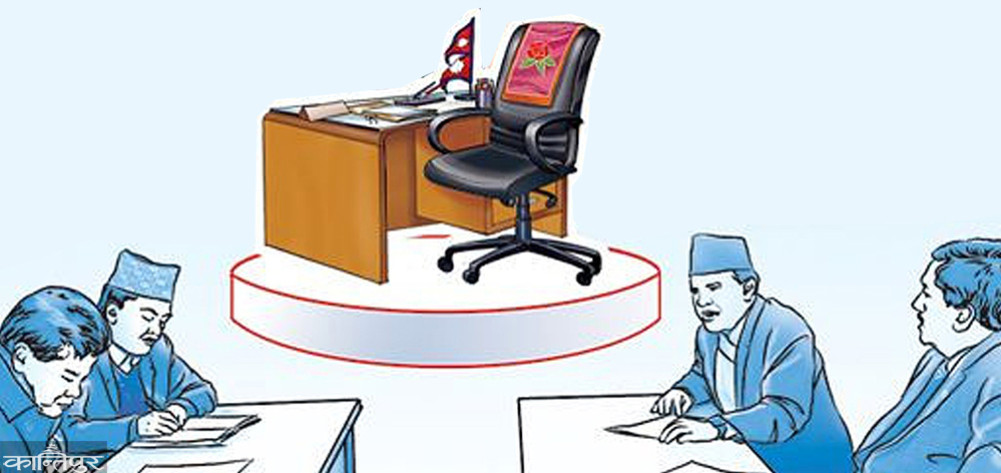
Economists say annual savings of 16 to 20 billion
We use Google Cloud Translation Services. Google requires we provide the following disclaimer relating to use of this service:
This service may contain translations powered by Google. Google disclaims all warranties related to the translations, expressed or implied, including any warranties of accuracy, reliability, and any implied warranties of merchantability, fitness for a particular purpose, and noninfringement.
There will now be only 17 ministries in the federal government. The committee formed by Prime Minister Balendra Shah for the restructuring of the ministries has proposed to reduce the federal government to only 17 ministries by cutting four out of the existing 21 ministries. Officials of the Prime Minister's Secretariat say that the government is preparing to reduce the number of ministries as per the proposal.
Economists say that even if four ministries are cut, the national treasury will save 16 to 20 billion rupees annually. In the past, there was criticism of the tendency of dividing ministries and expanding the council of ministers to a large size to arrange the distribution of responsibilities when two or more parties form a government.
In the past, there was criticism of the tendency to divide ministries and expand the size of the cabinet to accommodate the division of responsibilities when two or more parties form a government. According to the committee formed by the Prime Minister, some of the existing ministries will be merged, while some will be withdrawn and added to new ministries. Similarly, it has been proposed to change the names of some ministries. Before the 21 Falgun elections, the Rashtriya Swayamsevak Sangh (RSS) had raised the issue of reducing the number of ministries and restructuring them in its manifesto. Based on the same manifesto, Prime Minister Shah had formed a five-member committee on 17 Chaitra to bring a proposal for the restructuring of the ministries.
The committee formed under the coordination of Govinda Bahadur Karki, Secretary to the Office of the Prime Minister and Council of Ministers, included the Joint Secretary of the Ministry of Finance, Federal Affairs and General Administration, the Chief of the Law Division of the Prime Minister's Office, and the Joint Secretary of the same office as member secretaries.
The committee proposed to reduce the number of 21 ministries to 17, citing economic transparency, administrative efficiency, and reduced expenditure burden on the state. Prime Minister Shah is preparing to have the report passed by the Council of Ministers and implement it.
The constitution states that a maximum of 25-member cabinet can be formed. Clause 9 of Article 76 of the constitution states that 'the President, on the recommendation of the Prime Minister, shall form a cabinet consisting of a maximum of 25 ministers, including the Prime Minister, from among the members of the Federal Parliament, in accordance with the principle of inclusion.'
Among the governments after the promulgation of the constitution, the government formed in Asoj 2072 under the leadership of KP Sharma Oli had a 27-member cabinet, including 6 deputy prime ministers, 18 ministers and 2 ministers of state. Similarly, in Bhadra 2074, Sher Bahadur Deuba had set a 'record' of a 50-member jumbo cabinet.
He had appointed 15 people, including 12 from the Nepali Congress, as ministers of state. Before that, Dr. Baburam Bhattarai, who became the fourth Prime Minister after the republic, had formed a 49-member council of ministers. Deuba also held the record for a jumbo cabinet in a multi-party system. Deuba, who became Prime Minister for the first time in 2052, had formed a 52-member cabinet. 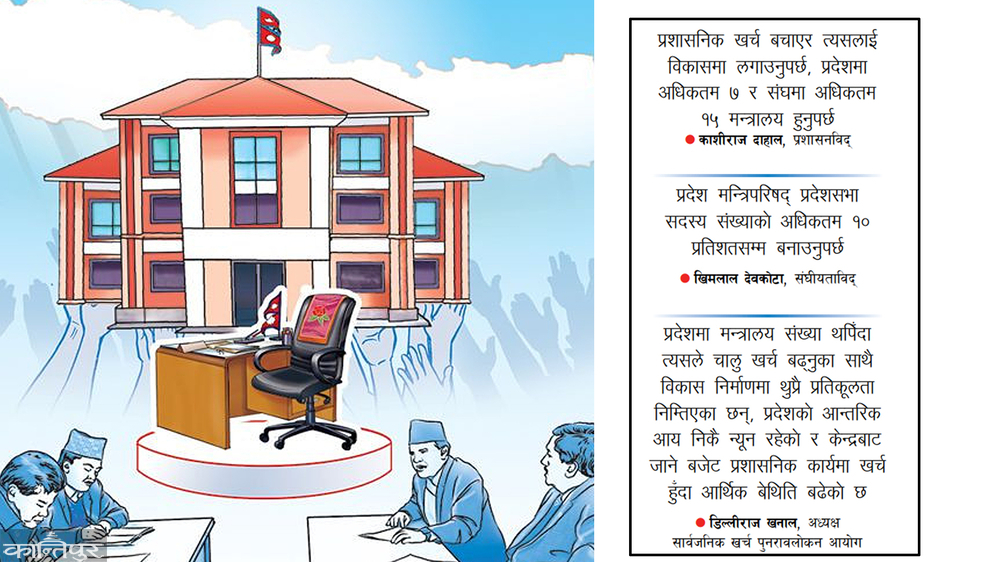
Economist Dilliraj Khanal says that the government's current move to cut ministries could save 16 to 20 billion rupees annually from the national treasury. "If we calculate only 4 billion rupees per ministry, even if 21 ministries are considered as the ceiling, four ministries will be reduced, which would reduce expenses by up to 16 billion," he said. He said that cutting one ministry would also reduce the departments, employees, vehicles and other expenses under it.
Economist Dilliraj Khanal says that the government's current move to cut ministries could save 16 to 20 billion rupees annually from the national treasury.
Khanal was also the coordinator of the Public Expenditure Review Commission. The commission had suggested how much savings could be made ministry-wise. The Khanal-led commission had suggested that 16 ministries should be created.

'The ministries should be streamlined and expenses should be reduced,' he says, 'In this year's budget too, 111 billion has been allocated to funds and government bodies under various ministries, and even in current expenditure, we should be able to make a minimum saving of 1.5 billion.'
In 2076, the then government formed a high-level administration reform implementation and monitoring committee under the leadership of Kashiraj Dahal. The committee submitted a 250-page report to the government. It suggested limiting the number of federal ministries to 15. Former chairperson of the Administrative Court and administration reform expert Dahal says that the change in the form of governance that the government is trying to initiate is welcome.
He also reminded that the Administration Reform Suggestion Committee formed under his leadership had suggested having a maximum of 15 ministries in the union and a maximum of 7 in the provinces. ‘Every year, administrative expenses are increasing more than development expenses, we had suggested going towards federalism and not forming ministries based on a centralized form of governance,’ Dahal says. ‘It is appropriate to have ministries of national importance and international relations at the center and ministries of provincial importance and implementing powers in the provinces.’