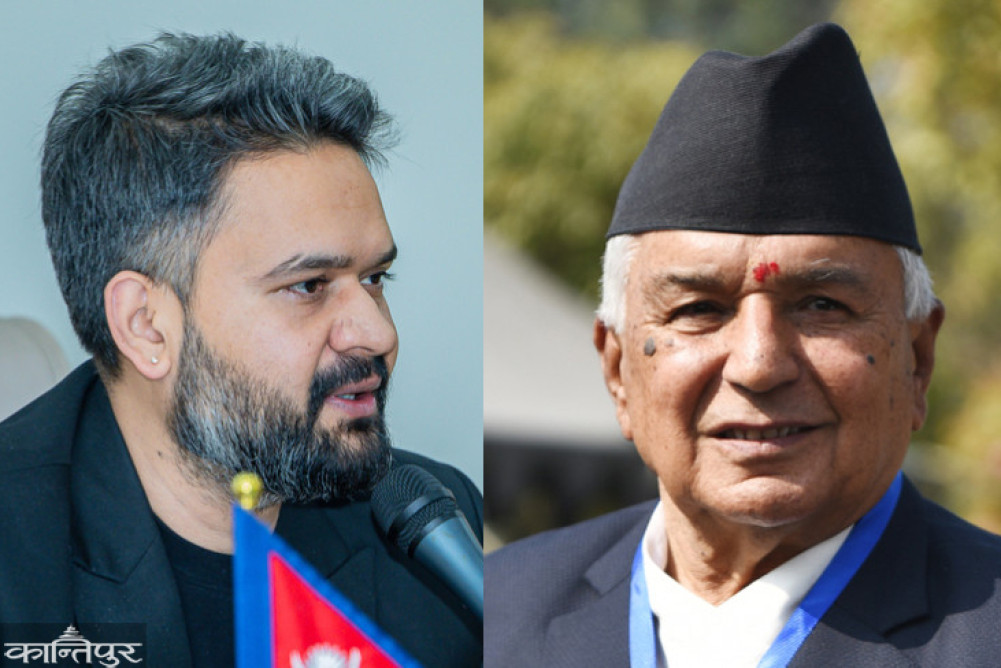
”The presence of the chairman and at least four members shall be considered a quorum for the meeting.” The previous arrangement has been amended, and now the chairman and at least three members constitute a quorum.
We use Google Cloud Translation Services. Google requires we provide the following disclaimer relating to use of this service:
This service may contain translations powered by Google. Google disclaims all warranties related to the translations, expressed or implied, including any warranties of accuracy, reliability, and any implied warranties of merchantability, fitness for a particular purpose, and noninfringement.
President Ram Chandra Poudel issued an ordinance on the Constitutional Council (functions, duties, powers and procedures) on Tuesday. The ordinance, which was withdrawn on Sunday, was issued by the President after being recommended to repeat the status quo.
With the issuance of the ordinance, the dispute between the President and the government regarding the procedure for the meeting of the Constitutional Council, which has been complicated for a long time, has been resolved immediately. The provision in the Constitutional Council Act that 'the presence of the Chairperson and at least four members shall be considered a quorum for the meeting' has been amended. Now, a meeting can be held in the presence of the Chairperson and at least three members.
If four people including the Chairperson are present, a majority, that is, three people agree, a decision can be made at the meeting. The Council, chaired by the Prime Minister, has a 6-member membership. The provision that decisions should be made on the basis of consensus in the first meeting, if consensus cannot be reached, another meeting should be called and reached, and if consensus cannot be reached, decisions should be made by majority, has not been implemented.
Advisor to the President Baburam Kunwar said that the President issued the ordinance in accordance with constitutional practice, its essence and spirit. The Balendra Shah-led government had recommended the ordinance on 14 Baisakh. After consulting with constitutional experts/legal experts, President Poudel had returned the ordinance, keeping in mind the explanation of the majority required to make decisions in the council. The President's concern was to ensure a clear majority of the total number of members while making the decision. While returning the ordinance, it was reminded that the bill passed by the parliament was returned in Shrawan 2082 and the ordinance recommended by the then Sushila Karki-led government on 2 Mangsir was not issued.
The Council of Ministers meeting held on Monday, the day after the ordinance was returned by the President, had decided to resend the ordinance as it was. Prime Minister Shah had also sent a two-page long explanatory note along with it, in response to the President's concern. It mentioned the concerns raised by the President.
Presidential Advisor Baburam Kunwar said that the President issued the ordinance in accordance with constitutional practice, its essence and spirit.
‘The President issued the ordinance in his capacity as the custodian and guardian of the Constitution, as the Prime Minister reiterated the ordinance with grounds and reasons on the issues that the President reminded the government about,’ he said. In his letter to the President, Prime Minister Shah argued that the ordinance had to be brought to prevent a legal vacuum related to the Constitutional Council since the old legal system did not automatically come into effect after the ordinance was issued. He gave an example of the need to bring a separate bill to revive the provisions of some Nepal Acts when the ordinance became inactive in 2063 BS. ‘The previous provisions of Section 6 of the Constitutional Council Act 2066, which was amended by the previous ordinance, have not been revived automatically, but have become a legal vacuum, so the present ordinance had to be brought,’ the Prime Minister argued.
Prime Minister Shah has also claimed that the Supreme Court's decision last October is not relevant to the proposed ordinance. The Supreme Court has already laid down the principle that there is no legal void through its judgment, stating that the old act will automatically be revived if the ordinance is inactive or rejected. The Supreme Court had held that even if there is a legal vacuum, the original act cannot be automatically considered to have returned to its amended state based on the repealed ordinance. Citing this Supreme Court judgment, some legal practitioners had been saying that it was not reasonable to bring an ordinance citing the reason for the vacancy.
Taking into account the message received when the President returned the bill last year, Prime Minister Shah had mentioned in the letter that the proposed ordinance had removed the word 'immediately restored' and that the meeting could only be held when the full members were restored.
Currently, there are 18 vacancies in the Chief Justice and 13 constitutional commissions. The National Natural Resources and Finance Commission, Muslim Commission, Tharu Commission, Madhesi Commission and National Inclusion Commission are without a chairman. 'The ordinance has provided that at least four members, including the chairperson, must be present for the council to meet. The presence of four members in the six-member council is seen as a majority of the total members and a quorum is achieved,' the Prime Minister's letter stated. The ordinance also addresses the possibility of a tie (3-3) in the plenary meeting when all six members are present. In such a situation, the majority is considered in favor of the chairman. Prime Minister Shah says that this will not hinder the decision-making process.
The then Prime Minister KP Sharma Oli had also amended the provisions related to the meeting procedure in the Constitutional Council Act in 2077 and 2078. At that time, the council made a legal provision that a meeting could be held even if only the chairman and at least two members were present, and 52 office bearers were recommended to various constitutional commissions. Since the House of Representatives itself was dissolved, they were appointed without even a parliamentary hearing.
Constitutional office bearers make it easy for the government to appoint the chief justice, auditor general and members of constitutional bodies on the recommendation of the Constitutional Council. But sometimes the council is incomplete or sometimes there is no favorable equation for the government, so the appointment of office bearers for constitutional commissions would not be timely. According to the constitutional provision, the appointment process should be started one month before the vacancy.
Currently, there are 18 vacancies in the Chief Justice and 13 constitutional commissions. The National Natural Resources and Finance Commission, Muslim Commission, Tharu Commission, Madhesi Commission and National Inclusion Commission are without a chairperson. Two posts, including the Chief Commissioner, are vacant in the Election Commission. There are also vacancies in the Commission for the Investigation of Abuse of Authority, National Human Rights Commission and National Women's Commission.
Especially, the National Natural Resources and Finance Commission, which is the busiest in the budget process, is dependent on one member. Only Bipin Raj Niraula is working in the commission as the acting chairperson. Under the federal system of governance, the commission is responsible for distributing revenue between the union, provinces and local levels, recommending grants and playing an important role in the proper utilization of natural resources. The commission is also responsible for setting the criteria for conditional grants based on national policies, programs, standards and infrastructure conditions, and determining the revenue distribution pattern between provinces and local levels from the provincial consolidated fund.
Commission spokesperson Sukdev Prasad Baskota says that there is no immediate impact on the budget as the recommendation for equalization grants to the provincial and local governments has already been made. ‘When there is only one person in the commission, other plans and work are automatically affected,’ he said.
After the legal provision that a decision can be made even if three members of the Constitutional Council agree, it has become somewhat easier for the Council Chairman, Prime Minister Balendra Shah, to hold meetings and take decisions. After the legal provision that a decision can be made even if three members of the Constitutional Council agree, it has become somewhat easier for the Council Chairman, Prime Minister Balendra Shah, to hold meetings and take decisions.
The Constitutional Council includes Speaker Dol Prasad Aryal, elected from the ruling Rashtriya Swayamsevak Sansthan Party. Another member, Deputy Speaker Rubi Kumari Thakur, was elected from the Shram Sanskriti Party. The Rashtriya Swayamsevak Sansthan Party supported her to be made Deputy Speaker. Another member, National Assembly Speaker Narayan Dahal, was elected from the then Maoist (currently CPN). Bhishma Raj Angdembe, leader of the main opposition party, the Congress, is also a member of the council.
There is a constitutional provision that the Chief Justice is also a member of the council. Currently, the post of Chief Justice is vacant, with Sapna Pradhan Malla as the acting Chief Justice. There is a constitutional provision that the Law Minister be a member when the post of Chief Justice is vacant and the Chief Justice is recommended. Law Minister Sobita Gautam is from the Rashtriya Swayamsevak Sansthan.
The National Assembly is dominated by the opposition party
Even if the President issues an ordinance on the recommendation of the government, it is constitutionally obliged to be approved by both houses of the federal parliament. Article 114, Clause 2 (a) of the Constitution states that after the ordinance is issued, it will be presented to both houses of the federal parliament and will automatically become invalid if both houses do not accept it.
The ruling Rashtriya Swayamsevak Sangh (RSS) has a clear majority in the House of Representatives. But the Rashtriya Swayamsevak Sangh (RSS) does not have representation in the other house, the National Assembly. If the Congress, UML and NCP do not support it, the ordinance will be rejected by the National Assembly.
Earlier, when the Congress and UML coalition government was in power, the ruling party had a majority of almost two-thirds in the House of Representatives. But due to the lack of a majority in the National Assembly, the land ordinance issued by the President on the recommendation of the KP Sharma Oli government could not move forward.