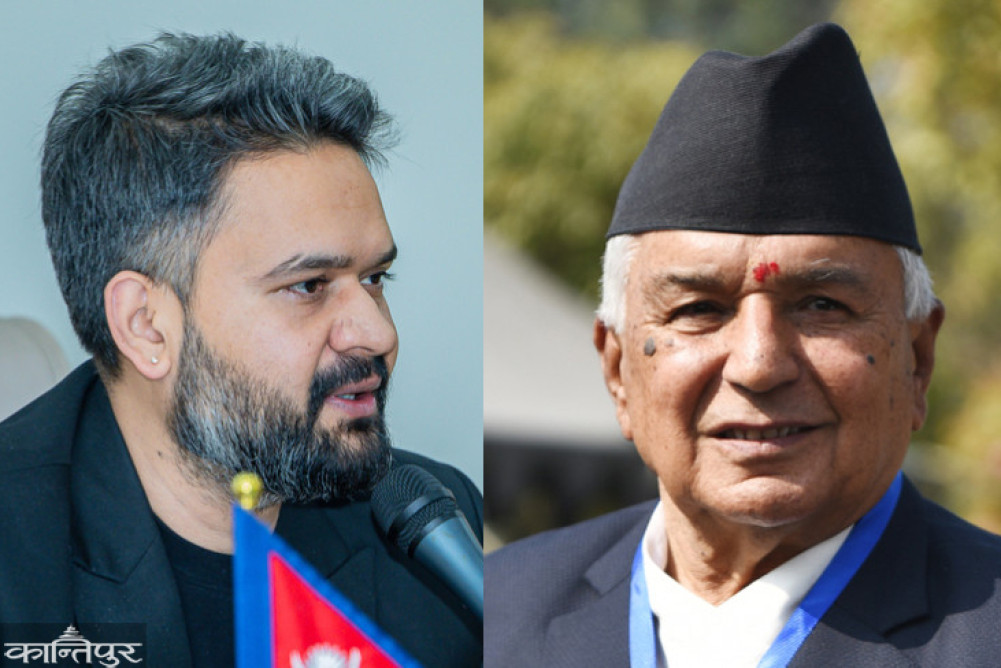
In the ordinance sent back by the President, the Prime Minister sent a two-page explanation citing past legal precedents and Supreme Court orders.
We use Google Cloud Translation Services. Google requires we provide the following disclaimer relating to use of this service:
This service may contain translations powered by Google. Google disclaims all warranties related to the translations, expressed or implied, including any warranties of accuracy, reliability, and any implied warranties of merchantability, fitness for a particular purpose, and noninfringement.
President Ram Chandra Poudel has issued an ordinance on the Constitutional Council (functions, duties, powers and procedures) recommended by the government for the second time. The same ordinance recommended by the Council of Ministers last week was sent back by the President for reconsideration.
However, the government sent the same ordinance to the President again on Monday without making any amendments. Based on the same recommendation, the President issued the ordinance on Tuesday.
Prime Minister Balendra Shah had sent a clarification presenting the legal and procedural basis to the concern raised by the President in the ordinance that the majority system may be weakened. In accordance with the Prime Minister's clarification and the spirit of the Constitution, President Poudel has issued an ordinance on the Constitutional Council. The ordinance sent back by the President for reconsideration was sent back as it was at the Council of Ministers meeting on Monday. However, along with the ordinance, Prime Minister Shah had also sent a two-page long clarification letter to the President.
Prime Minister Shah clarified the rationale of the ordinance, the amendments made to it, and the decision-making process, focusing on the questions raised by the President. Why did the President withdraw the ordinance related to the Constitutional Council? The Prime Minister has mentioned in the letter that if the ordinance is not issued, a legal vacuum will be created regarding the Constitutional Council as there is no practice of automatically implementing the old legal system.
In the past, when the ordinance was inoperative in 2063 BS, a separate act had to be brought, as the provisions of the old act were not automatically implemented, he has argued that the ordinance is necessary because the same situation may repeat itself. Prime Minister Shah claims that the Supreme Court's order last Kartik that the old law would automatically be activated after the ordinance is inoperative is not relevant to the presented ordinance .
The ordinance provides that at least four members, including the chairperson, must be present for a meeting of the council. The Prime Minister argues that since the presence of four members in a six-member council is a majority, this will ensure a majority system.
Prime Minister Shah has stated that the decision-making process has not been weakened by reducing the quorum, but rather by making it practical, the majority has been maintained. Similarly, a decision made by at least three members, including the chairperson, among those present in the meeting will be considered a decision of the council, which will not obstruct the decision-making process, he said.
‘In Sub-section (3) of Section 6 of the proposed ordinance, it is provided that if at least four people, including the chairperson and at least three members, are present in a meeting of the Constitutional Council, the quorum for the council meeting will be considered. It seems that the presence of four out of the six members of the Constitutional Council will constitute a majority of the total members,’ the Prime Minister’s reply to the President states.
The provision that the decision of at least three members, including the Chairperson and two members, shall be considered the decision of the Council in a meeting where the majority of the total number of quorums is present is mentioned in clause (c) of the clarification of sub-section (5) of Section 6 of the proposed ordinance.
The ordinance has also addressed the possibility of a tie (3-3) in the full meeting as the number of votes is even when all six members are present. In such a situation, the party supported by the Chairperson is considered the majority, which is intended to prevent obstruction in the decision-making process, says Prime Minister Shah. He has mentioned that if unanimity is not possible, it is appropriate to make a decision by majority.
Prime Minister Shah has said that it is not possible to imagine a situation where the Chairperson is in the minority in the Council.
‘Considering the fact that the Honorable President had earlier sent the bill back to Parliament with a message, it was pointed out that at least fifty percent of the chairperson and the sitting members of the council should be present in the council, and the ordinance has made provision for the Constitutional Council to have six members, including the chairperson, based on the total number of members,’ Prime Minister Shah has mentioned in the letter. ‘Similarly, the provision that a quorum is reached if there are three members including the chairperson, and the provision that the decision of the three members, including the chairperson and at least two members, in a meeting where a quorum is reached, is considered the decision of the council, seems to fulfill the majority of the quorum.’