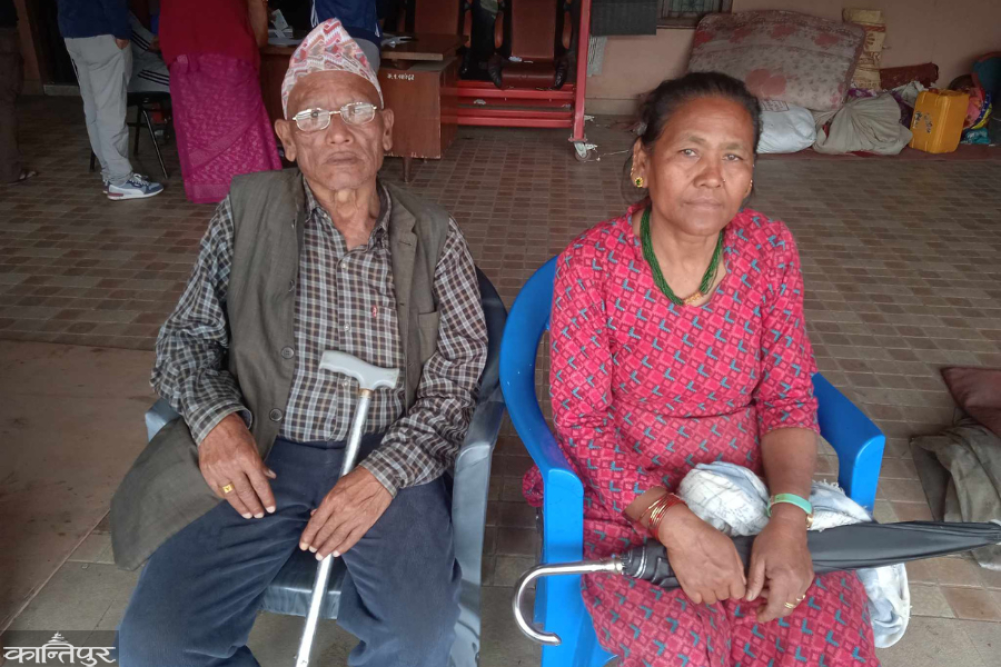
Hasta Bahadur Karki from Sankhuwasabha came to Kathmandu 40 years ago. While working as a painter in Kathmandu, a friend told him, ”There is a squatter settlement going on in Balkhu, a house to build.” He did what his friend said.
We use Google Cloud Translation Services. Google requires we provide the following disclaimer relating to use of this service:
This service may contain translations powered by Google. Google disclaims all warranties related to the translations, expressed or implied, including any warranties of accuracy, reliability, and any implied warranties of merchantability, fitness for a particular purpose, and noninfringement.
Hasta Bahadur Karki has turned 70. He has been paralyzed for 12 years. One part of his body cannot move. He reached the stadium in Tripureshwor on Friday afternoon, holding his wife's hand and leaning on a stick, to collect information. He noted that he had no land for three generations. He had been living in the Balkhu squatter settlement for the past 20 years and earning a living. He came to Kathmandu from Sankhuwasabha 40 years ago. While he was painting in Kathmandu, a friend told him, "A squatter settlement is going to be established in Balkhu, a house is being built." He did what his friend said. After building a house with bamboo, he added a block. Now that house has also collapsed. The belongings are on the way, and his children are waiting for him. His wife Sita, who is sitting in the corner after collecting the information, is remembering that house. With tears in her eyes, she said, "My parents and children grew up there, grew up there, now they are grown up, now they don't have a house, I remember everything we ate there."
She said that after the house collapsed, she was worried about where the family would go and what to do. She said, "The children are looking after their belongings, will they go to their friend's house at night?" Hasta Bahadur, who had to take medicine, stopped eating due to lack of money. Now she has to leave her home, she said, "The doctor said that I should always take medicine, but I haven't taken it for 6 months because I don't have money, now the house has collapsed, I don't know where they will take it, what they will do."
The government, which started removing unorganized and squatter settlements last Saturday, has started removing them again in the second phase from Friday. People from settlements in Tripureshwor, Shankhamul, Balkhu and other areas were kept in the stadium for data collection on Friday. From where their personal and family details to health check-ups were done. After collecting the data, preparations have been made to immediately arrange for them to be managed at the support office in Dhapakhel, Lalitpur, the Electricity Training Center in Kharipati, Bhaktapur, the Agricultural Development Bank Training Center in Bode, the Nagarkot Drinking Water Training Center, and the Red Cross Building in Banepa, Kavre.
The demolition of the unorganized settlement has affected the elderly, children, and even students. The house where Aarti Chaudhary, a graduate student, lived in a tent had already been demolished. The three-story house was being emptied. When the microphones started calling for the evacuation of the unorganized settlement on the banks of the Dhobi River in Anamnagar, Eliza and Archana Chaudhary, who were living in the tent with Aarti, also began to panic. Their worries increased - where to go now, where to put their belongings? They had a permanent home in Bara and had come to live in the same place two years ago. They knew that it was a tent, but they did not expect that it would be removed like this.
Aarti said, ‘I didn’t think we would have to move our belongings overnight, but it was very difficult.’ The housekeeper used to collect the rent before their period. Just two days ago, on Wednesday, the housekeeper came and asked for the rent as usual. They paid the rent of ten thousand for two rooms and settled down comfortably. But the next day after paying the rent, they had to get up and leave. The house was demolished. Their parents had already started telling them to find a room in the house immediately. It was not possible for them to get a room as soon as they said
. At night, they packed their belongings. They took the belongings to their relative’s brother in Gwarko. The brother had a garage, so they kept the belongings there and slept there. Aarti said, "My brother's room was small, there was no place to sleep or store things, so we slept in the garage." There had been rumors and fear in the slum for a month, but she said she had not been able to find a room because she thought they would not move. She said, "There is a college, we have to study, we sat wondering where to go to find a room, we had to run away overnight." One night, they moved their belongings to the house next door while staying in Gwarko's garage. Pointing to the house next door where she lived, she said, "They have kept the belongings there to keep them, and I don't know what to do now."
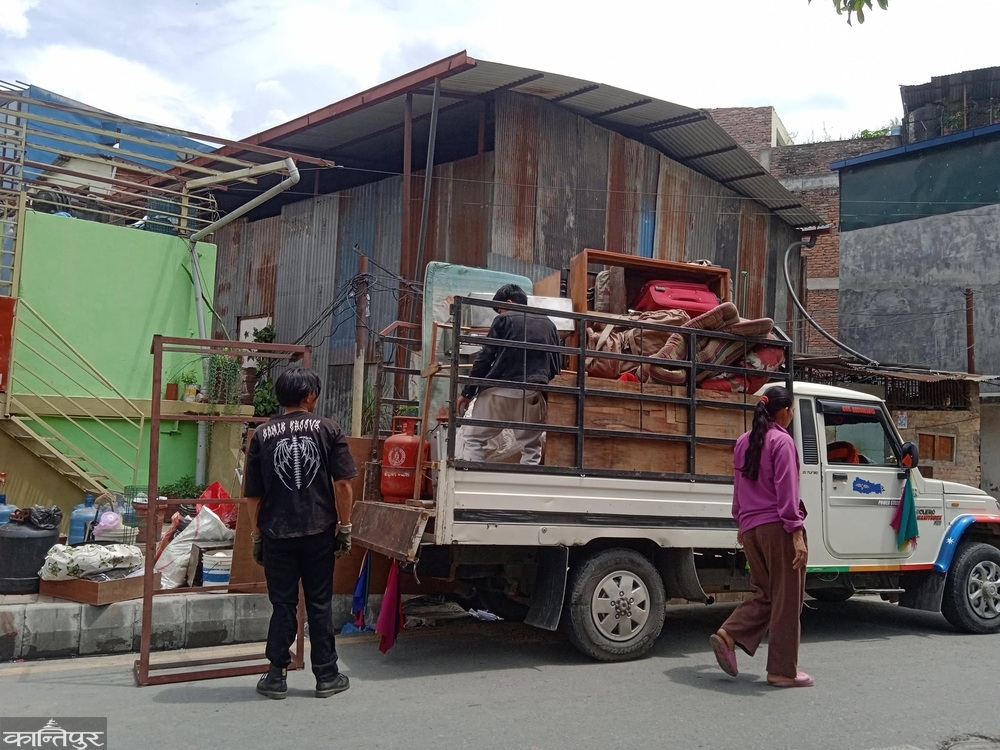 If it had been normal like any other day, Vikas Thapa would have been sleeping at 4 am on Friday. He would not have been in any hurry, nor would he have felt anxious. But on Friday, he was stressed differently than on other days. Where should he go now? He started worrying about where to stay. The previous day, the miking of the settlement was ringing in his ears. He started packing his belongings at 4 am. His friend had found a room in Jamal. Leaving the same belongings, he went to the stadium to collect the details. He registered his name in the name of a real squatter. He has been living in the settlement for 10 years and has been earning a living by doing odd jobs. He had heard that his grandfather had some land in the village. He said that when he searched for it later, the village headman had already registered it in his name.
Telling what he had heard about the land, he said, "My grandfather was not literate, his land also belongs to me, so someone from the district registered it in the name of the village headman who knows it." When he went to search for the land, he said that he had to register as a squatter because he did not have the proof to present. He said that he is now a real squatter. He said, ‘I am a real squatter, there is nothing in the name of my father, grandfather, mother or anyone else in this country.’ He expects the government to manage them as real squatters. He wants them not to be taken to the edge of the forest. He said, ‘The government should take them to a place where they can find work.’
69-year-old Pawan Gurung had been living in the Shankhamul squatter settlement for 53 years. On Thursday, his home was destroyed after a dozer was driven into the squatter settlement. He was found while collecting data at the stadium and said that he no longer has the word “home”. He said, ‘Everywhere I go, I say I have to go home, I have a home, but now I can’t even say that.’ He lamented that he had to become homeless in his old age. He has been in that place since 2030. He has two sons who are working as wage laborers.
One son has died and the other son has tuberculosis. He was also taking care of his 32-year-old son. He does not know where his ancestral home is. He has heard that the house is in the east, but he does not know where it is. He says, ‘I do not know much about the family, I have not seen any of my parents.’
He says, ‘Where can I go?’