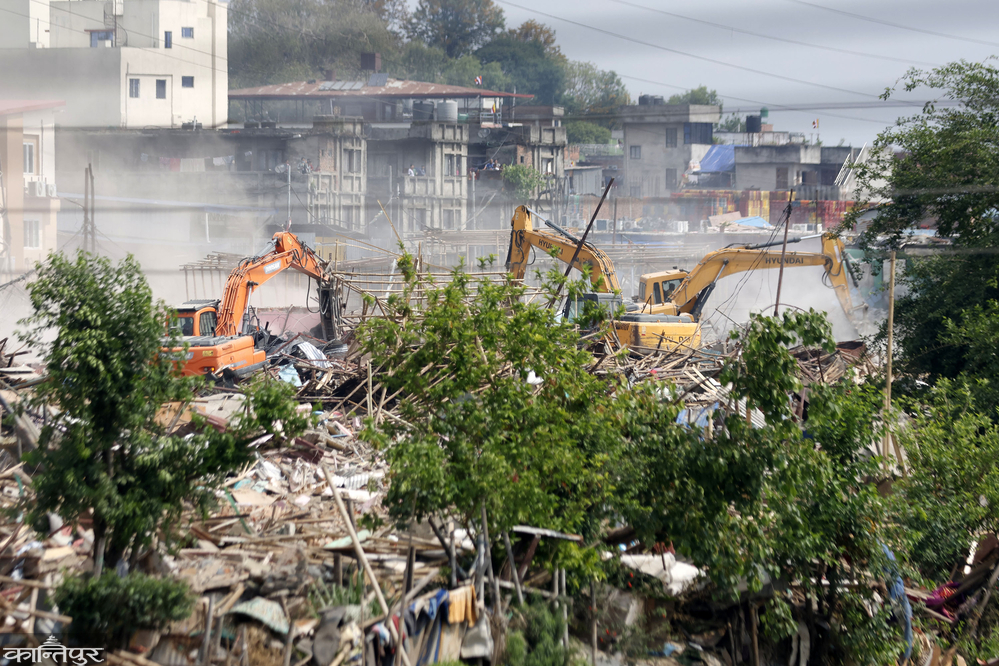
The day after the circular was issued, the Ministry of Urban Development deployed a bulldozer in Balkhu, Teku and other areas of Kathmandu. After the bulldozer was deployed, a monastery collapsed on the day of Buddha Jayanti. A deranged person jumped into the river in Balkhu after the bulldozer was deployed and died.
We use Google Cloud Translation Services. Google requires we provide the following disclaimer relating to use of this service:
This service may contain translations powered by Google. Google disclaims all warranties related to the translations, expressed or implied, including any warranties of accuracy, reliability, and any implied warranties of merchantability, fitness for a particular purpose, and noninfringement.
The Ministry of Federal Affairs and General Administration had written a letter to all municipalities across the country on Thursday, first directing them to identify, manage and remove encroachments from squatters. But the dozers did not stop running in Kathmandu from Friday morning. The day after the circular was issued, the Ministry of Urban Development ran dozers in Balkhu, Teku and other areas of Kathmandu. After the dozers were used, a monastery collapsed on the day of Buddha Jayanti. A deranged person jumped into the river after the dozers were used in Balkhu and died.
In the morning, a notification came from the Prime Minister's Office stating that the target was to remove 686 structures in a single day in the squatter settlements. After 486 structures in the Balkhu area and 200 structures in Bansighat were vacated, the notification mentioned that the work of removing structures in Shankhamul and other upper coastal areas would continue. Sunita Pariyar, a resident of Sukum, who has been living in Bansighat, Teku for 15 years, says, "The dozer started working while it was raining, and there was no way to store the belongings." The police were told to help transport the belongings and take them to Dasharath Stadium for certification and registration. "The police said they would take them, but they haven't," the stranded Pariyar told Kantipur. "I don't know where they will be kept."
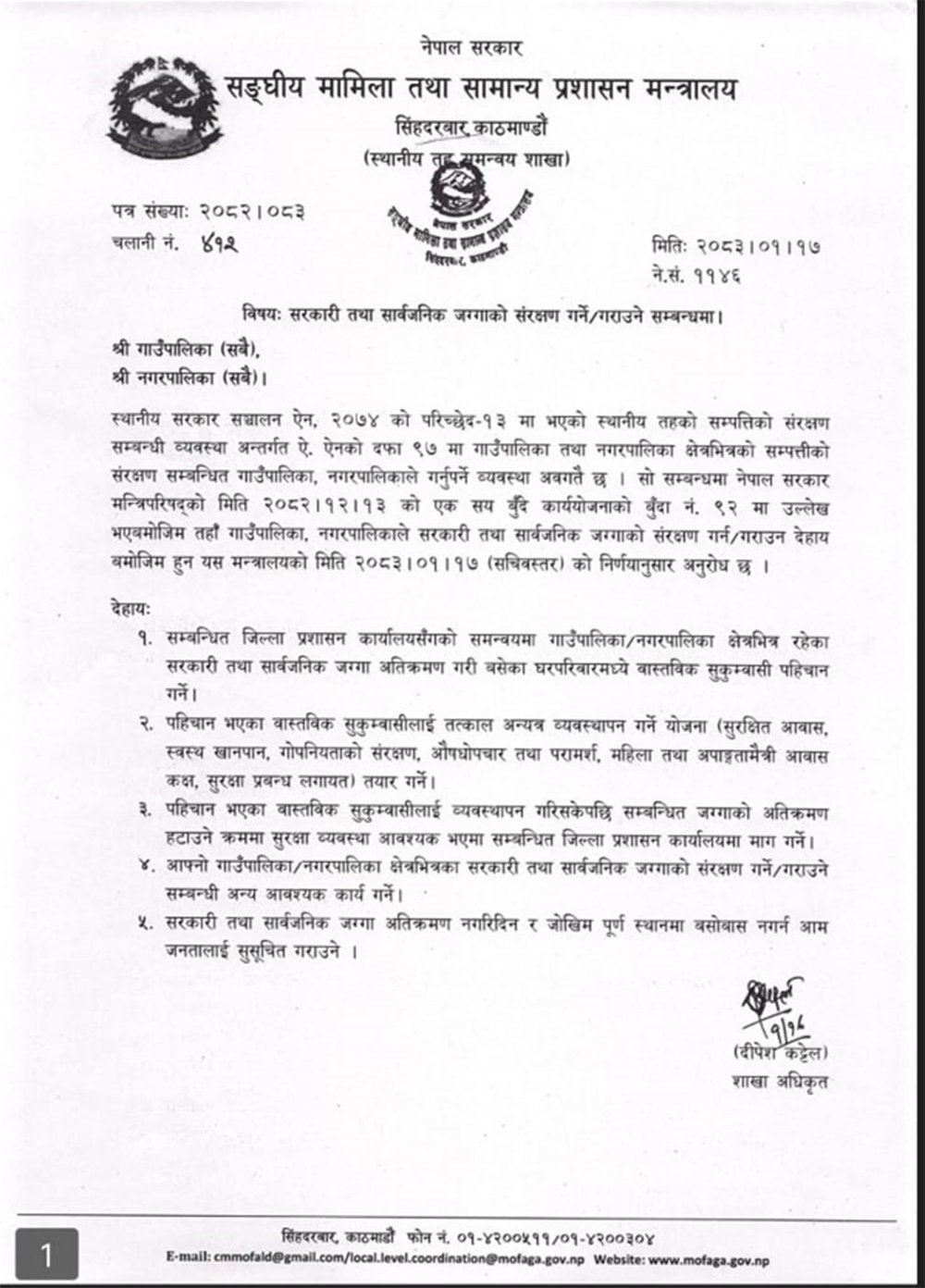
Ekdev Adhikari, spokesperson for the Ministry of Federal Affairs and General Administration, which issued the circular on Thursday, said, "We have made the details of the circular public on the website, but there is no information on other matters." He also said that since the ministry's work is to coordinate and facilitate all local bodies, they have written to them for that purpose. However, he says that he is unaware of what is happening.
In a 5-point circular issued by the Ministry of General Administration, which was called a secretary-level decision, it was first asked to identify the actual squatters among the households encroaching on government and public land within the rural municipality and municipal areas in coordination with the concerned District Administration Office. Then, it was asked to prepare a management plan elsewhere and manage the identified squatters and remove the encroachments, and to demand necessary security arrangements for that.
On Thursday evening, a message was sent to the WhatsApp group of Minister for Communications Sasmit Pokharel, who is also the government spokesperson, saying that ‘public land will be vacated only after the identification and safe management of the actual squatters.’ In a message sent by Prime Minister Balendra Shah’s press expert Surendra Bajagain, it was quoted as saying by Urban Development Minister Sunil Lamsal that ‘the settlements along the river banks, which are at high risk of flooding during the rainy season, have been vacated only from the perspective of human security.’ "In the case of the squatters in the remaining areas, Minister Lamsal has expressed his commitment that the process of vacating the land will not be carried out until a blueprint for their identification and proper management is prepared, so that the actual squatter families can rest assured," it was reported.
Kathmandu Chief District Officer Ishwaraj Poudel says he understands that the circular issued by the ministry applies only to those outside the valley. "The letter does not mean that it is a circular for those who are at risk of disaster around the river banks," he told Kantipur. "There are widespread squatter settlements in the interior areas of the Terai, and they are not being evacuated now, but rather a management modality is being developed."
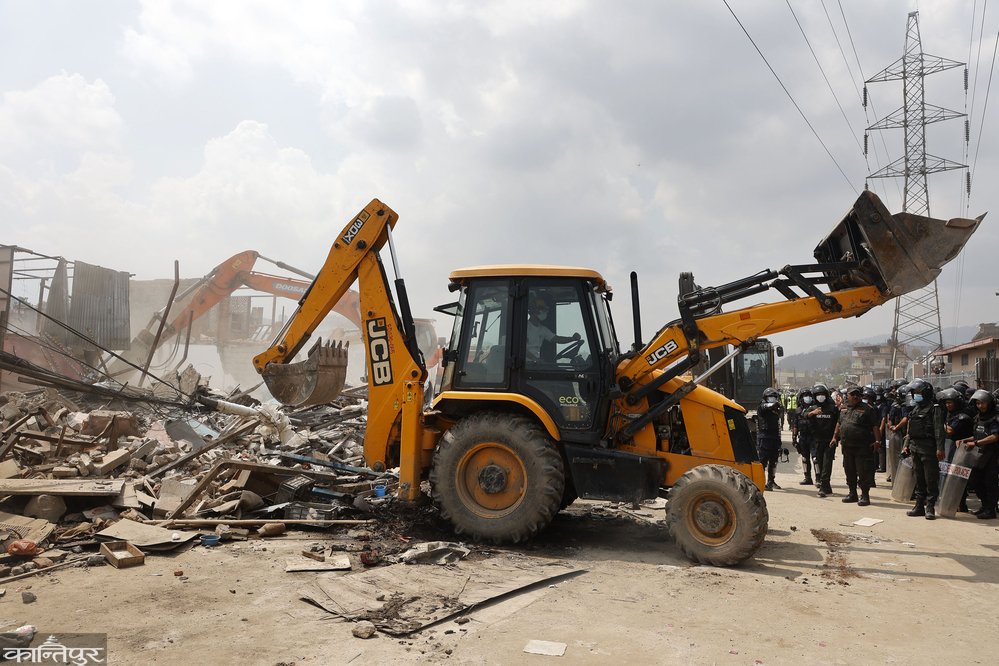
Reminding that reports of damage caused by floods in Kathmandu are coming every year, he added, "There was a big controversy because the helicopter did not come, now such a disaster will not happen again." On Friday evening, while dozers were operating in the Shankhamul area, he said, "There are huge structures with 4 or 5 floors here, they have been demolished. The government will manage those who are really squatters."
At least 1,000 families have applied for assistance at the stadium, saying that they were displaced after the government used the dozer. The government had been running a campaign to clear squatter settlements in Thapathali, Gairigaun, and Manohara areas of Kathmandu since last week. The government is being criticized for suddenly using bulldozers without any option to identify and manage the squatters.
Prime Minister Shah had tried to clear the squatter settlements when he was the mayor of Kathmandu. But the federal government did not support him. Even when Narayan Kaji Shrestha was the home minister to Rabi Lamichhane, he had asked for help in clearing the squatters. But they did not support Balendra. He entered the Rashtriya Swayamsevak Sangh (RSS), of which Lamichhane is now the president, and became the prime minister, and cleared the squatter settlements.
After Shah became the prime minister, the government's '100 agendas for government reforms' stated that the collection and verification of integrated digital data of landless squatters and unorganized settlements across the country would be completed within 60 days.

To resolve the problem of landless squatters and unorganized settlements within a thousand days, it was mentioned that a household survey would be conducted in coordination with the local level, clear criteria would be implemented for identifying the actual beneficiaries, and records of public announcements and Guthi lands would be updated. The agenda stated that 'Prepare an IS-based digital database, provide land to identified real squatters in phases or alternatively arrange for rehabilitation through integrated housing in dense urban areas,'
According to a report prepared by the empowered Bagmati Civilization Integrated Development Committee in 2079, there are 3,496 households living in unorganized settlements along the river banks of the valley. Of these, 2,245 are in Kathmandu Metropolitan City, 90 in Kageshwori Municipality, 156 in Budhanilkantha, 17 in Lalitpur Metropolitan City, and 773 in Bhaktapur Municipality.