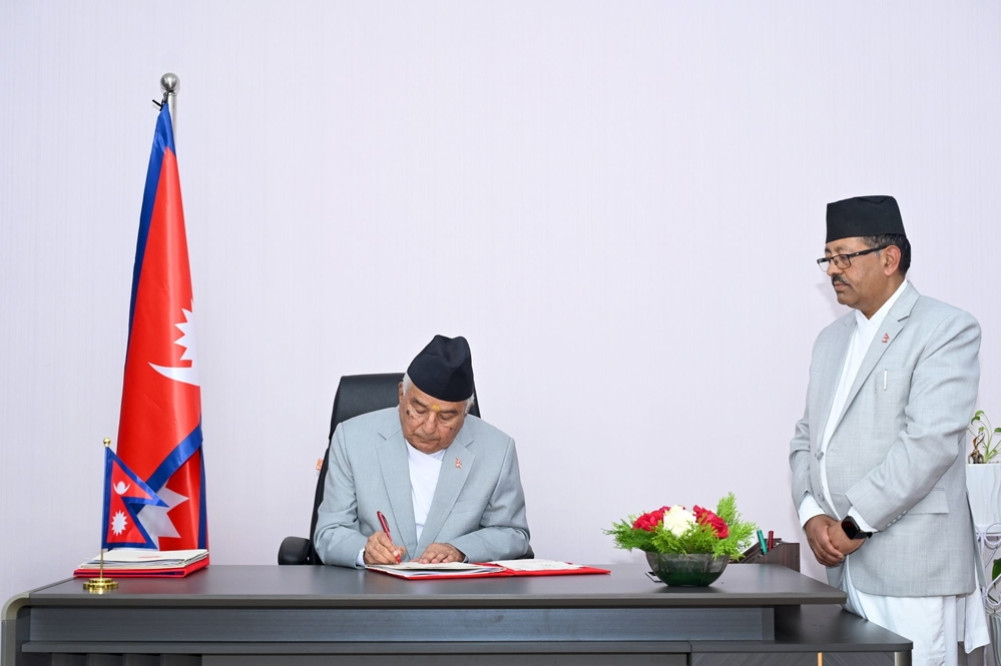
President Ram Chandra Poudel has issued Anti-Money Laundering Ordinance-083.
We use Google Cloud Translation Services. Google requires we provide the following disclaimer relating to use of this service:
This service may contain translations powered by Google. Google disclaims all warranties related to the translations, expressed or implied, including any warranties of accuracy, reliability, and any implied warranties of merchantability, fitness for a particular purpose, and noninfringement.
President Ram Chandra Poudel has issued the Prevention of Money Laundering (Third Amendment) Ordinance, 2083. The government sent the ordinance to the President's Office today. Earlier, the President had issued ordinances on cooperatives and public procurement. The statement said that the ordinance was issued on the recommendation of the Government of Nepal and the Council of Ministers in accordance with Article 114 (1) of the Constitution of Nepal.
Five ordinances, including the ordinance related to the Constitutional Council, are under consultation at the President's Office. The government has recommended a total of 8 ordinances.
The government has recommended an ordinance that will also empower the Money Laundering Investigation Department to investigate offenses related to financial crimes.
According to sources in the Prime Minister's Office, an ordinance has been recommended to empower the department to investigate crimes related to customs and revenue fraud, insurance securities, foreign exchange, and other crimes. The country is on the 'grey list', but many things need to be done to get out of it, and the ordinance has been recommended to expand the department's capacity and authority with that in mind. With this, now in addition to the Authority, the police and other investigative agencies, the Department of Money Laundering will also pave the way for initial investigations into the aforementioned crimes by considering them as the main offenses.
In Chaitra 2080, the then government amended the act and took away the department's right to investigate related crimes from the parliament and delegated them to other investigative agencies. This meant that if a complaint was received by the department after that delegation, it was forced to send it to other agencies instead of investigating it. If the President issues an ordinance, the department will now pave the way for investigating these crimes by considering them as the main offenses.