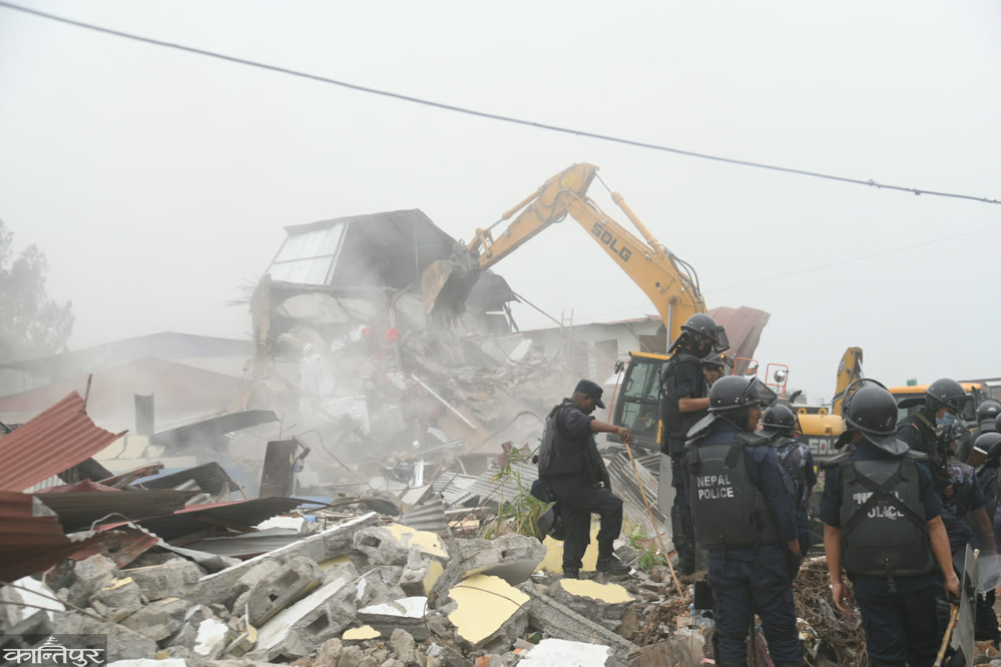
The Municipal Association and the National Federation of Rural Municipalities issued a joint statement, noting that such a situation is not beneficial in the long term in a democratic system of governance.
We use Google Cloud Translation Services. Google requires we provide the following disclaimer relating to use of this service:
This service may contain translations powered by Google. Google disclaims all warranties related to the translations, expressed or implied, including any warranties of accuracy, reliability, and any implied warranties of merchantability, fitness for a particular purpose, and noninfringement.
Local body associations have expressed their objection to the Nepal Army and security agencies demanding details of squatters. The Municipal Association and the National Federation of Rural Municipalities have issued a joint statement, stating that such a situation cannot be beneficial in the long term in a democratic governance system. Similarly, the associations have clarified six points.
‘Our serious attention has been drawn to the recent forced evictions from riverside settlements in Thapathali, Manohara and Sinamangal areas of Kathmandu Valley, the unusual activity of security agencies demanding details of landless and unorganized settlers from local governments across the country, and the pressure being exerted on various local governments to pick up the settlements,’ the statement said. ‘Such activities not only disrupt peace and security, but also increase the risk of panic, fear and making life more unsafe for the destitute, poor and landless citizens.’
Similarly, the content and process of the correspondence sent by the Nepal Army to the local government in Bardiya district to provide data, the attention of the local governments concerned in that regard, and the press release issued by the Nepal Army with clarifications have shown the ambiguity of responsibilities, lack of mutual trust and coordination among state bodies, they said.
The Federation has said that the work of collecting, verifying and certifying the data of landless Dalits, squatters and unorganized settlers by local governments has reached the final stage, which is in line with the federal government's priority for governance reform.
'In such a situation, the work of forcibly resettling does not seem justified in any way. Displacement without alternative arrangements seriously affects the citizens' right to housing, human dignity, social security and the fundamental right to live with dignity,' the statement said. 'We are fully aware that according to the Constitution of Nepal and existing laws, the primary responsibility for identifying, documenting, managing livelihoods, providing safe housing and managing informal settlements at the local level lies with the local government. The responsibility for protecting public land, preventing encroachment and vacating encroached public land also lies with the local government.'
No one believes that encroachment should be legitimized, but they say that a sensitive study and addressing of the social, cultural, economic and structural reasons why and under what compulsion citizens were forced to encroach on public land is indispensable.