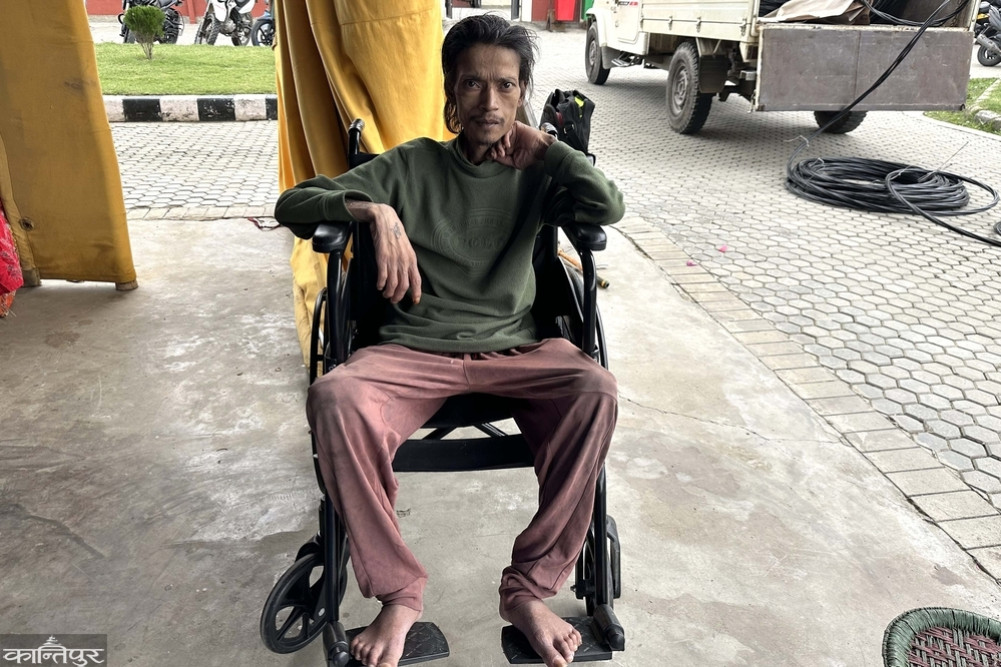
After he was ill for 8 years, the family was supported by his wife's earnings. Now their source of income has been cut off.
We use Google Cloud Translation Services. Google requires we provide the following disclaimer relating to use of this service:
This service may contain translations powered by Google. Google disclaims all warranties related to the translations, expressed or implied, including any warranties of accuracy, reliability, and any implied warranties of merchantability, fitness for a particular purpose, and noninfringement.
The ‘Holding Center’ at the Radhaswamy Satsang Center in Kirtipur.
A person was sitting in a wheelchair with a dirty face in front of the tent he was staying in. Just then, a vehicle carrying some necessary items from the ‘Holding Center’ arrived at his place. He could not move from there himself, nor could he push the wheelchair. A person who arrived there moved him a little further.
He is 38-year-old Bheshraj Darji. He has been ill for 8 years.
Bheshraj said that he had suffered from lung problems. He says, ‘I have been suffering from various stomach diseases for many years. I get stomach pain and back pain. The doctor had already said that water had accumulated in my lungs. I went to the hospital three years ago,' he said, 'I didn't go now because I didn't have money. Whatever I did, I needed money. How could I go to the hospital without money? Instead, I sat in my room, enduring the pain no matter what. The bulldozer also started working in that room.'
Bheshraj used to live in a slum area with his wife and a two-year-old son, paying 5,000 rupees for a room. His wife used to earn 8,000 rupees a month by doing housework in two places. After paying the 5,000 rupees for the room, there was 3,000 rupees left. Bheshraj says that it was not even enough to pay the balance of the shop that brought ration and vegetables. 'We had to wait another month for that 8,000 rupees. If necessary, we used to borrow money and take out loans to survive,' he said, 'Everyone asks why we didn't go to the hospital. The situation is like this. How can we go? He has not seen a doctor for three years.’
Although his birthplace is Jhapa, he says that he has had nothing since his father and grandfather. ‘We had nothing. That is why we had taken the support of the squatters’ settlement from our father. In Jhapa too, we used to live in rented accommodation in the squatters’ settlement,’ he said. ‘Later, I came to Kathmandu after getting sick.’
Although he was examined at first, he gradually became unable to do anything. He complained that he had lost a little income after the bulldozer was used in the squatters’ settlement. ‘Everything is stressful. I have neither money nor land,’ he says. ‘I have nothing, and I have fallen ill and am stuck on the one who has nothing.’
Fortunately, an organization, seeing his condition, had provided him with a wheelchair just a day before the bulldozer was used in the settlement. ‘Now, I have no money to find a room and live in another place.’ So the government's trust is - wherever it takes us, we will come. Now the government should make arrangements for those who have nothing like us.'